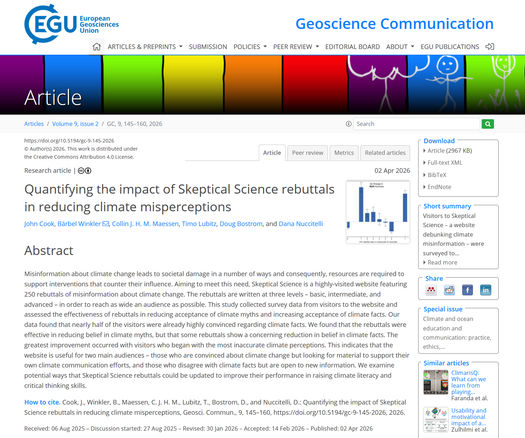
For nearly two decades Skeptical Science has been publishing rebuttals to #ClimateMyths, always following best understanding of how to honestly and most effectively communicate facts in an environment crowded with confusing misinformation.

Undoing harm caused to a human intellect isn't easy. Is Skeptical Science doing any good with this effort?

Having concluded a multi-year experiment with the cooperation of our readers, now we have some information on "how are we doing?". By formal assessment it appears we're not wasting our time.

You can see our results in our freshly published paper. Visit the link to read all about it.

Full disclosure: we're also asking for help with our publication fee (European Geosciences Union journals are 100% open-access but that does not mean they magically have no operational expenses).

#ClimateCognition

https://skepticalscience.com/published-research-experiment-paper.html
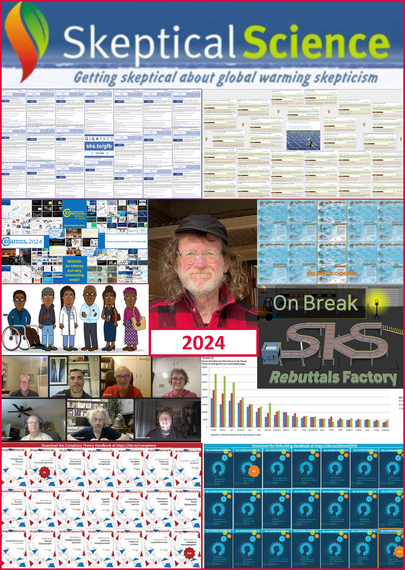
For 10 years (!) our invaluable volunteer @BaerbelW has authored an annual review of Skeptical Science's accomplishments in connection with fixing our #ClimateChange problem- by building better #ClimateCognition.

Here's Bärbel's recap of 2024, narrating a year including numerous research papers published, collaborations cemented, conference presentations delivered, #DebunkingResource translations completed, infrastructure projects progressed.

And a truly shocking loss.

https://skepticalscience.com/2024-SkS-Review.html?utm-source=mastodon&utm-campaign=socialnetworks&utm-term=sks

2024 in review - a bittersweet year for our team

The year 2024 at Skeptical Science has been bittersweet. We are incredibly proud of the progress we've made in debunking climate myths, thanks in large part to the tireless efforts of our late colleague John Mason. John passed away unexpectedly in September, leaving a huge void in our team. This post is a tribute to his immense contributions and the lasting impact he'll have on climate science education for years to come.

Skeptical Science

Paper just published:

"Until now, science has held a seemingly unrivalled primacy in the public discussion of the subject (Sarewitz 2011, p. 479)."

Now is not 13 years ago.

Anyway, there's much of interest here all the same despite the halting start [also despite no actual technical orchestration revealed therein].

#ClimateScienceCommunications
#ClimatePolicyFormulation
#ClimateCognition

http://link.springer.com/10.1007/s10584-024-03697-3

Orchestrating the climate choir: the boundaries of scientists’ expertise, the relevance of experiential knowledge, and quality assurance in the public climate debate - Climatic Change

Scientific knowledge is at the heart of discussions about climate change. However, it has been proposed that the apparent predominance of climate science in the societal debate should be reconsidered and that a more inclusive approach is warranted. Further, the introduction of new communication technology has made the information environment more fragmented, possibly endangering the quality of societal deliberation on climate change concerns. Using focus group methodology, this paper explores how climate scientists, climate journalists, and citizens perceive scientific experts’ mandate when they communicate publicly, the role of experiential knowledge in discussions of climate-related issues, and who the three actors prefer to guard the quality of the climate information exchanged in the public sphere. The findings show that scientific experts are perceived to carry a high degree of legitimacy, but only within their own narrow specialty, while experiential knowledge was seen as more useful in applied domains of science than in arcane research fields. In the new media landscape, journalists are still generally preferred as gatekeepers by all three actor types.

SpringerLink

When climate denial means "too scared to think about it."

If you'd like to see a case study of motivated reasoning pushed into the role of prayers, you could do worse than reading this article about a BC, Canada ski resort operator staring exitnction in the face and thinking his way to a happy outcome. His conclusions are founded on major talking points found in professional denier output. Incantation may be imported.

#ClimateCognition
#HopeIsNotAPlan

https://macleans.ca/society/environment/ski-hill-closure-bc/

How one B.C. ski hill is coping with a weird, warm winter - Macleans.ca

"Our revenue was down by 40 per cent. We had to offer discounts of up to 50 per cent on lift tickets because we could not open all our runs for a good portion of December."

Macleans.ca

Truth hurts?

"We found a substantively worse user experience among the opinion minority groups (e.g., climate deniers, racists) and the education minority groups; however, these groups changed attitudes toward supporting BLM and climate change efforts much more compared to other social groups after the chat."

#ClimateCognition

https://www.nature.com/articles/s41598-024-51969-w

Conversational AI and equity through assessing GPT-3’s communication with diverse social groups on contentious topics - Scientific Reports

Autoregressive language models, which use deep learning to produce human-like texts, have surged in prevalence. Despite advances in these models, concerns arise about their equity across diverse populations. While AI fairness is discussed widely, metrics to measure equity in dialogue systems are lacking. This paper presents a framework, rooted in deliberative democracy and science communication studies, to evaluate equity in human–AI communication. Using it, we conducted an algorithm auditing study to examine how GPT-3 responded to different populations who vary in sociodemographic backgrounds and viewpoints on crucial science and social issues: climate change and the Black Lives Matter (BLM) movement. We analyzed 20,000 dialogues with 3290 participants differing in gender, race, education, and opinions. We found a substantively worse user experience among the opinion minority groups (e.g., climate deniers, racists) and the education minority groups; however, these groups changed attitudes toward supporting BLM and climate change efforts much more compared to other social groups after the chat. GPT-3 used more negative expressions when responding to the education and opinion minority groups. We discuss the social-technological implications of our findings for a conversational AI system that centralizes diversity, equity, and inclusion.

Nature

#ScientificConsensus with Dr John Cook

Misconceptions about consensus in science abound (and are sometimes encouraged). It it a popularity contest? Mindless conformity? If not those, what? To answer these and many other questions, Melanie Trecek-King - who runs the "Thinking is Power" website - talked with John Cook about the scientific consensus in general and about his study finding 97% consensus about human-cased climate change in particular.

#ClimateCognition
https://skepticalscience.com/conversation-about-the-scientific-consensus.html?utm-source=mastodon&utm-campaign=socialnetworks&utm-term=sks

Scientific Consensus with Dr John Cook

There are so many misconceptions about consensus in science: What is a consensus? Does science work via consensus? To answer these and many other questions, Melanie Trecek-King - who runs the 'Thinking is Power' website - talked with John Cook about the scientific consensus in general and about his study finding 97% consensus about human-cased climate change in particular.

Skeptical Science

"Beyond retrospectively examining to what extent extreme weather events influence climate change opinion and behaviors, environmental communicators could play a more direct role in facilitating learning and action among the public in the wake of extreme events."

And how will they do that? These researchers help us to understand.

Then we need to remember to operationalize our better understanding. Pay attention.

#ClimateCognition
#ClimateCommunication
#OpenAccess

https://www.tandfonline.com/doi/full/10.1080/17524032.2023.2259623?af=R

Public attention is very limited. Use it wisely.

"...we redesigned graphs from the Intergovernmental Panel on Climate Change (IPCC) Fifth Assessment Report (AR5) and compared participant attention and perceptions...Here, we demonstrate our robust graph redesign process and the associated impacts on participants’ perceptions of graph usability, graph and scientist credibility, and risk associated with climate change."

#ClimateCommunications
#ClimateCognition
#GSA

https://pubs.geoscienceworld.org/gsa/geosphere/article/doi/10.1130/GES02517.1/628200/Seeing-is-believing-Climate-change-graph-design

Seeing is believing: Climate change graph design and user judgments of credibility, usability, and risk | Geosphere | GeoScienceWorld

"A national climate security discourse could emphasise military uses of AI and its role in propaganda and misinformation. The international security discourse suggests that international organisations can take advantage of AI to conduct their mission. However, transnational companies can also benefit from AI, with potential negative outcomes on consumption and resource extraction."

#ClimateCognition
#ClimateChange
#SyntheticBunk
#OpenAccess

https://www.sciencedirect.com/science/article/pii/S1877343522001026?dgcid=rss_sd_all