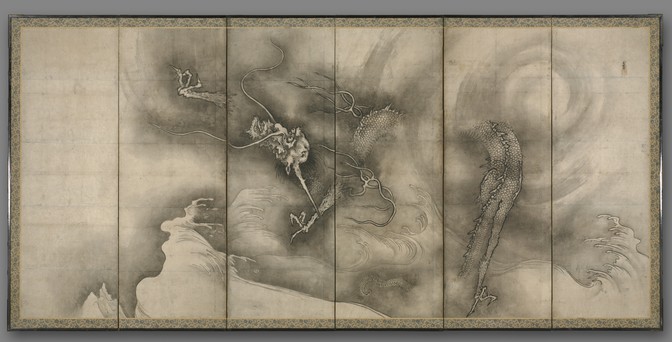
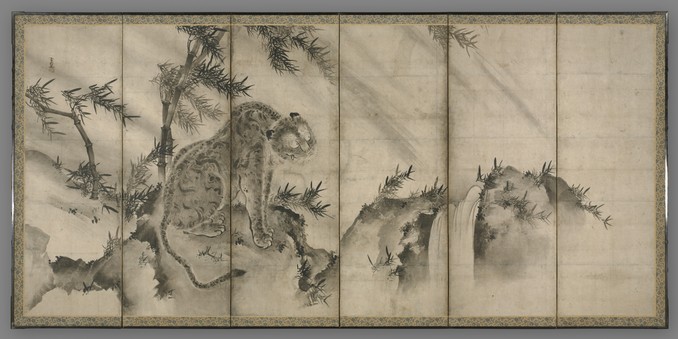
Delighted to witness the vibrant cosmic dance of the Dragon and Tiger at
#ClevelandMuseumofArt. A spectacle of power and grace, the artwork sparks infinite thought. Do you see conflict or harmony?
#ArtDiscussion #ClevelandArtExhibithttps://clevelandart.org/art/1959.136.1
Dragon and Tiger | Cleveland Museum of Art
In Chinese cosmology, dragons produce rain clouds. The dragon disappearing into and reemerging from clouds in this painting seems to generate rough waves in the water below, pulling it toward the sky. The shape of the foreground wave is indirectly sampled from a painting by 13th-century Chinese painter Yujian, a handscroll once owned by the Ashikaga military rulers of Japan. Sesson must have known the famous painting though copies, and made a copy of his own. Here, the wave reinforces the powerful quality of the dragon.
Delve into the mystical representation of nature's power with 'Dragon and Tiger' at
#ClevelandMuseumofArt. What's your interpretation of this timeless parable?
#ArtApreciation #ClevelandArtExhibithttps://clevelandart.org/art/1959.136.2
Dragon and Tiger | Cleveland Museum of Art
In Chinese cosmology, the tiger's roar is said to produce wind. In Chinese paintings, the tiger is often shown with a dragon, who creates rain clouds. Together, they represent the balancing forces of the universe. Chinese presentations of the theme, often in hanging scroll format, provided the basic composition for the pair of screens to which this one belongs.
Immerse in the rich tapestry of Vajrapani's Embroidered Mount with Garuda at
#ClevelandMuseumofArt. This fusion of craft & strongly preserved culture is a sight to behold. What myth does this masterpiece make you think of?
#ArtEncounters #ClevelandArtExhibithttps://clevelandart.org/art/1989.11.a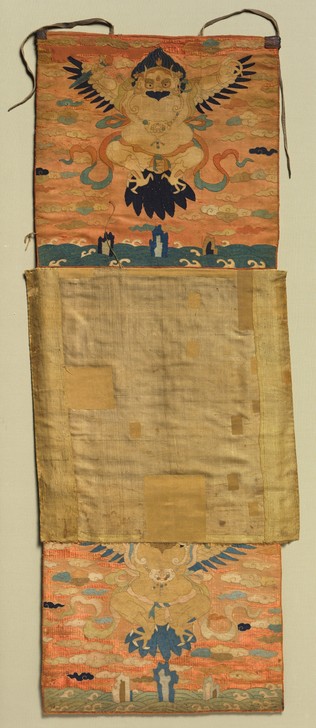

Vajrapani
Embroidered Mount with Garuda | Cleveland Museum of Art
Kneeling and holding his left hand in a gesture of reverential greeting, this Buddhist protector holds a stylized thunderbolt called a <em>vajra</em>, for which he is named. His black body is set off by the gold cloud and flames that stand out from the indigo sky through which birds of prey fly with serpents. His hair stands on end, and his eyes—including his third eye of wisdom—bulge with ferocity. These attributes, plus the powerful bulk of his body, convey his ability to eradicate obstacles to enlightenment. Though unsigned, the painting appears to have been made by a high-ranking Tibetan patriarch. Rare examples of textiles from the Yuan dynasty (1279-1368), the upper and lower borders feature the Indian man-eagle Garuda, who in Tibetan Buddhism is associated with Vajrapani. Garuda hovers over the three Islands of the Immortals that rise from the stylized waters of the Eastern Sea, a motif associated with the Chinese religion of Daoism. Cross-cultural visual references to Indian, Tibetan, and Chinese images come together in this remarkable devotional ensemble.
 Hidden Gems