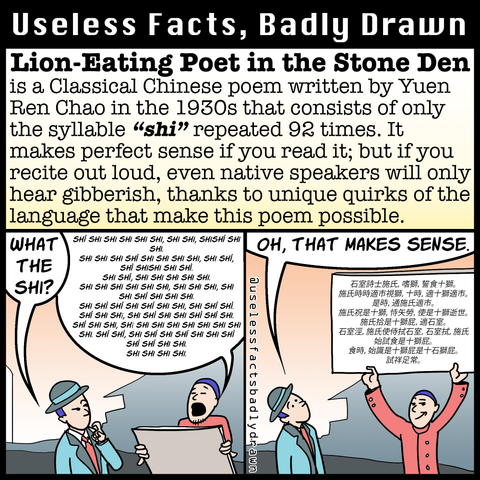
Useless Facts, Badly Drawn #507: Lion-Eating Poet in the Stone Den.
.
.
#poetry #tonguetwisters #comics #literature #china #classicalchinese #language #webcomics #funfacts #facts #uselessfactsbadlydrawn

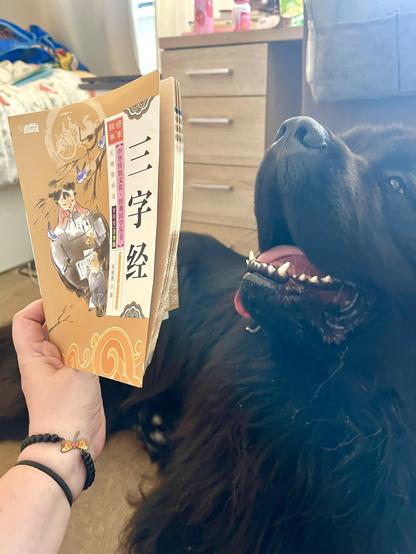
犬之初,性本善;不必习,狗乃善。

When doggies are born, they are naturally good; they don't even practice, they're really that good. – lost verse of the Three Character Classic

#classicalchinese

犬守夜鸡司晨
苟不学曷为人
蚕吐丝蜂酿蜜
人不学不如物

As dogs guard the evening,
As birds hail the morning,
A soul without knowledge
Had best heed this warning:
As silk comes from silkworms,
As honey from bees,
An ignorant person
Is lower than these.

A verse of the Three Character Classic, an educational poem for ancient Chinese children, rhyming translation by me.

#classicalchinese #poetry #translation

okay, my attempt at rendering a very interesting but also very uhh fraught verse of Three Character Classic:

蔡文姬能辨琴
谢道韫能咏吟
彼女子且聪敏
尔男子当自警

Miss Wenji was our wisest muse,
Miss Daoyun mastered rhyme;
Yes, girls can have such talents too!
They beat boys all the time!

full names Cai Wenji (or Cai Yan) and Xie Daoyun if you want to look them up. I say "fraught" because the most literal interpretation is more like "Even girls can pull it off, so you boys better watch out [or you'll be embarrassed when your sister outdoes you]"

#classicalchinese #poetry #translation

A second poetic translation in one day? The medication must be working:

苏老泉二十七
始发愤读书籍
彼既老犹悔迟
尔小生宜早思

Old Scholar Su was half through life
When he resolved to learn;
And he regretted all those years
That he allowed to burn.
Start reading now while you're yet young
And you'll exceed his reach;
Spend wisely every day and year
And learn what it can teach.

A verse of Three Character Classic, an educational poem for ancient Chinese children, rhyming translation by me. It's referencing the story of Su Xun, who did not get crackin' until he was 27, but was a highly respected scholar by the end of his life. https://en.wikipedia.org/wiki/Su_Xun

#classicalchinese #translation #poetry

Su Xun - Wikipedia

如囊萤如映雪
家虽贫学不辍
如负薪如挂角
身虽劳犹苦卓

Read by the glow of fireflies,
Read by the sheen of snow;
No child is too poor to learn,
To study hard, and grow.
While gathering the firewood,
While tending herds in fields;
When work is hard, read further still
And reap the harvest's yields.

A verse of the Three Character Classic, an educational poem for ancient Chinese children, rhyming translation by me.

#classicalchinese #translation #poetry

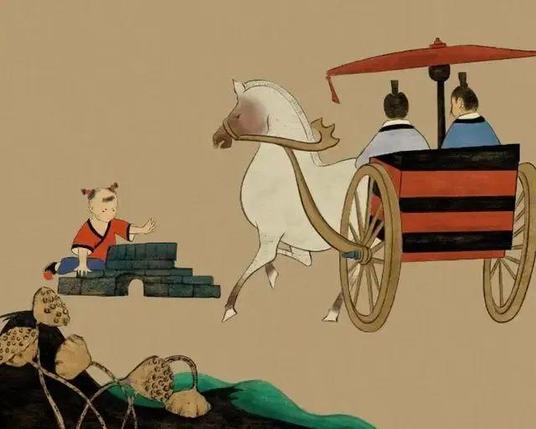
“Confucius Gets Rekt By A Child,” a blatantly apocryphal anecdote but I do love glimpses into ancient childhood:

Once, they say, while Confucius was traveling with his disciples, they came across some children building a big sand castle right in the middle of the road. The children all scattered when they saw the oncoming carriage, except for one: Xiang Tuo, the smartest little boy in the world.

The driver hurriedly stopped the carriage and demanded to know why this little boy would not get out of the way. Xiang Tuo answered: “You approach my moats! Now tell me, do carriages go around castles, or are castles supposed to get out of the way of carriages?”

After getting a good look at the “castle,” Confucius chuckled. “Oh, what a clever child! I see you are wiser than most, so how about a little wager, some honest fun between young and old. I pose a riddle, you pose a riddle, the winner becomes the teacher and the loser becomes the disciple.”

“It’s a deal!”

Confucius asked: “How many stars are in the sky, how many grains grow upon the earth, how many hairs are in your eyebrows?”

Xiang Tuo answered “One skyful of stars, one cropsful of grains, one faceful of hairs. Now, sir, riddle me this: what water has no fish? What fire has no smoke? What tree has no leaf, and what flower has no stem?”

Confucius answered: “Every river, lake and sea has fish. All firewood gives off smoke when it burns. Whoever has seen a tree with no leaves, or a flower with no stem?”

Beaming, Xiang Tuo explained: “There’s no fish in a well. There’s no smoke coming off a firefly. Dead trees don’t have leaves! And snowflakes (‘snow flowers’) don’t have stems.”

Confucius conceded that the child was now his teacher, but Xiang Tuo asked if he could wash his hands off first before all this teaching stuff.

Translation mine, based on the version found in a book about the Three Character Classic by Hu Yuanyuan. (There are many variations of the story.) Art by Wang Lumin

#classicalchinese #translation #philosophy

The perils of semantic drift over multiple millennia:

"古者,贵以德而贱用兵。"

The intended reading of this ~2100yo statement concerning how to deal with foreigners: "In ancient times, virtue was valued and use of force was despised."

What I first read, influenced by the everyday modern usage of the words:

"In ancient times, virtue was expensive and use of force was cheap."

Literally dead opposite implication!

(sentence is from first few paragraphs of Salt and Iron) #classicalchinese #translation

读史者考实录
通古今若亲目
口而诵心而惟
朝于斯夕于斯

Read all of history, go through every shelf
Ancient to modern, and see for yourself;
Profess with your mouth, possess in your heart
From dawn until dusk, to learn every part.

- a verse of Three Character Classic, an educational poem for ancient Chinese children, rhyming translation by me

#classicalchinese #poetry #history #translation