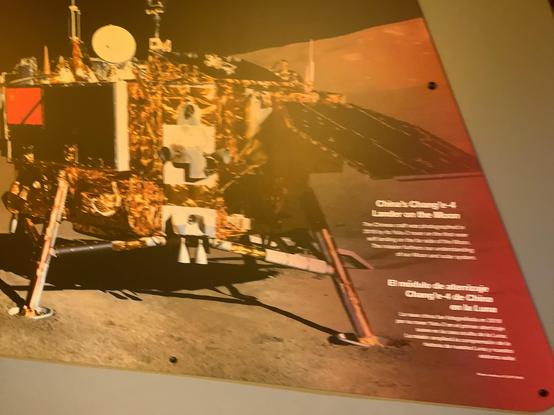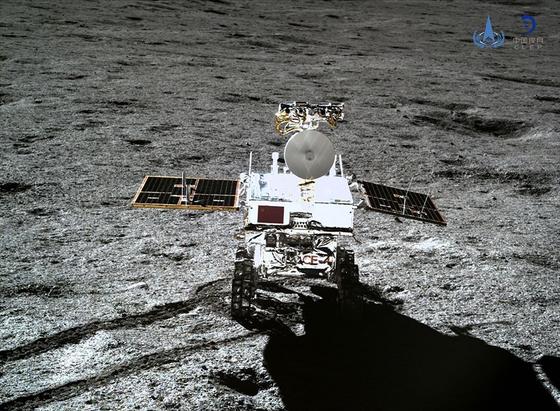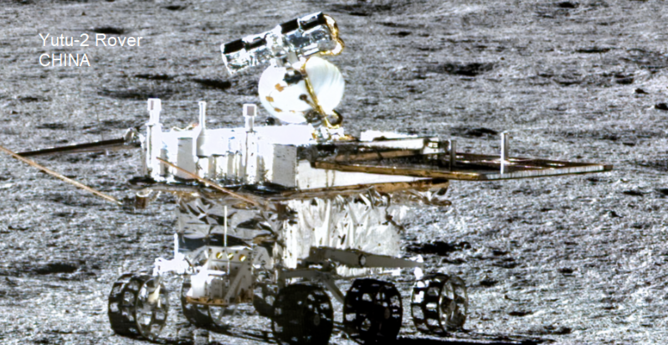
#Change4 (/tʃɑːŋˈə/; Chinese: #嫦娥四号; pinyin: Cháng'é Sìhào; lit. 'Chang'e No. 4') is a robotic spacecraft mission in the #Chinese Lunar Exploration Program of the #CNSA. It made a soft landing on the far side of

Na bijna 6 jaar rijdt Yutu 2 nog steeds op de Maan rond

De Chang’e maanrover is sinds begin 2019 in bedrijf maar China geeft laatste jaren nog maar mondjesmaat informatie vrij over hun tweede Jade Konijn op de Maan.

https://www.kuuke.nl/na-bijna-6-jaar-rijdt-yutu-2-nog-steeds-op-de-maan-rond/

#Change4 #china #maan #maanrover #VerreZijdeVanDeMaan #Yutu2

Na bijna 6 jaar rijdt Yutu 2 nog steeds op de Maan rond

De Chang’e maanrover is sinds begin 2019 in bedrijf maar China geeft laatste jaren nog maar mondjesmaat informatie vrij over hun tweede Jade Konijn op de Maan.

Kuuke's Sterrenbeelden

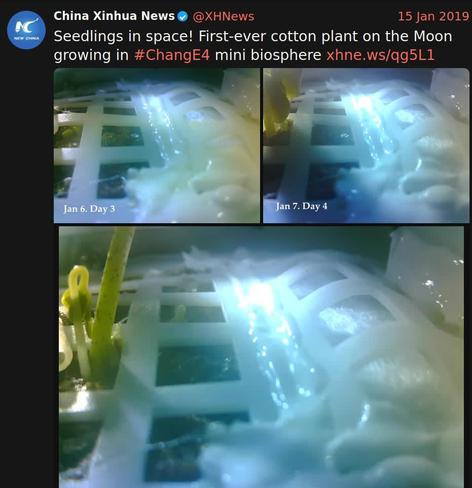
Coltivare piante sulla Luna per la biorigenerazione ambientale. La Cina ha realizzato una piccola fattoria sulla Luna nel 2019. Quali sono stati i risultati? Il 3 gennaio 2019, il lander cinese Chang'e-4 è atterrato sul lato nascosto della Luna e ha inviato il rover Yutu.

#ambientiextraterrestri #Arabidopsis #ariarespirabile #BiologicalExperimentPayload #BLSS #Change4 #crescitapiante #landercinese #LUNA #semidicolza #uovadimosca

https://scienzamagia.eu/scienza-tecnologia/coltivare-piante-sulla-luna-per-la-biorigenerazione-ambientale/

Coltivare piante sulla Luna per la biorigenerazione ambientale

La Cina ha realizzato una piccola fattoria sulla Luna nel 2019. Quali sono stati i risultati? Il 3 gennaio 2019, il lander cinese Chang'e-4 è atterrato sul la

Irailaren 4an, #Chandrayaan3 misioaren #Pragyan astromobila hibernazioan sartu zen Ilargi gaua igarotzeko (14 egun lurtar). Hau, Ilargiaren alde ezkutuan dagoen #ChangE4 misioaren #Yutu2 astromobilatik 1891 kilometrotara dago.

#Espazioa #Ilargia

Mondmission
Forschung
Vielleicht die bisher längste Mission am Mond Chang'e 4
auch #ChangE4

Platz 2500km Umkreis
Wo sich die Mission aufhält
Südpool Mond
Aitken-Becken
https://en.wikipedia.org/wiki/South_Pole%E2%80%93Aitken_basin

Bild Der Racker soll schon um 1500m bis 2023 gemacht haben - bei Forschungsarbeiten am #Southpol Moon
https://en.wikipedia.org/wiki/Yutu-2
Yutu2 Rover mit Robotik

South Pole–Aitken basin - Wikipedia

To 2019 η αποστολή #change4 προσεληνώνεται και εκτοξεύει το ερευνητικό σκάφος #yutu2.

Από γεννήσεις έχουμε την Αμερικανίδα κοινωνική αναμορφωτή Lucretia Mott (1793), το Γερμανό καλλιτέχνη August Macke (1887), τον Άγγλο συγγραφέα J.R.R. Tolkien (1892), τον Ιταλό σκηνοθέτη Sergio Leone (1929), τον Αμερικανό μηχανικό και επιχειρηματία Gordon Moore (1929), τον Αμερικανό κάτοχο βραβείου #turing μαθηματικό και επιστημονική πληροφορικής Richard Karp (1935),

(Συνεχίζεται)

Das James-Webb-Weltraumteleskop liefert vom Lagrange-Punkt L2 gerade faszinierende Bilder. Diese Punkte bieten strategische und wissenschaftliche Möglichkeiten.
Hotspots im All: Warum die Lagrange-Punkte so interessant sind

Das James-Webb-Weltraumteleskop liefert vom Lagrange-Punkt L2 gerade faszinierende Bilder. Diese Punkte bieten strategische und wissenschaftliche Möglichkeiten.

heise online
Erst vor zwei Jahren war in den USA die bis dahin genaueste geologische Karte des Mondes veröffentlicht worden. China stellt nun einen neuen Rekord auf.
China übertrumpft die USA mit detailliertester geologischer Mondkarte

Erst vor zwei Jahren war in den USA die bis dahin genaueste geologische Karte des Mondes veröffentlicht worden. China stellt nun einen neuen Rekord auf.

heise online
An Lagrange-Punkten können Satelliten fix zwischen Himmelskörpern schweben. Dort bieten sie viele strategische und wissenschaftliche Möglichkeiten.
Hot Spots im All: Warum die Lagrange-Punkte so interessant sind
Hotspots im All: Warum die Lagrange-Punkte so interessant sind

Das James-Webb-Weltraumteleskop liefert vom Lagrange-Punkt L2 gerade faszinierende Bilder. Diese Punkte bieten strategische und wissenschaftliche Möglichkeiten.

heise online

China Rover Captures ‘Mystery Hut’ on Far Side of the Moon

China's Yutu 2 lunar rover has photographed what is being described as a "mystery hut" on the far side of the moon, and Chinese scientists are eager to have the robotic exploration vehicle investigate it further.

The finding was shared on Our Space, an online publication affiliated with the China National Space Administration (CNSA) that is documenting Yutu's lunar mission.

Yutu 2 first landed on the moon on the Chang'e 4 Chinese spacecraft back on January 3rd, 2019, and it was the first space mission to successfully soft-land on the far side (or "dark side") of the Moon. The "hut" was spotted by the rover on the mission's 36th lunar day, each of which is about 29 Earth days.

"Suddenly, an obtrusive cube on the northern skyline attracted their attention," Our Space writes (translated from Chinese to English). "This object pierced through the winding of the skyline, like a 'mysterious hut' that appeared out of thin air.

"There was a large 'baby' impact crater beside it. Was it a home built by aliens after the crash landing? Or is it the pioneer spacecraft of the predecessors to explore the moon?"

A crop of the photo by Yutu 2 offering a closer look at the "mystery hut." Photo by CNSA.

The photo shot by Yutu 2 shows that the cube-shaped object was about 80 meters (~260 feet) away on the horizon to the north in the 112-mile-wide (180km) Von Kármán impact crater.

Our Space referred to the object as "神秘小屋," or "mystery house," and says that the mission's scientists were immediately curious about the object after hearing about it from the rover's pilots.

"This thing is interesting!" they reportedly responded. "Let's go check it out!"

Ah. We have an update from Yutu-2 on the lunar far side, including an image of a cubic shape on the northern horizon ~80m away from the rover in Von Kármán crater. Referred to as "神秘小屋" ("mystery house"), the next 2-3 lunar days will be spent getting closer to check it out. pic.twitter.com/LWPZoWN05I

-- Andrew Jones (@AJ_FI) December 3, 2021

It will take some time before the rover is able to get to the bottom of the mystery, though. Despite being only 260 feet away, it will take the rover about 2 to 3 lunar days, or two to three months of "trekking" before it will reach the object to get a better look at it.

Andrew Jones, a journalist tracking China's space program, Tweets that a possible explanation for the "hut" is that it is a large boulder that was pulled out of the lunar surface by an impact event.

So yeah, it's not an obelisk or aliens, but certainly something to check out, and hard to discern much from the image. But large boulders (right) are sometimes excavated by impacts, as seen by the Chang'e-3 mission, which launched 8 years ago on Dec 1. [CNSA/CLEP] pic.twitter.com/ifOIFr4oQI

-- Andrew Jones (@AJ_FI) December 3, 2021

Since it began its explorations in 2019, Yutu 2 has now traveled a total distance of around 2,760 feet (840m).

#news #astronomy #change4 #china #lunar #moon #mystery #rover #space #yutu2