 Andy Arthur - Threadinburgh
Erse Houses: the thread about Edinburgh’s Gaelic churches and the spiritual wanderings of the city’s Gaels
It’s been a while since I made a “Now And Then” animated image transition, so have yourselves one showing the “new” (then) Gaelic chapel at the top of what was Horse Wynd, now slap bang in the middle of Chambers Street.
Animated transition of the old “New Gaelic Chapel” relative to its position on modern day Chambers Street. Original image CC by NC from National Galleries ScotlandThis is one of a pair of images in the National Galleries of Scotland collection made by the photographer Archibald Burns about 1868 or 9. The image used in the transition animation is the first below. The second, below it, is taken looking the other way along what is now Chambers Street, but which at that time was a narrow street giving access bettwen North College Street and Argyle Square. Horse Wynd is running downhill to the right of the horse and cart. It ran steeply downhill downhill to the Cowgate from the Potter Row and was one of the principal routes into old Edinburgh from the south, and about the only one really suitable for horse traffic, hence its name.
Gaelic Church from Minto House Grounds, Archibald Burns, c. 1869. CC-by-NC National Galleries ScotlandGaelic Church, Archibald Burns, c. 1869. CC-by-NC National Galleries ScotlandWe can see from these pictures that the chapel was relatively plain and roughly finished, a 2-storey, 5-bay building with its better face onto the street. An Edinburgh Improvement Act 1867 bill, defaced by a Temperance movement fly poster, gives the clue about what is going on here. This act saw the creation of Chambers Street from the series of narrow lanes and squares that existed at this time.
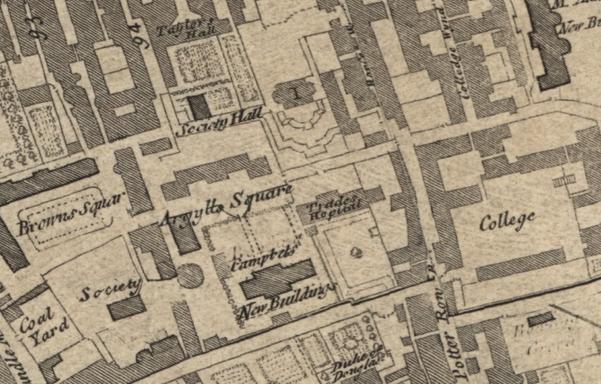
At the centre of these improvements, Chambers Street was a broad new boulevard to link the South Bridge with George IV bridge. In doing so ploughed its way through Argyll’s Square, Brown’s Square (he who gave his name to George Square), the Society, Minto House, the Trades Maiden Hospital,
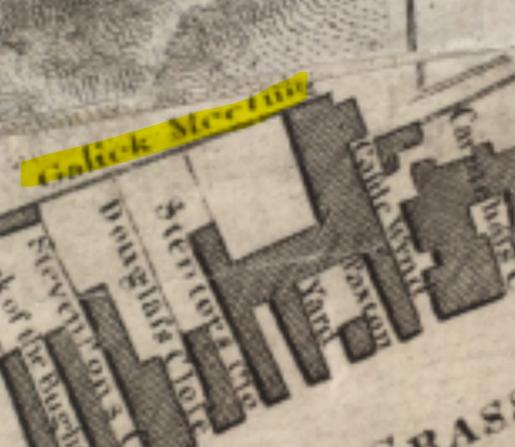
Edgar’s Town Plan of Edinburgh, 1765. The building marked “I” is Minto House, in whose garden Archibald Burns was standing to photograph the chapel. Horse Wynd is just to its right. Reproduced with the permission of the National Library of ScotlandThis was not the first Gaelic chapel or meeting house in the city however, the first was at the top of Castle Wynd, off the Grassmarket. It’s shown in 1784 (Galick, sic), 1804 (Earse, or Erse, a lowland Scots phrase for Gaelic), 1817 and up to 1849, when only its former site is recorded.
Kincaid, 1784. Reproduced with the permission of the National Library of ScotlandAinslie, 1804. Reproduced with the permission of the National Library of ScotlandKirkwood, 1817. Reproduced with the permission of the National Library of ScotlandOrdnance Survey, 1849. Reproduced with the permission of the National Library of ScotlandDuring the 17th century, the population of Gaelic speakers in the city had increased to such an extent that in 1704 the General Assembly of the Kirk agreed to provide a place of worship for them “to hear service in their own tongue“. Highlanders were drawn to the city by socio-economic factors. They long supplied the city with “certain classes of its population; the town Guard, the caddies, the linkmen, the hewers of wood and drawers of water generally were from the glens“. There was no progress on the Gaelic chapel (at this time it was a Chapel of Ease, somewhere handier to reach your place of worship in what could be enormous parishes and not a distinct parish Church) until 1766-67, when the building on Castle Wynd began to be erected.
The new chapel opened in 1769, oddly with financial assistance from the Society in Scotland for Propagating Christian Knowledge, a lowland organisation to “civilise” the Highlands and keep out Catholicism through religious education. Civilising of course meant protestant, although the SSPCK leaned towards Anglicanism, rather than the Presbyterianism of lowland Scotland. (I say oddly because the SSPCK is better known for being virulently against “that barbarity and the Irish language” and made concerted efforts to stamp it out in the Highlands. So it was somewhat odd that it was actively spreading it in Edinburgh.) The minister of the new church on opening was by the name of Macgregor and he was something of a not-too-closeted Jacobite.
Mr Macgregor, “The Highland Minister”. By J. Jenkins in the style of John Kay, late 18th century. CC-BY-4.0 National Library ScotlandThis was in direct contrast to the previous Gaelic-speaking minister in Edinburgh, Neil McVicar of the West Kirk (now St. Cuthberts). The appropriately named McVicar was trusted with the “charge of the Highlanders of the City” and preached strenuously against the 1715 and 1745 uprisings. Indeed, when Charles Edward Stuart (Bonnie Prince Charlie) entered the city after his victory at the Battle of Prestonpans, McVicar preached openly “In regard to the young man who has recently come among us in search of an earthly crown, may he soon obtain what is far better, a heavenly one.” McVicar, they said, “never knew fear“. One day, out on a promenade in Comely Bank, he was challenged by the Laird of Inverleith (Sir Francis Kinloch of Gilmerton, 3rd Baronet) who was aggrieved at the public humiliation of being put under Kirk discipline by McVicar. The laird arrogantly threatened the Minister “But for the coat you wear, I should have taught you a lesson today!” In an instant, McVicar whipped off his long and solemn black Minister’s coat, threw it to the ground and with the thunderous delivery honed by preachering retorted “There lies the minister of St. Cuthbert’s, and here stands Neil McVicar, and by yea, and by nay, sir, come on!” Prudence got the better of the laird, who beat a hasty retreat with his tail between his legs less he found himself fighting the fearless man of the Kirk.
A Victorian illustration of Charles Edward Stuart “reading a dispatch” in full Highland garb. CC BY-NC-SA 4.0, The Trustees of the British MuseumBack to the Gaelic chapel, it issued its own communion tokens with a verse from Corinthians on the back. The New International Bible gives this verse as “Let a person examine himself, then, and so eat of the bread and drink of the cup. For anyone who eats and drinks without discerning the body eats and drinks judgment on himself.” The date of 1775 most likely refers to the appointment of the minister.
1775 Edinburgh Gaelic Chapel communion tokenIn 1807, a new minister, John MacDonald, was appointed. John Kay helpfully made a caricature and biography of him in his book of Edinburgh notables. McDonald was very highly thought of in the city and was quite the megapreacher. He kept getting himself into trouble by wandering uninvited into other minister’s parishes and preaching to anyone who would listen. He went uninvited into their kirks, or preached outside them or even in dissenting churches. He later devoted himself to bettering “the religious and moral conditions of St. Kilda.” He made numerous visits to that distant archipelago, ingratiated himself with the locals and helped arrange for a permanent Church and minister. His are some of the first detailed accounts of the place.
The Reverend McDonald, by John Kay, 1813Before all that though, in Edinburgh, a combination of the rising Gaelic-speaking population and his popularity as a preacher saw his flock out-grow the meeting house on Castle Wynd and he sought to obtain adjoining ground to have it extended. There is no known image of the first meeting house, but there’s an outside chance this is it below, in this Joseph Farington sketch of 1788, before the north side of the Grassmarket was really built up at its eastern end.
Green arrow highlighting the possible building that is the Gaelic meeting house on Castle Wynd. From a picture by Joseph Farringdon, 1788. CC-BY-NC National Galleries ScotlandThe SSPCK was again approached for assistance, but at the same time there were other plans afoot to provide a second chapel. However this was to be a Gaelic and English Chapel of Ease, with services in Gaelic but other instruction given in English for the “benefit” of children. With the financial assistance of the Edinburgh Corporation and the Writers to the Signet, the site at the head of Horse Wynd was acquired and the new chapel with seats for 1,100 was built at a cost of £3,000. It is one of my favourite features of the 1849 Town Plan that the surveyors and draughtsmen troubled to record in the basic internal layouts of public buildings and recorded the capacity of churches. I think in this instance “Free” means seats not reserved to a particular member of the congregation, rather than the Free Church.
OS Town Plan showing the Gaelic “Quoad Sacra” Chapel, 1849. Reproduced with the permission of the National Library of ScotlandThe new chapel opened in 1813 but that it was both Gaelic and English I think caused a bit of a schism in the congregation, thus the old chapel briefly remained in the Gaelic language alone until the departure of Reverend Macdonald. This schism seems to have been resolved largely by the practicalities of financial matters; the congregation could not support both the old chapel and the debts of constructing the new one. Both chapels were without minister and common sense prevailed to close and sell the old one, transfer its financial trust to the new chapel and recruit a single new minister. The congregations agreed to merge and this did so in 1815 under the Rev. John Munro. The Kirk issued regulations that “Service ought to be performed in the Gaelic language at the ordinary meetings for public worship… of every lord’s Day, but with leave to the Minister to have an additional service in English in the evening or at any other time during the week.” In 1832 the then Minister, Duncan McCaig, was found guilty of stealing books from the library of the Faculty of Advocates and was sentenced to transportation to the prison colony of Port Arthur in Tasmania.
In 1834 the Kirk passed the Chapels Act which converted the Chapel of Ease into a Parish Church Quoad Sacra, that is an ecclesiastical parish but not an administrative one. The Gaelic Chapel thus became a Church, but with no specific parish boundary. This meant that it now had its own Session (governing committee) and the office bearers were thus recorded – the Gaelic church elders included a writer (lawyer), excise officer, grocer, stonemason, cow-feeders, marble cutter, tavern keeper and coach hirer. Church life was impacted by The Disruption of 1843 when a significant part of the etablished Church of Scotland walked out and set up its own Church, the Free Church in protest. The Gaelic Church was no exception to this, however the building on Horse Wynd and its contents was legally the property of the established Kirk. The majority of the Gaelic congregation and the Minister had joined the Free Church but stayed on in the building and so the Kirk moved them on. The Gaelic Free Church settled in another temporary Free Church on Cambridge Street before building its own home; Free St. Columbas. Here it stayed as a Gaelic church until 1948. The Traverse Theatre later moved in, before clearing it for their modern building .
The former St. Columba’s Free Church on Cambridge Street being used as the Traverse Theatre. The Usher Hall peeks out on the right.The small remnant of the Gaelic Church that stayed behind in the Church of Scotland took a long time to rebuild itself, having lost its minister and all its elders. This rebuilding was rudely disrupted in 1867 by the compulsory purchase order for its home by the Improvement Scheme. The Church got £6,000 and leave to remain until the bulldozers moved in. They spent some time after this moving around until the Catholic Apostolic Church on Broughton Street came on the market when the latter moved down the road to what is now the Mansfield Tracquair Centre.
https://www.flickr.com/photos/davids_leicas/14752650390
The new Church was much smaller, but the Gaelic-speaking population of the city was declining overall and much of it was in the Free Church, so this probably wasn’t an issue. The congregation moved in during 1815 with the first service on October 15th 1876 under the minister Donald Masson. The 5-bay classical building was officially given the name St. Oran’s in 1900. The congregation stayed here until 1948 when declining membership and the death of the minister, MacDonald, saw both it and St. Columbas (by now back in the Church of Scotland via the United Free Church of Scotland) closed, despite merger plans. A continuing St. Columbas congregation remained in the Free Church, where some Gaelic services are still held – in a building originally built as St. John’s Free Church at the top of Johnston Terrace. Remember what I have said before about Victorian Scotland building a mindboggling number of churches?
This thread was only made possibly by some (lots) help from Neil Macleod who patiently answered my questions and kindly sent some scans of the relevant books! Thanks Neil! Thanks also to Fraser MacDonald for assistance in accessing relevant academic papers.
If you have found this site useful, informative or amusing then you can help contribute towards its running costs by supporting me on ko-fi. This includes my commitment to keeping it 100% advert and AI free for all time coming, and in helping to find further unusual stories to bring you by acquiring books and paying for research.
Or please do just share this post on social media or amongst friends and like-minded people, sites like this thrive on being shared.
Explore Threadinburgh by map:
Travelers' Map is loading...If you see this after your page is loaded completely, leafletJS files are missing.
These threads © 2017-2026, Andy Arthur.
NO AI TRAINING: Any use of the contents of this website to “train” generative artificial intelligence (AI) technologies to generate text is expressly prohibited. The author reserves all rights to license uses of this work for generative AI training and development of machine learning language models.
#Lochend #Logan #Restalrig #StMargaret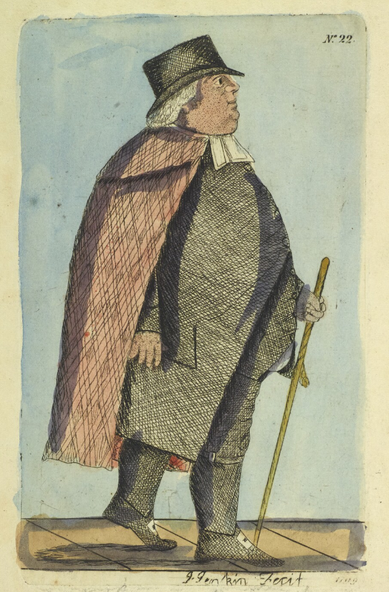
 NY Public Library Appreciation