RE: https://mastodon.art/@inarticulatequilter/114082160860371500

I'm irritated that #BlackHistoryMonth 2026 is ending, awash in current events that will push today's quilter especially off the timeline

I just wish all these quilters, already marginalized, could get their art seen and their stories heard by more people

This is the 🧵 I wrote at the end of #CelebratingBlackQuilters last year. Much is still relevant. I think I have at least two more years of quilters to explore, tho the research is getting harder

Thank you for reading all month and warm wishes

#CelebratingBlackQuilters
#BlackHistoryMonth

Hystercine Rankin (1929-2010) was taught to quilt by her grandmother, who she went to live with as a preteen after the murder of her father. Co-founder of the Crossroads Quilters collective, Rankin was a renowned fiber artist who influenced many Mississippi artists with both her utilitarian and narrative works

Representative work:
Memories of My Father’s Death

Cotton
78” x 94”
1989

More info:
https://mississippifolklife.org/exhibits/hystercine-rankin

Photo credit: MDAH

#Quilting

#CelebratingBlackQuilters
#BlackHistoryMonth

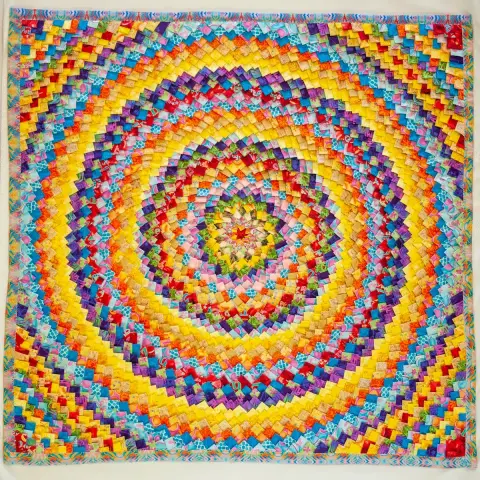
Betty Ford-Smith (1951-) is the foremost contemporary creator / instructor of traditional African American pinecone (or pine burr) quilts. Often weighing up to 30 lbs, each hand sewn quilt from this Florida native can include careful spiral placement of more than 4,000 folded triangles

Representative work:
Pinecone Baby Quilt (You Are My Sunshine)

Cotton
40” x 40”
2022

More info:
https://createwhimsy.com/projects/spotlight-betty-ford-smith-pinecone-quilter/

Photo credit: Appleton Museum

#Quilting

#CelebratingBlackQuilters
#BlackHistoryMonth

Ora Clay (1945-) started quilting in 2011 after taking a class at the Museum of the African Diaspora. Her first quilt, started during that class, was later acquired but the Smithsonian (seen below.) The daughter of a quilter who grew her own batting cotton, Clay now uses quilts to tell her own story

Representative work:
Remembering Brown vs Board of Education

Cotton
56” x 47”
2015

More info:
https://www.quilts-by-ora.com/

Photo credit: SAAM

#Quilting

#CelebratingBlackQuilters
#BlackHistoryMonth

Arester Earl (1892-1988) quilted lying down in bed to accommodate poor eyesight and paralysis of one side of her body; the result was a unique style of individual blocks sewn together with large stitches. Many of her designs came to her in dreams and her quilts often include images believed to be protective charms

Representative work:
Dream Quilt
Unknown
92” x 87”
1981

More info:
https://en.wikipedia.org/wiki/Arester_Earl

Photo credit: Maude Wahlman

#Quilting

#CelebratingBlackQuilters
#BlackHistoryMonth

Anna Williams (1927-2010) is considered the founder of three seperate quilting traditions - African-American, improvisational and scrap. Quilting since a child in Louisiana, she would piece small scraps found while cleaning a fabric shop during the 70s into the vibrant quilts that became her signature

Representative work:
Quilt CCXLII

Cotton/Synthetic
59” x 59”
c 1990s

More info:
https://64parishes.org/entry/anna-williams

Photo credit: Gavin Ashworth

#Quilting

#CelebratingBlackQuilters#BlackHistoryMonth

Dr. J. Janice Coleman (1962-) has been quoted as saying “I think I started sewing quilts in the womb,” because she grew up in a rural Mississippi community surrounded by quilters. An English professor, Coleman’s work often features cotton sacks, Mississippi natives and literary themes

Representative work:
Is This America? The Fannie Lou Hamer Quilt
Cotton
Unknown
2024

More info:
https://www.magnolialiteracyproject.org/post/the-beloved-quilt-remembering-toni-morrison

Photo credit: Rooted Magazine

#Quilting

#CelebratingBlackQuilters
#BlackHistoryMonth

Clementine Hunter (1886-1988) became a farm laborer at Melrose Plantation when she was 15. Established by free Black people prior to the Civil War, Melrose later became an artist colony and Hunter became a prolific painter, muralist and quilter. Few of the quilts depicting everyday activities from her long life now survive

Representative work:
Melrose Quilt
Cotton
73” x 60”
c. 1960

More info:
https://artsandculture.google.com/story/mAXhLE-PhSKCJQ

Photo credit: SAMM

#Quilting

#CelebratingBlackQuilters
#BlackHistoryMonth

Gary Tyler (1958-…) was wrongfully convicted of murder during a fight over desegregation as a teen. Once the youngest person on death row, legal efforts eventually saw him released in 2016. During his time in Angola, he took up quilting; the humanity behind prison life is a frequent topic of his appliqué quilts

Representative work:
Captivity, 1974

Cotton
74” x 49”
2023

More info:
https://www.smithsonianmag.com/smart-news/gary-tyler-wrongfully-imprisoned-41-years-first-solo-exhibition-180982641/

Photo credit: Hyperallergic

#Quilting

#CelebratingBlackQuilters
#BlackHistoryMonth

Sandra Nobel (1941-…) taught art in both Detroit and Cleveland public school systems and is currently an adjunct at Case Western Reserve University. Her early interest in rug hooking eventually morphed into wall art quilts, though many of Nobel’s pieces continue to be heavily embellished with thread and fiber

Representative work:
Annie Box Neal

Cotton/Photo transfer
34” x 39”
2021

More info:
https://www.sandranobleartquilts.com/bio

Photo credit: Artist

#Quilting