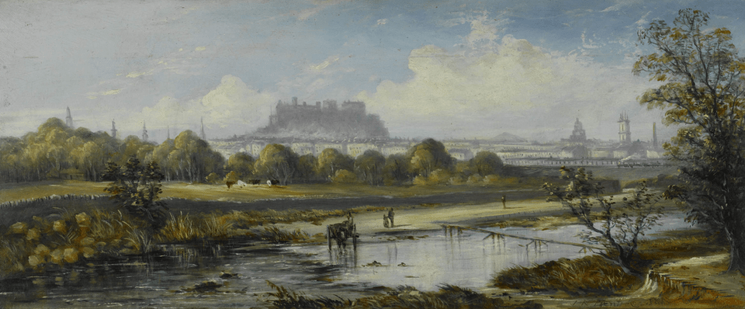
Peter Puddock and the Puddocky: the thread about Municipal Frogs and Flood-prone Pitches

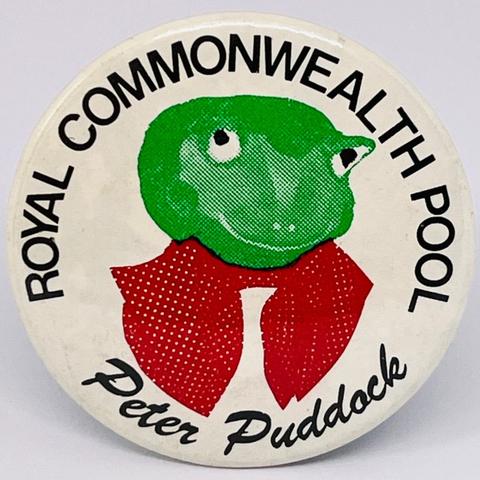
An unexpected – and irresistible – eBay find in recent days was this charming (or, depending on your feelings towards anthropomorphic frogs, terrifying) button badge featuring Peter Puddock, the one-time mascot of Edinburgh’s Royal Commonwealth Pool. Peter was created as a marketing campaign by the District Council in 1987 and his name was chosen by a children’s competition which attracted some three hundred entries.

ROYAL COMMONWEALTH POOL – Peter Puddock

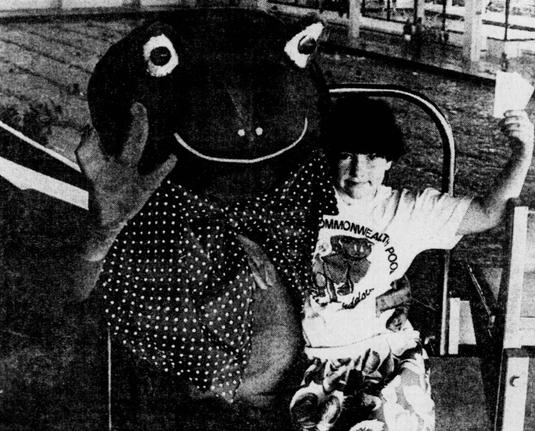
The lucky winner was ten year old Marjorie Drysdale from Prestonfield. In addition to securing the naming rights she was awarded a photo-shoot with Peter, who presented her with two golden passes for a year’s free swimming at The Commie. In addition, from the chairman of the council’s Recreation Committee, she received one of these badges and a matching t-shirt.

Marjorie and Peter at the Commonwealth Pool, she sporting her t-shirt and holding the prize tickets, he resplendent in his enormous bow tie. Edinburgh Evening News photo, 18th March 1987

Following this, Peter’s first official public outing was at McDonald Road Library on March 21st, the occasion being the sale of 20,000 ex-circulation books. After that, what became of him is not recorded in the pages of the Evening News or any other newspaper. However, in August 2018 the Dartmouth Chronicle reported that a Peter Puddock had accused Kingswear Parish Council of financial mismanagement and running up a £17,000 financial shortfall. Coincidence? Who is to say…

So what’s in a name? As recorded in the Dictionaries of the Scots Language, Puddock is the word for a frog in that leid (or a toad, the two species are often confused). It can also be spelled puddick, poddock or paddock, but does not share an etymology with the English word paddock (from parrock or park), instead having its roots in the Old Norse padda for toad. It may be used as an adjective – puddockie or puddocky – to describe the sort of wet, boggy ground which abounds in amphibians. It has various reduced forms including paddy but it’s pure coincidence that the same word is used in English for a flooded field where rice is grown; in this case that’s a loan from the Malay word pādī.

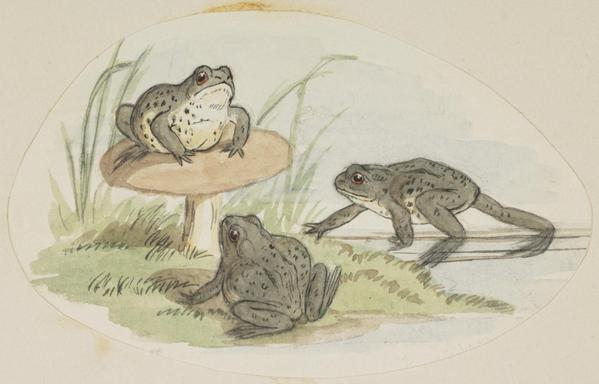
Three Frogs, by Jemima Blackburn (née Wedderburn), mid 19th century. National Gallery of Scotland collection.

Sections of the Water of Leith were once commonly known as the Puddock Burn although by the mid-19th century it was remarked upon that this was a nostalgic notion on account of the river pollution having rendered it almost entirely devoid of such wildlife. This association is also used more specifically for the section of the river between Canonmills Bridge and Powderhall, long known as The Puddocky.

“Water of Leith from Back of Warriston Cemetery”, a romantic scene at The Puddocky in the 19th century – in reality the river here by this time was extremely polluted. Note the steam train running along the railway embankment on the middle right distance. 1850, John Reid Prentice. Credit; Edinburgh Museums and Galleries.

While it’s true that generations of children have fished here for frogs with bits of string and jeelie jars, the name instead derives from an older placename of Paddockhaw or Puddockhall, a farm of that name in this location being recorded in 1724. There was no actual hall here however, the word being referred to is the Scots Haugh; a level plain alongside a river, seasonally wet land prized by farmers and frogs alike.As a place it disappeared after 1763 when the river was significantly straightened in an attempt to deal with flooding, but the name has persisted in to modern times.

Robinson & Fergus 1759 Town Plan of Edinburgh (left, photo © Self) and Kirkwood’s 1817 Town Plan (right, reproduced with the permission of the National Library of Scotland) overlaid on each other, move the slider to compare. This shows the development of the area around this time, in particular the straightening of the Water of Leith that trapped a portion of land belonging to Heriot’s Hospital that was once contiguous with the holding on the north bank of the river on the south instead.

The persistence of the name in collective memory has perhaps been helped by its surprisingly prominent literary profile. In an 1898 biography of Robert Louis Stevenson – educated nearby at the Canonmills school of the Free Kirk – Evelyn Blantyre Simpson relates that on learning the 23rd psalm (“The Lord’s my Shepherd, I’ll not want; he makes me down to lie in pastures green; he leadeth me the quiet waters by“) the boy’s over-active imagination pictured this as being his riverside playground of the Puddocky where he spent many an hour splashing around, attended by his ever-present nursemaid Cummy.

A statue dedicated to Robert Louis Stevenson, depicting him as a boy, located by the Water of Leith at Colinton Parish Church where his grandfather was minister. CC-by-SA 4.0 Rosser1954

The young RLS was not the only Edinburgh author to have formative memories of the place, Muriel Spark recalls in her autobiography Curriculum Vitae that “at weekends we roamed in the botanical gardens or went for walks at Puddocky“. She would use it as a location in The Prime of Miss Jean Brodie where the character Teenie allegedly took a romantic “walk” with her boyfriend which resulted in an unwanted pregnancy. Norman Macaig refers to it in “his most sustained meditation on Edinburgh“, the 1973 poem Inward Bound:

Journeys, Mine were
as wide as the world is
from Puddocky to Stockbridge
minnows splinter in a jar
and a ten-inch yacht
in the roaring forties of Inverleith Pond
crumples like a handkerchief

The Puddocky name also has a number of long-standing associations with sport in the district. Part of Warriston Park was taken on as playing fields by the Edinburgh Institution (later to become Melville College) in the 1860s, with cricket played in the summer and rugby in the winter. This ground was part of the Water of Leith’s flood plain and had once been the site of the ornamental pond of Wester Warriston House. Unsurprisingly as a sports pitch it was perpetually damp, usually waterlogged in winter and more suited to webbed feet. It gained the derisory nickname of The Puddocky. It was taken over later by the Edinburgh School Board in 1910 and remains as playing fields for school use to this day.

Lothian Regional Council hasn’t existed for 30 years, but their sign for Warriston playing fields is nevertheless still in remarkably good condition

On the opposite bank from here was the triangle of land possessed by The Governors of Heriot’s Hospital that had been marooned on that side when the river was straightened out. From 1883 this was used as a football ground by the itinerant St Bernards F.C. but after 1887 it was transferred back to Heriot’s as school playing fields. Again this site was frequently damp and again it found itself nicknamed The Puddocky. The school lasted here for little more than a decade before removing to altogether more commodious and drier facilities further north at Bangholm. Renamed Old Logie Green, it became the ground of Leith Athletic F.C. who played here until 1915. The displaced St Bernards didn’t have too far to go however and moved just next door to the New Logie Green ground.

1894 OS 1:25 inch map of Edinburgh showing the various Puddocky sports grounds. The Institution’s Ground on the left can be seen below Eildon Street, now merged with Warriston Park as the council playing fields. The Heriot’s Ground is on the opposite bank of the river, and wound later be known as Old Logie Green. The ground marked as St Bernard’s Football Ground was New Logie Green. Reproduced with the permission of the National Library of Scotland

Once again the nickname Puddocky was applied for the usual reasons and this site holds a unique claim to fame in that it is the only football ground outside of Glasgow where the Scottish Cup has been held. Owing to a timetabling clash at the usual Hampden Park venue in 1896 the game was played instead at the ground of the holders – St Bernards. The match was an Edinburgh derby, Heart of Midlothian prevailing over their city rivals Hibernian by three goals to one. St Bernards departed here in 1899 when their lease expired and the ground was removed, Logie Green Road driven through its heart.

The 1896 Scottish Cup game, the unique occasion of it being an Edinburgh derby at an Edinburgh ground. On the left is the old house of Logie Green which abuts the pitch and in the background is the roof line of Warriston Crescent. Note the steam locomotive on the railway embankment, which appears to have stopped to spectate. Note also the pitch line markings are different from those we are familiar with these days.

To keep you on your toes if you are trying to research either of these two football teams or either of the two Logie Green grounds, Leith played very briefly at New Logie Green in the 1899 season and St. Bernards returned to Old Logie Green between 1921-24. From then until final closure in 1926 Old Logie Green was home to, you’ve guess it, Leith Athletic. In the century since then it has been the football boots of generations of Edinburgh school children playing soggy winter fixtures at Warriston that have trod on the last remaining Puddocky pitches.

If you have found this useful, informative or amusing, perhaps you would like to help contribute towards the running costs of this site – including keeping it ad-free and my book-buying budget to find further stories to bring you – by supporting me on ko-fi. Or please do just share this post on social media or amongst friends.

These threads © 2017-2026, Andy Arthur.

NO AI TRAINING: Any use of the contents of this website to “train” generative artificial intelligence (AI) technologies to generate text is expressly prohibited. The author reserves all rights to license uses of this work for generative AI training and development of machine learning language models.

#Canonmills #Powderhall #River #RobertLouisStevenson #Sport #SwimmingPool #Warriston #WaterOfLeith #Written2025
Teaching “self denial as well as thrift”: the thread about Canonmills Public School

Preamble. The schools of the “School Board” era of public education (1872-1918) have for some reason a particular fascination for me, one which is more profound where they are either no longer in use as schools or have disappeared entirely. This thread began as a couple of lines for my own notes about each of the “Lost Board Schools of Edinburgh” but rapidly snowballed into an intention to cover each, in alphabetical order, on its own and in rather more detail, but not so much that they can’t be posted quite frequently.

The second instalment of our series detailing “Lost Board Schools of Edinburgh” looks at Canonmills Public School on Rodney Street. Before this institution, education in the neighbourhood was provided either at the Church of Scotland’s St Mary’s School – also on Rodney Street – or the Free Church School at the foot of Canonmills (the former is now part of the Elsie Clark Halls of the Royal British Legion and the latter is the Canonmills Baptist Church.) The Edinburgh School Board acquired half an acre of ground immediately to the east of St Mary’s for a new school and plans were prepared by architect to the Board, Robert Wilson. These were forwarded for approval of the Scotch Education Department in 1879, the estimates for the total cost being £8,500, to be paid for by a loan over thirty years from that authority.

Overlay comparison of 1893 Ordnance Survey town plan of Edinburgh, centred on Canonmills School (Reproduced with the permission of the National Library of Scotland) and contemporary Google Earth satellite imagery. Move the slider to compare.

The school was very similar to others for the board by Wilson (who would later become their staff architect); a two-storey sandstone building in the favoured Collegiate Gothic style, minimally ornamented except for the Edinburgh School Board roundel (“the female figure of education” dispensing knowledge to the young and surrounded by books and a globe) on the central gable. It was roughly symmetrical in layout, with an entrance at the north end of the block for boys and another at the south end for girls and infants. Internally it was similarly segregated and effectively two schools, the two halves meeting in the centre in large, multi-function halls on both floors. These had moving partitions to allow them to be split up into smaller teaching spaces and also served as the only direct connection between the two halves. To the rear was a playground, around the edge of which were play sheds, and a house for the resident janitor.

The former Canonmills School. The building to the right is the Elsie Clark Halls, which includes the original St Mary’s School building to its rear. Note the ESB roundel on the principal gable in the centre of the building. Picture via S1 Developments.

The Board advertised to staff their new school in May 1880, ahead of its opening for the new term later that year. They appointed Mr Maxwell Shennan headmaster but he left before the end of that first term to join the Heriot Trust schools. He was replaced by Mr John Bauchope of New Street Public School.

Evening News, 20th May 1880, “Situations Vacant” requesting applications for various teachers at the new Canonmills and Lothian Road schhols

Compared to its contemporaries in the city, Canonmills suffered less from the effects of social deprivation. As an example, in 1893 it had an attendance rate of 99.5% while Castlehill in the Lawnmarket could achieve only 78%. In a favourable inspection the following year it was remarked as running a library and a penny savings bank; “very successful institutions” . Headmaster Bauchope had instituted a similar scheme at his previous charge and noted that by saving their pennies rather than spending them, the “children are taught self-denial as well as thrift“.

The expansion of Edinburgh’s late Victorian tenement town as well as the nationwide abolition of school fees in 1890 put pressure on school rolls thus in 1894 an extension at Canonmills was authorised to provide workshops and a sewing room as was another new school for the district – at Broughton Road. In 1897 the pupils raised £2 7s 6d towards famine relief in India.

The rear of the redeveloped school, with the playground turned over to car parking. The low structure on the left was the block containing the workshops and sewing room. Picture via S1 Developments.

In 1908 the school was briefly the focus of some of the bitter, anti-Catholic sectarianism that flourished in Edinburgh local politics in the first half of the 20th century. At this time the education of Roman Catholic children was still directly provided for by that church – it was not until the Education (Scotland) Act 1918 that it would be incorporated into the public sector. In November a crowded meeting was held at the Queen’s Hall on Queen Street to protest there being two “nuns” teaching at Canonmills. These, it turned out, were students allocated by the Provincial Committee for the Training of Teachers who were in general (i.e. not religious) training towards becoming teacher at Catholic schools and who wore a uniform which had been mistaken for the habit of a nun. The School Board capitulated on the issue, under pressure from “Pastor Primmer” – the Rev. Jacob Primmer, a prominent Protestant rabble-rouser at the time – and the students were withdrawn. They wrote to the Provincial Committee requesting that it no longer send them any Catholic students and were condemned in turn by Canon Stuart as “a committee of nun-hunters“.

Reporting on the case of the “nuns” at Canonmills School. Edinburgh Evening News, November 23rd 1908

A further “Popish plot” at the school was soon uncovered and in December Primmer’s meeting attacked the School Board for allowing a class of boys from St. Mary’s Cathedral Roman Catholic School on York Place the use of the workshop at Canonmills for woodworking lessons once a week. The meeting was outraged that Catholic children should get to use the “benches, expensive tools and fittings, along with the manual instructor, which are all paid for by the Edinburgh ratepayers“. This, they said, was “virtually placing a Popish school to a certain extent, on the rates” and they protested that “Popish Schools, not being under popular control, had no right to a share of the public rates”. It is not clear who won this particular denominational battle.

During WW1, Continuation Classes (that is, education continuing beyond the school leaving age of 14 for those who wished to take it but did not pass the qualifying exams for Higher schools) for young women were moved from London Street School which had been commandeered by the military for the duration for the instruction of new recruits. These classes offered “a wide variety of educational courses, thoroughly practical and well suited to meet modern requirements” and included domestic subjects, “cutting out, sick-nursing and cookery” for “married women” (i.e. expectant mothers) and trade dressmaking. In 1916 a number of windows in the school were broken as a result of bombs dropped nearby on empty ground at Bellevue Terrace during the Edinburgh and Leith Zeppelin Raid of 2nd – 3rd April 1916.

In 1928 the boys of Canonmills School won the Edinburgh Inspector’s Cup, one of the first junior football trophies in Scotland and – as far as I can establish – the oldest that is still competed for. They beat Gorgie Public School by 1-0 at Tynecastle Park, M. Mcphee scoring the winning goal for the Boys from Bellevue. In 1930 a further sporting accolade was brought to the school by pupil Harry Harkness who was chosen as captain of the Scottish schoolboy’s eleven in an international match against England. Harkness was a centre half who played for Edinburgh Emmet, a junior side at Meadowbank, and later the short-lived Niddrie Thistle senior team.

The Inspector’s Cup in 2025. Photo by James Hobson

In 1931, sixty pupils from the school took part in a novel educational experiment in the neighbouring Ritz picture house. They were shown an instructive cartoon film by the Western Electric Company explaining how sound was recorded and reproduced in motion pictures, a subject on which they were later tested. The school’s headmaster, Mr D. Fulton, expressed his support of the idea as “an educational force” but noted that such films would have to be specially made for the purpose. Fulton was replaced by Mr Bunce in 1932, who died only three years later on June 27th 1935.

https://www.flickr.com/photos/oldcinemaphotos/2307624634/in/photolist-4vVbpC-4D7iAF-4Dbyqj-4DbyQj-4jqdj6-4to2hH-46KNPp-5qCgNe-5T8gJ1-5uTYkb-5QtDTq-5wSbkU-49upMk-5pC8Sq-5RfgWC-4hGJz4-7Rqkk1-4BknZy-4EGxSz-4gSGHR-7Rn5oz-5LTSVu-4w6WsP-4vhpWL-7RqjGh-65zkhb-74JxRy-4vhMRs-6aj67n-4vhLVJ-4vdHJv-5u9VJi-4vdGHc-4vdGxP-4vhMvQ-4vhM3s-4vdEi2-4vdGQ8-5urccQ-4vdHop-6A6QeB-4vdEV8-4vdGkZ-4vhKjm-6yRHrD-4vdE4X-4vdEJi-4vhKJy-4vdHcP-4vdFBp

In 1937 the Scottish Education Department (it dropped the title Scotch in 1918) condemned both Stockbridge School and – provisionally – Canonmills as unfit for purpose. A particular complaint about Canonmills was that it was “very noisy“, being surrounded by a number of industries and also being immediately above the Scotland Street railway yard. The city Corporation therefore quickly advanced plans for a combined new school for the district at Tanfield. At this time, Stockbridge had a roll of 547 and Canonmills 449 and it was forecast that a 14-class building with a capacity of 800 would be sufficient to replace both. £30,000 was budgeted for this scheme as part of a huge, city-wide investment in schools on the back of the Education (Scotland) Act 1936. Approval was granted in 1938, however like many of the plans made at this time for schools in the city it was put on a hiatus as a result of WW2, one which would become permanent.

At 7AM on Friday 1st September 1939, Canonmills was one of the central assembly points for the wartime evacuation of the city’s children who would proceed from there directly to Waverley station. But not all children evacuated and many soon returned home once the initial fears of sudden, mass aerial attacks on cities had passed. The school therefore remained open during wartime, the Evening News reporting on 10th March 1943 that class 5A had raised £12 12s 6d towards the “Wings for Victory” appeal, which they presented to the Lord Provost William Young Darling. In May it was reported further that the children of the school had formed a Street Savings Group and had bought one hundred and eleven National Savings certificates.

A class at Canonmills School during wartime in 1941. Via Edinphoto.org, with acknowledgement to Ian Scott

The next phase of the school’s life began in 1956 when the Corporation announced a major shake-up to education in the north central area of the city. Canonmills, condemned for replacement 20 years previously, was to close. By this time as a result of the general post-war depopulation of the inner city only seven of its twelve classrooms were in use and its pupils would be reallocated to the schools at Broughton, Stockbridge (by now no longer condemned!) and London Street. At those schools there was also an excess of capacity for the same reason. Primary pupils left for the last time on Friday March 1st 1957, heading the following Monday instead to their allocated new schools.

Headline and photograph of Canonmills School on the announcement of closure. Evening News, 27th November 1956.

After closure the school remained in educational use, becoming a temporary annexe for Ainslie Park Secondary at East Pilton whose roll had risen to 1,900 and which was bursting at the seams. This problem was as a result of the deferred pre-war schemes to provide new Secondary schools, delays to the new Craigroyston Secondary at Muirhouse and a demographic “bulge” in children of secondary school age on account of the effect that the end of WW2 had on human reproduction. The capacity issue at Ainslie Park was particularly acute as that school had never been properly completed and much of its accommodation was in “temporary” wooden huts.

After Ainslie Park’s overspill left, in 1970 Clarebank School for the Mentally Handicapped was relocated to Canonmills. That establishment had been forced to move from its home in Leith when it was condemned and was moved to the former North Fort Street School which too was then condemned in short order. Parents of the 73 children at Clarebank pointed out these Victorian schools were “hopelessly inadequate” for modern specialist educational needs and it lasted only a few years at Canonmills. Following this the name returned to Canonmills School and it was used for children of secondary school age with “behavioural difficulties” who had been removed from other schools or who were persistent truants. By the year 2000, there were just 54 students attending.

In that year plans were announced to close Canonmills and merge it with Cairnpark School, the two getting a new, purpose-built school for children with additional needs on the site of the former North Merchiston Public School. This scheme became something of a cursed one. Part of the funding was to come from the sale of the Canonmills building and planning permission in outline was granted for the property developer Miller Homes to demolish it and replace it with a 6-storey block of 24 flats. This was strongly objected to by Edinburgh World Heritage Trust, the Cockburn Association and other local civic and residents’ groups and it took three years for it to be finally rejected. A further and more significant spanner was thrown in the works when there was the sort of suspicious fire at the vacant North Merchiston site in 2002 (isn’t it curious how suspicious fires so often seem to happen for no good reason when there is a vacant public building and the involvement of property developers… 😇) Following the fire, protracted wrangling by the Council with both its insurers and the Public Private Partnership body that was meant to fund and build the school eventually resulted in the whole scheme collapsing. The North Merchiston site was sold to the developers and an alternative was sought. After an exhausting hunt for a site, which considered seventeen different locations across the city, it was eventually decided to build upon the former Willowpark and St Nicholas’ Special Schools in Gorgie and do so by direct contract. It was therefore not until February 2008 that the combined new school opened, called Gorgie Mills.

Gorgie Mills School, a descendant of Canonmills. Architect’s picture from Anderson Bell + Christie

Coincidentally, just days after Gorgie Mills opened, there was a suspicious fire in the now closed and vacant Canonmills School library… Following the refusal of the plans to demolish it, an alternative scheme to retain and convert the original building for this purpose was proceeded with by S1 Developments, who christened their scheme “Primary One“. This consists of fourteen flats, five maisonettes and two Mews houses and was completed in 2010, opening a new and hopefully long and secure chapter in the life of the 130-year old school.

Want to read more about Edinburgh’s Lost Board Schools? The previous chapter was about Bristo Public School and the next chapter is about Castlehill School.

If you have found this useful, informative or amusing, perhaps you would like to help contribute towards the running costs of this site – including keeping it ad-free and my book-buying budget to find further stories to bring you – by supporting me on ko-fi. Or please do just share this post on social media or amongst friends.

These threads © 2017-2026, Andy Arthur.

NO AI TRAINING: Any use of the contents of this website to “train” generative artificial intelligence (AI) technologies to generate text is expressly prohibited. The author reserves all rights to license uses of this work for generative AI training and development of machine learning language models.

#Canonmills #Catholic #Depopulation #Edinburgh #EdinburghSchoolBoard #Education #LostBoardSchoolsOfEdinburgh #School #Schools
If you don't fancy the crowd intensity of the #christmasmarket or the prices then Ice Angels is maybe 10 minutes walk away in #Canonmills, about a third cheaper for a third more (well, based on my thorough crêpe testing) and they have a #santa mailbox. There's even Christmas Trees for sale up the road. An alternative evening out.