My own talk, which is coming up / just happened, is on #Multilingual #Stylometry.

Based on our work for #CHR2024, we've moved on from the influence of language and translation on stylometric attribution accuracy to the influence of corpus composition. I'll be presenting both parts, but for the corpus composition issue, we are still at the stage of preliminary results.

With a special thanks to @artjomshl.bsky.social!

Slides: https://dhtrier.quarto.pub/icla/

@rebsim #ICLA2025

@jomla I agree that at #DHd2025, #Mastodon worked great. Similarly at #CHR2024 last year. It is more quite here at #DH2025, clearly. But I hear that #Bluesky is not all that intense either, apparently? (Maybe only in the first few days.) I think #Whova takes some of the social media / microblogging energy away from the open social media, which is a pity.
A point of consensus that emerged tacitly in #CHR2024: memorization is not creating big distortions for literary research using LLMs. Eg in paper #96, Zhang, Seminck, & Amsili conclude "overall, the degree of memorization was low." And echoed later in same panel by @dbamman.bsky.social. +

ceur-ws.org/Vol-3834/paper...
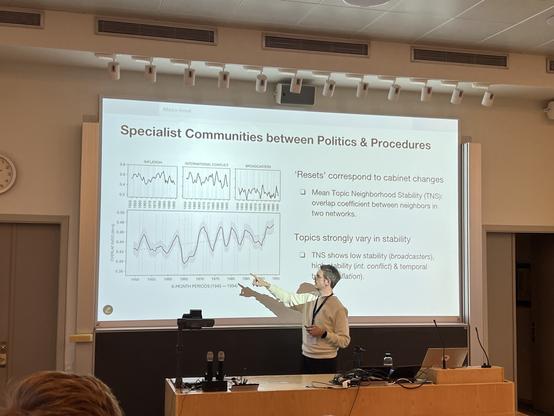
"With every cabinet change there was an epistemic reset" โ€” Melvin Wevers @melvinwevers and Ruben Ros @rubenros present their computational study of Post-World War II Dutch parliamentary debate, which involved network analysis, community detection, and topic modeling
Paper: https://ceur-ws.org/Vol-3834/paper39.pdf
#CHR2024

Awesome! The #CHR2025 edition will take place at #C2DH in #Luxembourg! That's a great place for this conference (and right around the corner from @tcdh at #Trier University).

"Small country, big ambitions."

#CHR2024

#CHR2024 is almost over... it was an awesome conference! Very high quality of the talks, great food, wonderful people!

(The only thing I have not been impressed with is that #CHR2024 is definitely, and sadly, NOT happening here on #Mastodon.)

Heard about so many models, tools and methods here at #CHR2024: Could I please have a few months off to try them all out on our various datasets?

Here's the link to the abstract and paper: https://2024.computational-humanities-research.org/papers/paper102/

And here's the link to an interactive showcase, where you can play around with the data: https://edabel.shinyapps.io/setlist-variety/

Of course, the data is there as well: https://github.com/edabel/setlist-variety

#CHR2024

Computational Humanities Research 2024

๐Ÿ’ฏ I honestly did not know what to expect from my last talk at #CHR2024, on some statistics regarding setlists of bands on their tours, but blown away by the actually really fascinating trends and patterns in the data: Which songs are played almost always, which ones only once, when looking at the shows in a tour. Different shapes for different bands at different times, and interesting patterns where cover songs are used: in the shelf (core repertoire) or the tail (singletons). Kudos to Ed Abel!

Now up at #CHR2024, a paper on historical "arrest patterns" in Brussels, by Folgert Karsdorp @folgertk, Mike Kestemont and Margo de Koster.

Abstract and link to full paper here: https://2024.computational-humanities-research.org/papers/paper13/

(Image is not about arrests, but first slide to illustrate diversity in a collection, which is their approach to the data.)

Computational Humanities Research 2024