 Sharon A. Hill
One of the most important aspects of a sound a scientific explanation is how well-supported it is. Specifically, we’d prefer to see an array of multiple lines of independently derived evidence that points towards a common conclusion. This gives us a theory with predictive power – evolution, plate tectonics are two classic examples in science and now global warming also has converging results from different fields of study. All solid scientific theories have a strong network of these lines of information. It is not just one person’s idea or one or two study results. Sound explanations are multi-directionally supported.
I am pleased to say that a recent special aired on British television regarding the Yeti did a fine job of using this concept of multiple lines of evidence to support a conclusion. The following has some spoilers although many of you already know – the legendary Yeti has biological origins from bears.
You should have seen me smiling when the show began with EXACTLY the right tone: Dr. Bryan Sykes, geneticist who is heading the DNA analysis portion of the project through Oxford University, is not looking for evidence for the Yeti. He is looking for ANSWERS.
My main beef with amateur researchers looking for Bigfoot, ghosts or UFOs is that they fail to understand the critical importance of the research question. They start off on the wrong foot – by looking for proof of what they want so desperately to be true. That first misstep hopelessly biases any investigation from the start. The question must be “What, if anything, is happening here?” See the difference? By changing the question, the narrow scope has now opened to include the best answer and helps prevent the potential for sham inquiry, which is how I characterize Melba Ketchum’s DNA project.
Host Mike Evans, a vet and a biologist, declares: “Bigfoot believers claim they have evidence to support its existence. The problem is, none of it has ever been properly substantiated.”
Finally! A documentary about a cryptid that focuses on the core problem with the field. Anecdotes by the thousands mean little when they are not supported with something more reliable. This show lays out a careful and refreshingly new path to reach answers about a mystery animal.
I’ll run down some of the bits from it. The show is in three parts, only the first part has aired as of this posting. It covers the Yeti in the Himalayas of Nepal and Tibet. Further episodes will examine the Sasquatch in North America and the Almasty in Russia.
This episode was hyped as having “spectacular” results and as “judgement day for the Yeti”. I’ve seen hyped episodes before so I was concerned this would be another show full of repeats and fillers. It wasn’t.
The Yeti legend was famous long before Bigfoot. Given the misnomer “abominable snowman”, the photo of a footprint, taken by Eric Shipton near Mt. Everest base in 1951, signaled the explosion of popular interest. The story of this print is examined. Evans interviews a local who lost some of his livestock to the Yeti. He calls the Yeti “an animal of God”. Yeti is part of the culture of the people in this region. Evans is mesmerized but the “monster” aspect is not stressed; the Yeti is part of nature.
Three samples of supposed Yeti hairs were analyzed by Sykes. He has taken on the most ambitious Bigfoot DNA project ever simply because, he says, he is curious. Sykes chastises cryptozoologists slightly by saying science does not reject this field. “Show me the evidence and I’ll examine it.” As of late, there are several big budget searches for Sasquatch. Therefore, there should be far fewer rants about how money, attention and science has been withheld from cryptid studies. Cryptozoologists must stop making excuses and put forth what they have. If it does not show a primate as Bigfoot is described, then this is solid reasoning to conclude that such an animal does NOT exists. But, back to the Yeti.
One sample was retrieved by a French biologist who collected fur from a preserved creature that had been shot in Ladakh. The body was said to resemble a cross between wolf and bear but was smaller than a man.
A second sample Sykes collected from a very unusual looking stuffed mount kept in Italy that was shot in Tibet by Nazi researchers. This body was new to me as I had never heard of it and it was remarkably strange. It was preserved poorly so much of the original features were lost or distorted.
A third sample of hair was collected in Bhutan from a tree lair. Therefore, the entire range of the Himalayan mountain habitat was covered, not just a small area – an important point.
The Yeti is known by many regional names such as Tengmo (Ladakh), and the Chemo in Tibet. Reinhold Messner, probably the world’s greatest climber, relates his encounter with a huge animal and the prints that it left behind. His prints matched well with the Shipton print. Evans further explored a hypothesis by conducting a test in Montana using a Grizzly bear to see if the prints were double prints (back paw overlaps front paw) from bear. Indeed, it matched well. Messner remarks that he is certain his encounter was with an unusual bear.
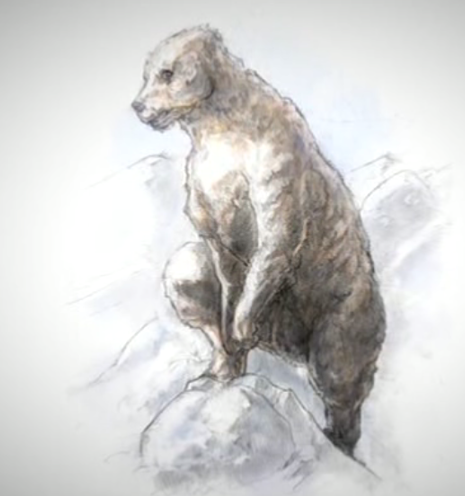
Rendition of unknown bear that may represent the YetiHimalayan brown bears can roam into the 18,000 ft elevation range where the Messner and Shipton events took place. All evidence so far was pointing towards the Yeti being a bear. A newly translated manuscript showing the “Chemo” described the Yeti as a variety of bear. But it was not a normal bear, say the residents. Not one of the three they are familiar with (brown, black and Sloth bears).
What would Sykes DNA tests show?
Sadly, no result were retrievable from the Nazi taxidermy bear – the DNA was not present, likely destroyed by chemicals during the preservation process.
But the big news was that the Ladakh and Bhutan samples MATCHED to a sample from an ancient polar bear from Svalbard, Norway that was in the genetic databases. Bear genetics are complex and there may be several interpretations of the result but it is clear that Yetis are linked to bear – potentially a hybrid brown-polar bear. These two bear types are already known to interbreed. Their hybridization may explain their different look and behavior from other bears.
Sykes spoke of how exhilarating it is to see these surprising results for the first time anywhere. That is why he became a scientists, he says. It’s GOOD solid data. It meshes with the other independent lines that all point to … bear.
Evans closes the show also very excited at what was found. No one has ever come close, he says, to a scientific explanation for the biological basis of the Yeti. Now, this finding will change the way we think about Yetis forever. And, most exciting, the animal people call the Yeti are likely still out there today.
What does this mean for cryptozoology? For hominology (study of unidentified primates like Sasquatch/Bigfoot/Yeti), it’s stunning but not in the way they wished. They did not get the primate result hoped for. It is still a significant, fascinating discover. And, this is also a textbook example of how personal experiences are a good start but mean little without being bolstered by solid objective results.
I was very impressed by this first episode of the Bigfoot Files and am so eager to see the next two episodes which I anticipate may have more surprises in store. I am also most anxious to see Sykes work published and reviewed by other experts to confirm or critique it, as must be done, and get the book he will produce about the study.
I am lucky to have obtained access to the show from those who knew my keen interest in seeing it as soon as possible. An edited version of the Bigfoot files will air on U.S. TV channel Nat Geo on November 17. Make sure you tune in.
After a week of arguing with a few commentators about how wrong I am in my views on science and skepticism as applied toward cryptozoology, I feel vindicated by the Sykes study so far. THIS is cryptozoology on the right track. Exactly what the more science-based cryptozoology enthusiasts have been saying: To get the science right, you have to cooperate and get it to the right people.
#BigfootFiles #BryanSykes #Yeti https://sharonahill.com/?p=1894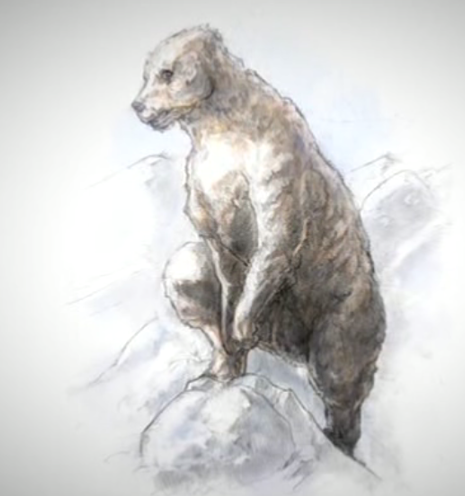
 Out of Context Podcast Quotes