We’re securing systems… but ignoring the fastest growing attack surface.

While studying IoT security, one thing became clear:

It’s not the big systems that worry me anymore.

It’s the small, always-on, barely monitored devices inside the same network.

Smart cameras. Sensors. Wearables. Controllers.

Individually harmless.

Collectively… a blind spot.

The problem isn’t one vulnerability

It’s this:
• Devices that are always trusted
• Minimal visibility into what they do
• Weak or inconsistent updates
• Constant background communication
• Growing faster than we can track

At scale, this creates something dangerous:

A network you don’t fully understand anymore

Why this matters

IoT devices are rarely the final target.

But they can become:
• Silent entry points
• Internal visibility nodes
• Pivot points between systems
• Long-term unnoticed presence

Not because they’re powerful —
but because they’re overlooked and trusted.

What I’m learning

IoT security is less about the device itself…
and more about:
• How it fits into the system
• What it communicates with
• What assumptions exist around it

Because risk doesn’t always come from complexity.

Sometimes it comes from what we stop paying attention to.

I wrote a deeper breakdown on this 👇

https://dev.to/blackcipher/the-iot-blind-spot-the-part-of-the-network-we-keep-ignoring-53eg

Curious to hear your thoughts —

#CyberSecurity #IoT #IoTSecurity #InfoSec #RedTeam #ThreatIntel #EmbeddedSecurity #BlackCipher

🚨 Most people think red teaming is about exploits.

It’s not.

The most effective attacks today don’t start with vulnerabilities —
they start with **trust**.

Modern environments are cloud-heavy, identity-driven, and full of SaaS integrations. In these systems, attackers don’t always need to “break in.”

They move quietly through:

• Over-permissioned identities
• Weak approval workflows
• Misconfigured cloud roles
• OAuth tokens and API access
• Human behavior under pressure
• Business processes no one questions

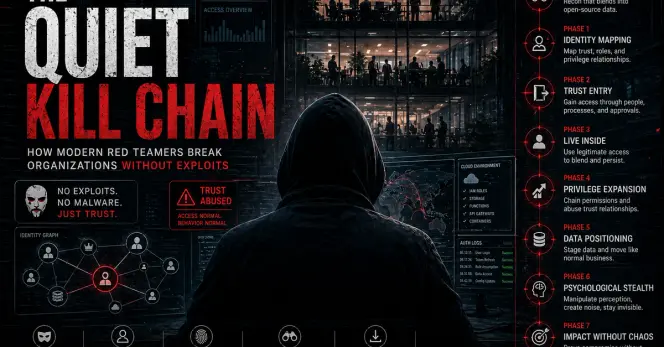
This is what I’ve been studying and calling the **Quiet Kill Chain** —
a sequence of legitimate-looking actions that, when chained together, become an attack path.

No loud exploits.
No obvious malware.
Just normal activity… used the wrong way.

## What changes at an advanced level?

You stop asking:
“What exploit should I use?”

And start asking:

• Where does this system trust too easily?
• Which action would look completely normal?
• What would defenders ignore?
• How can I blend into business operations?

Because the strongest intrusion today is not the one that is invisible.

It’s the one that looks **legitimate**.

## My takeaway

Offensive security is shifting from breaking systems
to understanding them deeply enough to move inside them unnoticed.

I’ve written a full deep-dive on this concept here 👇

🔗 https://dev.to/blackcipher/the-quiet-kill-chain-how-modern-red-teamers-break-organizations-without-exploits-1ell

Curious to hear your thoughts —
Is detection today ready for this level of subtlety?

#CyberSecurity #RedTeam #OffensiveSecurity #ThreatIntel #CloudSecurity #IdentitySecurity #EthicalHacking #BlackCipher

The Quiet Kill Chain: How Modern Red Teamers Break Organizations Without Exploits

Most people imagine offensive security as a chain of loud events: Scan → Exploit → Shell → Pivot →...

DEV Community