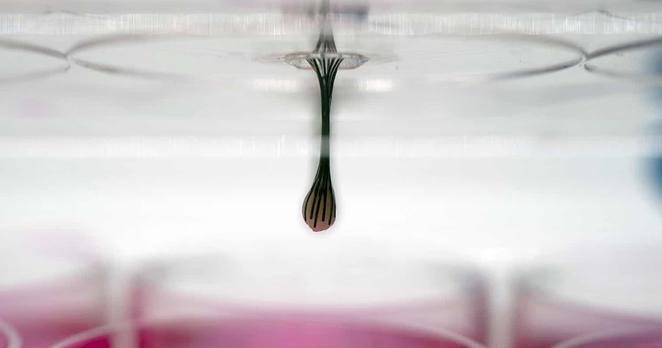
CAMEO (Conformal Array for Monitoring Electrophysiology of Organoids) is a low-cost, scalable sensor platform designed to monitor electrical activity within human cerebral organoids.
#NeurodevelopmentalBiology #ElectricalEngineering #BiomolecularEngineering #Biosensing #Nanotechnology #sflorghttps://www.sflorg.com/2026/04/bio04022601.html
New Sensors Lower the Cost of Studying Genetic Disorders
Previous sensor technologies were prohibitively expensive, forcing researchers to use fewer than 10 organoids per study and limiting the reliability
The light-powered biohybrid cardiac interface is an advanced polymeric device that utilizes light to electrically and mechanically control living heart tissue without the use of traditional metal electrodes.
#BiomolecularEngineering #MaterialsScience #Biomaterials #Cardiology #sflorghttps://www.sflorg.com/2026/03/beng03242601.html
Researchers engineer a light-powered biohybrid cardiac interface
Optoelectronic device may offer benefits in heart drug screening and disease modeling
A novel, environmentally sustainable biomanufacturing process that utilizes genetically engineered yeast to produce oxalic acid, which is subsequently used to extract and purify free rare-earth elements (REEs) from low-grade ore.
#SyntheticBiology #Chemistry #BiomolecularEngineering #MaterialsScience #Environmental #sflorghttps://www.sflorg.com/2026/03/beng03162601.html
Engineered yeast gives the U.S. a green edge in the critical minerals market
Biomanufacturing oxalic acid by engineering the low-pH-tolerant yeast Issatchenkia orientalis greatly simplifies the process