 Contemporary Classical - Thea Derks
Emilie Mayer defied 19th century mores with grand symphonies
As with many a composer, Emilie Mayer (1812-1883) was very successful during her lifetime, but was forgotten almost immediately after her death. The German historian Barbara Beuys is now restoring her to her former glory with the biography Emilie Mayer, Europas größte Komponistin (Emilie Mayer, Europe’s greatest female composer).
Mayer composed in all genres and left behind a large oeuvre, including eight highly praised symphonies, seven concert overtures and ten string quartets.
Yet in 1893 – only 12 years after her death – a German critic wrote about the premiere of a symphony by Luise Adolpha le Beau that ‘this is unique, we have never before heard a symphony by a lady’.
Beuys subtitled her biography somewhat provocatively ‘Europe’s greatest composer’. In an interview, she laconically states that some exaggeration is appropriate to draw attention to your subject.
Moreover, she stresses that Mayer was considered one of the most important composers of her time, and that critics started to emphasise her gender less and less.
Happy single
Those who listen to Mayer’s colourful symphonies – numbers 3 and 6 have just been recorded by the Philharmonisches Orchester Bremerhaven – and the beautiful songs on the also recently released CD This Be Her Verse by Golda Schultz and Jonathan Ware, will wholeheartedly support Beuys’ decision. Mayer has an enormous flair for orchestration and her setting of Goethe’s poem Erlkönig is at least as chilling as Schubert’s.
On the basis of the little source material available, Beuys tries to sketch Mayer’s personality. This paints a picture of a self-assured woman, who worked purposefully to realise her dreams and deliberately remained unmarried. Thus she was able to avoid the fate of her contemporaries Fanny Mendelssohn and Clara Schumann, who as composers always remained in the shadow of their brother and husband respectively.
Royal blessing
In 1850 Mayer even organised a concert in the Royal Theatre in Berlin, dedicated entirely to her own music and made available free of charge by Friedrich Wilhelm IV. – With foresight, she had earlier given his wife Elisabeth of Prussia a bread sculpture of her own making. The sovereign was so impressed that she awarded Mayer with a gold medal.
https://www.youtube.com/watch?v=EEubWpNjBkk&t=3s
In her ‘royal’ concert, Mayer presented chamber music as well as choral works, an overture and the premiere of her Third Symphony. This was performed by the renowned Euterpe Orchestra, led by Wilhelm Wieprecht, with whom she was studying orchestration at the time.
One critic speaks of ‘captivating phrases’ and ‘a confident command of the material’. The influential Ludwig Rellstab praises the way the themes ‘flow smoothly through the securely defined realm of tonal colours, often with surprising elegance’.
Mayer also persuaded her former teacher, Carl Loewe, to move from Stettin to Berlin, the city to which she had moved in 1840. This took place shortly after the suicide – the circumstances of which are unknown – of her father, who ran a pharmacy in the small town of Friedland and had wholeheartedly supported her talent.
Although Loewe was somewhat sceptical about female composers, he had immediately accepted Mayer as a composition student on the basis of her earlier work. Thanks to him, Mayer became a well-known figure in Stettin’s lively music scene, where also her first two symphonies were successfully premiered.
International fame
Gradually, her fame grew and her music was heard in such important cultural centres as Leipzig, Brussels, Vienna and Budapest. She negotiated the publication of her compositions courteously but firmly with the leading publisher Bote & Bock. But despite this glittering career, her fame faded soon after her death.
Beuys is a dedicated but somewhat verbose author, who provides a detailed biography of every person discussed. Even those whom Mayer probably did not know, such as the French composer Louise Farrenc. Moreover, Beuys – no doubt due to a lack of sources – makes quite a few assumptions, which are not always convincing.
Women independent until 18th century
The book gets off to a fascinating start. It comes as quite a shock when Beuys points out that women were independent until the 18th century, but were subsequently labelled as impotent beings by the Enlightenment philosopher J.J. Rousseau. But because the author keeps harping on about the fact that women were reduced to breeding machines, she eventually gets on one’s nerves: yeah, we know this by now!
The biographer’s devotion to her subject is sincere, however, and Emilie Mayer’s music deserves to be heard. Apparently Beuys’ appeal has not fallen on deaf ears, as shown by the increasing number of performances, the recent CD-releaes and the first edition being sold out soon after publication.
– As I wrote before: the female composer is definitely on the rise!
https://www.youtube.com/watch?v=DLxEmW9RFEU
#BarbaraBeuys #EmilieMayer #EuropasGrößteKomponistin #GoldaSchultz #LudwigRellstab #PhilharmonischesOrchesterBremerhaven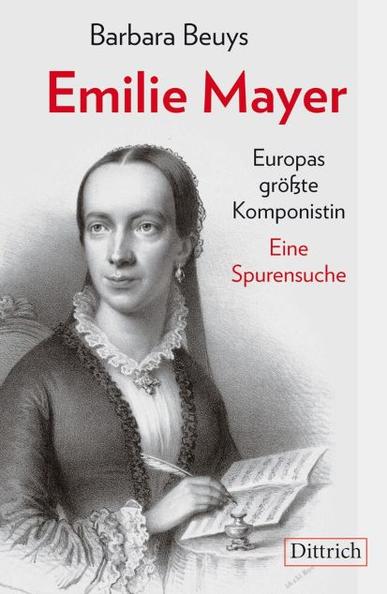
 aproitz