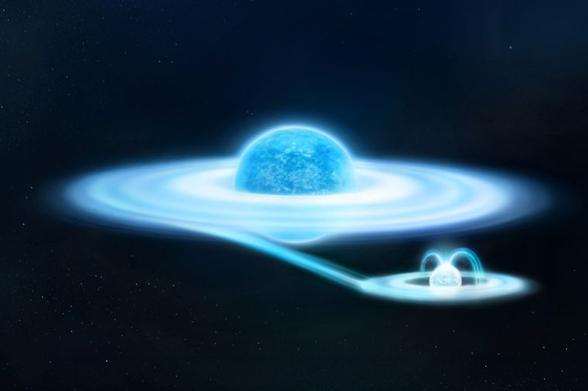
MeerKAT spotted the most distant luminous object ever seen—a powerful hydroxyl megamaser “space laser” beaming from billions of light-years away!
This amplified mega-beam offers a rare glimpse into the early universe and galaxy formation.
Read more: https://thedebrief.org/meerkat-telescope-spots-mega-powered-space-laser-beaming-across-the-cosmos-revealing-most-distant-luminous-object-known/

@goodnews

#GoodNews #SpaceLaser #MeerKAT #CosmicDiscovery #AstronomyWin

MeerKat Telescope Spots Mega-Powered “Space Laser” Beaming Across the Cosmos, Revealing Most Distant Luminous Object Known

Science, Tech and Defense for the Rebelliously Curious.

The Debrief

🌟🔭 Hubble spots cosmic ghost! A near-invisible galaxy, CDG-2, shines faint with just 1% stars—99% dark matter! This low-brightness oddity challenges formation theories, hinting at hidden universe secrets. A stellar mystery unveiled! Read more: https://phys.org/news/2026-02-hubble-invisible-galaxy-dark.html

@goodnews

#GoodNews #HubbleDiscovery #DarkMatterGalaxy #SpaceMystery #AstronomyWin

Hubble identifies a near-invisible galaxy that may be 99% dark matter

In the vast tapestry of the universe, most galaxies shine brightly across cosmic time and space. Yet a rare class of galaxies remains nearly invisible—low-surface-brightness galaxies dominated by dark matter and containing only a sparse scattering of faint stars.

Phys.org

🌟🔭 Hubble’s cosmic egg cracks open! Stunning new image of the Egg Nebula captures clearest view ever—a dying star’s dusty shell glowing in white & yellow, revealing evolution secrets. A stellar farewell 3,000 light-years away! Read more: https://thedebrief.org/stunning-hubble-image-of-the-egg-nebula-is-the-clearest-ever-captured/

@goodnews

#Goodnews #HubbleNebula #EggNebula #SpaceDiscovery #AstronomyWin

Stunning Hubble Image of the Egg Nebula is the Clearest Ever Captured

Science, Tech and Defense for the Rebelliously Curious.

The Debrief

🌟🔭 Hubble’s cosmic surprise! First-ever “RELHIC” spotted—a starless dark matter cloud bubbling with gas, a relic from the universe’s infancy defying galaxy formation rules. A new astronomical oddity unlocking early secrets! Read more: https://thedebrief.org/a-new-type-of-astronomical-object-hubble-telescope-confirms-first-detection-of-a-relic-unlike-anything-astronomers-have-seen/

@goodnews

#GoodNews #HubbleDiscovery #RELHIC #CosmicRelic #AstronomyWin

“A New Type of Astronomical Object”: Hubble Telescope Confirms First Detection of a “Relic” Unlike Anything Astronomers Have Seen

Science, Tech and Defense for the Rebelliously Curious.

The Debrief

🌌✨ Stellar surprise! The Pleiades (Seven Sisters) star cluster is 20x larger than we thought—thousands of hidden siblings uncovered via NASA’s TESS & ESA’s Gaia. A cosmic family reunion reshaping our view of the galaxy! Read more: https://www.discovermagazine.com/the-seven-sisters-star-cluster-is-20-times-larger-than-we-thought-48250

@goodnews

#GoodNews #Pleiades #StarCluster #SpaceDiscovery #AstronomyWin

The Seven Sisters Star Cluster Is 20 Times Larger Than We Thought

Learn how NASA’s TESS and ESA’s Gaia missions helped astronomers uncover thousands of hidden stars, revealing that the Pleiades are 20 times larger than previously believed.

Discover Magazine

🌌🔭 Cosmic breakthrough! Astronomers use an Earth-sized super-telescope & gravitational lensing to spot a “mystery dark object” 1B times the Sun’s mass—possibly dark matter or a dwarf galaxy! Read more: https://thedebrief.org/astronomers-use-earth-sized-super-telescope-to-spot-mystery-dark-object-too-faint-for-conventional-observatories-to-see/

#GoodNews #DarkMatter #SuperTelescope #SpaceDiscovery #AstronomyWin

Astronomers Use Earth-Sized 'Super-Telescope' to Spot “Mystery Dark Object” Too Faint for Conventional Observatories to See

Science, Tech and Defense for the Rebelliously Curious.

The Debrief

"Just discovered a new galaxy, Centaurus A! Looks like the stars are really pulling an all-nighter out there. Hope they don’t mind the name change—how about 'Dunlop’s Getaway'? #AstronomyWin #StarRenaming"
— James Dunlop

Apr 29, 1826 - The galaxy Centaurus A or NGC 5128 is discovered by James Dunlop.
https://en.wikipedia.org/wiki/Centaurus_A

Centaurus A - Wikipedia