Intriguing ancient aesthetic!
#ClevelandMuseumofArt's Textile Fragments tie to an era long vanished, yet echo in every thread of today's culture. Is fashion a timeless art form?
#FashionHistory #ArtLovers #AskTwitterhttps://clevelandart.org/art/2007.2
Textile Fragments | Cleveland Museum of Art
These fragments are rare survivors of catastrophic rains that destroyed much of the Moche textile legacy and may have helped to bring about the decline of Moche culture. Each depicts a serpent and a snail beneath a hovering raptorial bird—perhaps a snail kite, a type of hawk named after its favored food. The size of the motifs implies that the original textile was large; a mantle (a shawl-like garment) or a hanging are among the possibilities.
Mesmerized by the seasonal whispers in Spring Mist over Jiangnan
#ClevelandMuseumofArt. The artwork evokes serenity, reflecting the delicate balance of nature. What's your first emotion after seeing this?
#ArtLover #AskTwitterhttps://clevelandart.org/art/1954.126
Spring Mist over Jiangnan | Cleveland Museum of Art
Immerse in the opulence of 18th century French dining with this striking 'Bottle Cooler' #ClevelandMuseumofArt. Dual use piece - emblem of status & practicality. Can modern art rival this subtle grandeur?
#ArtAppreciation #FrenchArt #AskTwitter
https://clevelandart.org/art/1944.226.1

Bottle Cooler | Cleveland Museum of Art
The form of these cachepots is entirely typical of Saint-Cloud porcelain of about 1725. Their decoration, based upon Chinese porcelains of the so-called "famille-verte" type, is most unusual. Polychromed enamels were not often employed on Saint-Cloud porcelains, and figural scenes are very rare.
Exploring Daumier's 1839 piece
#Rijksmuseum: 'Echtpaar met kinderen in de regen.' A captivating depiction of family life amid adversity. But what emotions does it awaken in you?
#Art #AskTwitter #Rijksmuseum #Daumierhttps://www.rijksmuseum.nl/nl/collectie/RP-P-1945-56
Echtpaar met kinderen in de regen, Honoré Daumier, 1839 - Rijksmuseum
Exploring Alexander Ver Huell's 'Fabrieksmeisjes in een regenbui' at
#Rijksmuseum - a poignant depiction of 19th century factory girls mid-storm. What's your interpretation?
#ArtExploration #19thCenturyArt #AskTwitterhttps://www.rijksmuseum.nl/nl/collectie/BI-1924-384-3-2
Fabrieksmeisjes in een regenbui, Alexander Ver Huell, ca. 1854 - ca. 1887 - Rijksmuseum
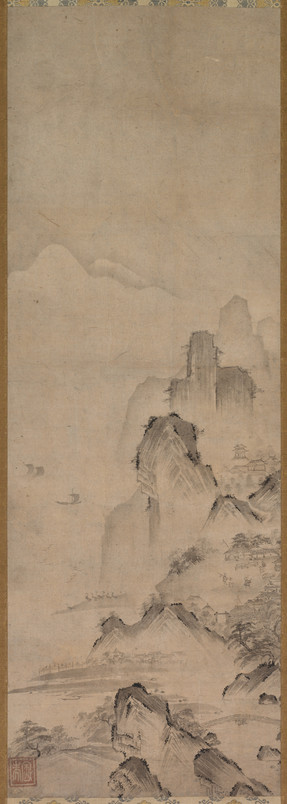
Dived into the soothing blues and greens of 'Landscape' at
#ClevelandMuseumofArt! The tranquility it emanates is truly surreal. What does it inspire in you?
#ArtInspires #AskTwitterhttps://clevelandart.org/art/2015.470
Landscape | Cleveland Museum of Art
This composition includes imagery from the Eight Views of the Xiao and Xiang Rivers. Scanning the composition from top to bottom, at least six of the views are discernible: night rain over Xiao and Xiang, evening bell from a mist-shrouded temple, returning sails off a distant shore, geese descending to a sandbar, mountain village in clearing mist, and sunset glow over a fishing village. Inside the painting’s box is a document with a long inscription by prominent calligrapher, collector, and connoisseur Maeda Kōsetsu (1841–1916) discussing the painting’s subject and the matter of the painter’s biography—he appears to have been a Kano school artist, but his precise identity is unclear.
Experience serene tranquility with 'Figure Mooring a Boat' at
#ClevelandMuseumofArt. A testament to the artist's love for minimalistic elegance. You can almost smell the sea breeze. How would you interpret this piece?
#ArtLovers #AskTwitterhttps://clevelandart.org/art/2015.474
Figure Mooring a Boat | Cleveland Museum of Art
Kannan is a little-known painter of the Kanto region. Close inspection of this quiet scene suggests that it represents the “night rain over Xiao and Xiang” scene from the Eight Views of the Xiao and Xiang Rivers. The style of the painting is similar to some works from Korea; as Japanese and Korean monk-painters traveled back and forth between one another’s monastic communities during the 1400s and 1500s, Kannan surely had the opportunity to consider incorporating Korean stylistic features into his work.
Exploring the fluid strokes and muted hues in 'Rain'
#ClevelandMuseumofArt, one feels a quiet resonance with nature's melancholy moods. Do you feel the same thrill when rain meets art or only in reality?
#ArtFeed #AskTwitterhttps://clevelandart.org/art/1928.217
Rain | Cleveland Museum of Art
Submerged in the stirring atmosphere of "Buiig Weer," Frederika Henriëtte Broeksmit's 1885 masterpiece in
#Rijksmuseum. What emotions does this dramatic landscape evoke for you?
#ArtLovers #InteractiveArt #AskTwitterhttps://www.rijksmuseum.nl/nl/collectie/RP-P-1931-441
Buiig weer, Frederika Henriëtte Broeksmit, 1885 - 1931 - Rijksmuseum
Discover the tranquility and magic captured in 'Branch Hill Pond, Hampstead' at #ClevelandMuseumofArt. The strokes whisper tales of solitude. 🖼 💭 #ArtChat #FindYourselfInArt. What emotions stir within you while admiring this piece?
#AskTwitter #ArtEnthusiasts
https://clevelandart.org/art/1972.48

Branch Hill Pond, Hampstead | Cleveland Museum of Art
<br>An amateur meteorologist, John Constable was most at home painting meticulously observed cloud formations, weather conditions, and natural light effects. He believed an accurate rendering of these constantly shifting elements could convey his vision of the vitality and magnificence of the English countryside. Working from the summerhouse he rented at Hampstead from 1819–26, Constable painted a landscape focusing more on the dark rain clouds than on the laborers in the foreground, keeping the details of their backbreaking work at a picturesque distance.
 Hidden Gems