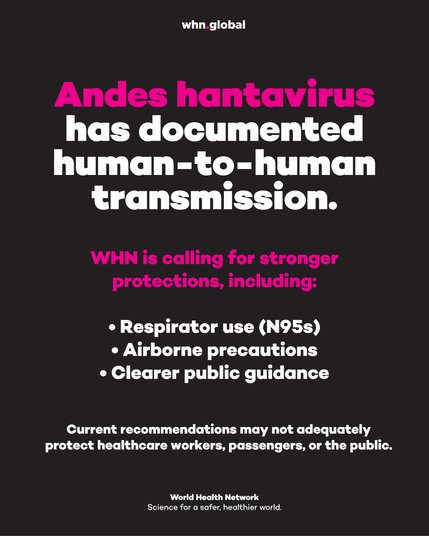

With documented person-to-person transmission, uncertain infectious timing, and long incubation periods, the World Health Network is calling for stronger airborne precautions, including universal respirator use and clearer public communication around airborne risk.

Read the full piece here: https://whn.global/scientific/hantavirus-outbreak-highlights-need-for-effective-response/

#AndesHantavirus #Hantavirus #PublicHealth #Respirators #CleanAir #AirborneProtection

Andes Hantavirus Outbreak Highlights Need for Effective Response and International Coordination - WHN

Starting in early May 2026, reports emerged of an outbreak of Andes hantavirus (Andes virus, ANDV) associated with the cruise ship MV Hondius. As of May 12, 2026, at least eleven cases and three deaths have been associated with the outbreak, including three additional passengers who tested positive after repatriation to France, Spain, and the … Continued

WHN

The article also examines:
• Rising case numbers and mortality trends
• The historical Epuyén superspreader outbreak
• The MV Hondius cruise ship outbreak
• Why experts are concerned about spread through modern travel networks

Read the full article here: https://whn.global/newsletter/the-current-andes-hantavirus-situation-in-argentina-may-2026/

#Hantavirus #AndesHantavirus #PublicHealth #MVHondius #GlobalHealth #InfectionPrevention

The Current Andes Hantavirus Situation in Argentina (May 2026) - WHN

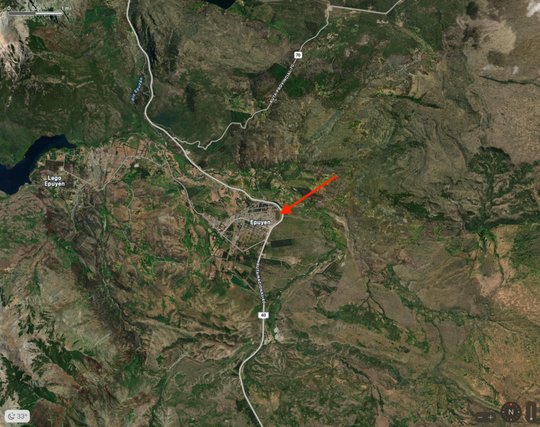
May 14, 2026 Authors: Ifrah Ahmad, Yaneer Bar-Yam Figure: The well-studied 2018–2019 Andes hantavirus outbreak in Epuyén, Argentina [7] resulted in 34 cases and 11 deaths associated with superspreader events in a town of only 1,749 people located in the rural Andes mountain foothills (red arrows). Recent spread of Andes virus cases into Buenos Aires … Continued

WHN
Canada confirmed an Andes hantavirus case linked to the MV Hondius cruise ship outbreak. Officials said public risk remains low as monitoring continues. https://english.mathrubhumi.com/news/world/canada-andes-hantavirus-case-mv-hondius-cruise-ship-outbreak-bnmgxbwn?utm_source=dlvr.it&utm_medium=mastodon #AndesHantavirus #MVHondius #Canada #Hantavirus #CruiseShip
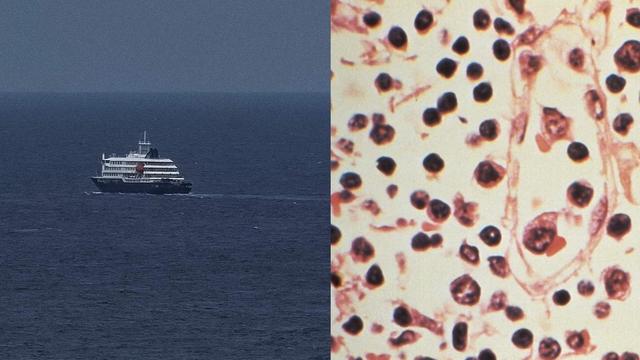

Because the outbreak investigation is ongoing and publicly available information remains incomplete and rapidly evolving, some details may later change as additional reporting and updates emerge.

Corrections or additional sourced information may be sent to [email protected].

#Hantavirus #AndesHantavirus #PublicHealth

The andes hantavirus outbreak is raising urgent new public health questions, and in this WHN Town Hall, experts discuss what’s currently known, where guidance is falling short, and why airborne precautions matter.

This conversation features critical discussion around respirators, transmission risks, and the global response as the situation continues to evolve.

Watch the full live recording now: https://www.youtube.com/watch?v=MjUTieBRDO4

#Hantavirus #AndesHantavirus #PublicHealth #InfectionPrevention

Andes Hantavirus Outbreak Town Hall with Barry Hunt and Eric Feigl-Ding

YouTube

#HantaVirus #AndesHantaVirus #WHO

Good opinion piece in the BMJ: "Hantavirus outbreak should reset WHO’s default approach to airborne risk"

"Therefore, WHO should change its default response. For pathogens with documented person-to-person spread and severe outcomes, the initial assumption should be airborne risk unless and until evidence supports easing back. The burden of proof should not be on those arguing for caution. It should be on those arguing to relax it."

https://www.bmj.com/content/393/bmj.s919

Hantavirus outbreak should reset WHO’s default approach to airborne risk

The multinational outbreak of Andes hantavirus (ANDV) linked to cruise ship travel should prompt the World Health Organization (WHO) to change its default response to the risk of airborne transmission of the virus. Hantavirus is a pathogen with documented person-to-person transmission and high case fatality. Therefore, the starting point should not be to downplay the risk of airborne transmission until it is definitively proven. The starting point should be the immediate adoption of precautionary measures to reduce airborne transmission, such as respirator use by healthcare workers, cases, and close contacts; ventilation optimisation; avoidance of unfiltered air recirculation; and portable HEPA (high efficiency particulate air) filtration in all enclosed quarantine and transport settings. On 8 May 2026, WHO issued several documents that point in different directions. A Disease Outbreak News report acknowledged possible person-to-person transmission, but largely framed precautions around droplet and contact transmission outside aerosol generating procedures.1 By contrast, WHO’s guidance for managing contacts of Andes virus cases and disembarkation from the cruise ship adopted much more precautionary measures, including quarantine, universal respirator use during disembarkation, respirators for healthcare workers …

The BMJ
I am not a #conspiracy theorist BUT, the timing of the #Hanta virus is "interesting". the geographical distribution of "tourists" going back to their countries combined with the lack of #quarantine requirements is "interesting". if I would invent a theory, I'd say "someone" is planning a #covid like lockdown soon because of #AndesHantaVirus in order to mask the fallout of #StraitOfHormuz #fuel #shortages. business claim #ForceMajeure to avoid collapsing #global #economy
https://archive.is/TSrMs

Andes hantavirus has documented human-to-human transmission, yet current WHO guidance still does not recommend airborne precautions or respirator use (such as N95s).

WHN has issued an open letter urging stronger protections for healthcare workers, passengers, and the public, including clearer guidance on airborne risk, respirator use, and prevention measures.

Read the full open letter: https://whn.global/open-letter-to-who-hantavirus-outbreak/

#Hantavirus #AndesHantavirus #PublicHealth #InfectionPrevention