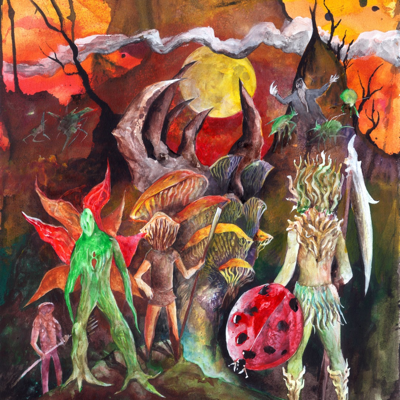
No wonder they were demonized in #Homer's #Odyssey! (See related posts...)

The Power of Women in Minoan Civilization

by Alexios Zorbas, May 23, 2023

Excerpt: "The Minoan civilization, flourishing on the island of Crete from approximately 2700 to 1450 BCE, stands out in ancient history for its progressive social structure and remarkable gender equality. Unlike the predominantly #patriarchal societies of the ancient Mediterranean world, Minoan society was a beacon of #egalitarianism particularly concerning women’s liberties.

Women in Minoan society held a significant position, relishing a degree of independence and freedom that was extraordinary during that era.

"Their roles extended beyond domestic confines, as they actively engaged in various facets of public life. They were seen in religious ceremonies, political discussions, and economic activities, showcasing their versatility and contributing to the societal fabric of Minoan civilization.

"Furthermore, women were not silent spectators in politics; they actively participated in political affairs, serving in roles such as advisors, administrators, and even rulers. Their influence was also evident in foreign affairs, as they took part in diplomatic missions and negotiations.

"Economically, Minoan women demonstrated their prowess by engaging in a wide array of activities that contributed to the prosperity of the Minoan civilization. They participated in agriculture, trade, and craftsmanship, managing their own businesses and properties, further proving their autonomy.

"Moreover, Minoan women enjoyed legal rights and protections that were exceptional in the ancient world. They had the right to own property, inherit wealth, and independently engage in legal contracts. This level of legal autonomy was indeed extraordinary for the period, emphasizing the advanced nature of Minoan society."

Read more:
https://knossos-palace.gr/2023/05/23/power-of-woman/

#Matriarchy #AncientWomen #AncientCrete #Histodons #BronzeAgeCollapse #AncientHistory #WomensRights #MinoanWomen

The Power of Women in Minoan Civilization - Knossos Palace

Power Facts about the less well-known is the prominent place of women in Minoan society and religion.

Knossos Palace

#Matriarchy May Have Prevailed in #Minoan Civilization

By Maria Rybachuk, November 13, 2023

Excerpt: "The Minoan civilization, among the earliest and most advanced societies in the #BronzeAge, excelled in art, trade, and the prominent role of women.

"Women in ancient Greece were markedly disadvantaged in terms of rights, often confined to domestic and reproductive spheres. However, there were some exceptions such as ancient #Sparta. This city-state presented a fascinating departure from #patriarchal norm, showcasing women who were robust, independent, and well-educated.

"A more enigmatic occurrence involves the portrayal of women on Bronze Age #Crete. Several scholars concur that women held a notably dominant position compared to men. Thus, John Younger, professor of classics at the University of Kansas, noted that 'this culture on Crete around 1600-1500 BCE is the closest candidate for a matriarchy.' "

https://greekreporter.com/2023/11/13/minoan-civilization-matriarchy/

#AncientWomen #AncientCrete #Histodons #BronzeAgeCollapse #AncientHistory #WomensRights #MinoanWomen

Matriarchy May Have Prevailed in Minoan Civilization - GreekReporter.com

Matriarchy may have prevailed in Minoan civilization, the earliest and most advanced in the Bronze Age, located in Crete, Greece

GreekReporter.com

As an author and artist, I'm a small business trying to be seen and heard in the loud and crowded marketplace. Each week, I share one of my creations - maybe one of them will ring your chimes. Up this week: The Last Priestess of Malia, a historical novel set in ancient Crete.

#book #books #bookstodon #HistoricalFiction #QueerFiction #Minoan #AncientCrete #pagan

SPACESEER - ‘SHORES OF CRETE’
.
.
.
.
.
.
.
.
.
🏺Realm of Antiquity🏺
April 5, 2024
.
..
.
.
.
.
.
.
.
#dungeonsynth #ambient #darkambient #ancienthistory #ancientcrete #europa #zeus #crete #bandcamp #bandcampfriday #greekmythology
・・・

#Minoan #Crete: The #WomenRulers

27/07/2021

In Minoan times, women had critical roles in society, holding positions of great power.

John G. Younger, Professor of Classics at The University of Kansas, is one of the several scholars who recognize the importance of the Minoan women in ancient Crete:

“Basically, this culture on Crete around 1600-1500 BCE is the closest candidate for a matriarchy that we have. That’s huge,” he noted. “In this culture, at this time, we have an awful lot of representations of what are obviously powerful women, single-seated women flanked by a bunch of guys.”

Younger studied Minoan artifacts unearthed on Crete to discover that women were usually portrayed in elaborate clothing on pottery and frescoes, while men wore significantly fewer garments (a loincloth and some accessories). They were also seated, signifying a position of power:

“In this culture, at this time, we have an awful lot of representations of what are obviously powerful women, single seated women flanked by a bunch of guys,” Younger said. “We don’t have a single representation of a seated man.”

Barbara A. Olsen, Associate Professor of Greek and Roman Studies at the Vassar College in New York and author of “Women in Mycenaean Greece: The Linear B Tablets from Pylos and Knossos,” suggests that Minoan women had more critical roles than child rearing:

“We see in Minoan iconography images of women in more public contexts: occupying prominent spacial positions in outdoor assemblies and processions, interacting with each other either in conversations or in dance, and acting in religious contexts either as individual worshipers or as officials involved in sacrificial rituals. Above all, emphasis is on the social rather than the biological, the public rather than the domestic.”

Among the iconographic representations of women from the Minoan era, two stand out: the Snake Goddess and the Ladies in Blue.

The Snake Goddess

Sir Arthur Evans unearthed two faience figurines representing the Snake Goddess and possibly a Snake Priestess during the Knossos Palace in 1903. They date from the Neopalatial period of the Minoan civilization (circa 1750-1490 BC). The snake probably had a protective role during that time, symbolizing the household’s welfare and rebirth or the renewal of life (as the snake sheds its skin periodically, it was probably believed to be an immortal being). The Snake Goddess was also identified as a Household Goddess. Worshipers of the goddess most likely used the two faience figurines in rituals.

“Besides the ritual function, they are among the best examples of Minoan art with its dominant features — naturalism and grace. They are presented as the ladies of the palace court, dressed in typical Minoan clothes, with a long skirt (flounced, or with an apron) and a tight open bodice,” writes Dr. Alena Trckova-Flamee.

The garments worn by the Snake Goddess appear in other visual representations of Minoan women from that era.
Ladies in Blue

The Ladies in Blue are three portraits on a fresco discovered at the Palace of Knossos by Sir Arthur Evans and recreated by him to give an idea of how Minoan royalty probably dressed before the extinction of this mysterious civilization. The three ladies of the court wear lavish garments, jewelry, and elaborate hairstyles. The fresco is currently on display at the Heraklion Archaeological Museum.

“Despite its fragmentary condition, the wall painting transmits the sense of opulence and prosperity of the royal court while reflecting the coquetry of the ladies, who gesture displaying the richness of their jewelry,” the official site of the museum notes.

These are just some examples in art showing the importance women had in the Minoan civilization. Women ruled the land and the household, while men were fearless seafarers.

https://blog.thesyntopiahotel.gr/minoan-crete-the-women-rulers/

#Knossos #Matriarchy #AncientCrete #WomensRights #WomensStatus #History #Histodon

Minoan Crete: The Women Rulers - The Syntopia Blog

In Minoan times, women had critical roles in society, holding positions of great power. John G. Younger, Professor of Classics at The University of Kansas, is one of the several scholars who recognize the importance of the Minoan women in ancient Crete: “Basically, this culture on Crete around 1600-1500 BCE is the closest candidate for…

The Syntopia Blog

So, written historical accounts are often written with an agenda in mind. If you want to know how people really lived, a good place to look is their household objects, art and religious artifacts.

Art, religious artifacts support idea of #Minoan #matriarchy on ancient #Crete, researcher says

Tue, 06/13/2017, University of Kansas

Popular culture for several decades has focused on the ancient Minoan culture on Crete as a matriarchy, despite skepticism from the academic world.

A University of Kansas researcher, however, in a recent publication has analyzed several pieces of archaeological evidence and art from the island and how they might support the idea that Minoan women ruled the ancient civilization.

"Basically, this culture on Crete around 1600-1500 BCE is the closest candidate for a matriarchy that we have. That's huge," said John Younger, KU professor of classics.

Younger, who has studied the Minoan culture for decades, said women figured prominently in art and religious artifacts and therefore probably in the administration of the Bronze Age civilization as well.

For example, women are always clothed, while males may be nude, and paintings depict women in elaborate court-style dress.

"In this culture, at this time, we have an awful lot of representations of what are obviously powerful women, single seated women flanked by a bunch of guys," he said. "We don't have a single representation of a seated man."

Almost all information about Minoan women comes from art, such as figurines, seal stones and finger rings, pottery and fresco. His article "Minoan Women" appeared recently in the volume "Women Antiquity, Real Women across the Ancient World." The book summarizes 40 to 50 separate pieces of evidence.

"It's one day in the life of a Minoan woman," Younger said.

Women participated in activities that contemporary cultures often depicted for men, like bearing weapons as hunters and the use of swords and bows.

One main piece of archaeological evidence he uses to argue for a Minoan matriarchal culture is the presence of large pits that appear to be shrines, called "lustral basins," in the middle of their palaces or large halls. Their makeup seems to match what anthropologists often call a "menstrual pit."

However, in most ancient cultures, such pits are removed from the town village or often put away into a special house, indicating women were often ostracized until their menstruation period ended.

"They're not putting them off into some house on the outskirts of the village," Younger said.

A wall painting above one of these lustral basins also shows a girl turning toward a shrine dripping in blood, he said, inducing the cultural significance of those pits.

Researchers have long struggled to definitively put together what actually happened in the Minoan culture on Crete for several reasons, including a lack of texts written in a language that we can understand.

"We have texts, but we can't read them," Younger said. "The height of this culture lasted 150 years maximum, and then about 1500 BCE, there was destruction all across the island."

The Mycenaean culture of the mainland eventually conquered the Minoan culture on the island, but Younger is researching another theory that the matriarchal Minoan society experienced a revolt either before or in anticipation of the Mycenaean takeover.

Because basically every site, including farms and houses, on the island except for the palace itself at Knossos was destroyed, he speculates it was the work of a revolution or people destroying their own property as a revolt against the matriarchal system.

"Some of these were huge buildings, about the size of Wescoe Hall (at KU), and an army would have to know where every site on the island is," Younger said. "Further, an invading army likely wouldn't have time to destroy everything like that."

He said art depictions of the Minoan society also show the women wearing saffron colored clothing, which is derived from autumn crocus flower. Saffron is also a source of vitamin A, and in paintings women have the blue streaks in their eyes while the men's eyes have red streaks, possibly indicating they were deprived of vitamin A. Possibly this could have made the men angry and driven them to revolt, Younger said.

As a matriarchal culture, it would make the Minoans unique, especially in the respect of the women being shown in important positions.

"It gives us a glimpse of what could be different," said Younger, who is also KU's Director of Jewish Studies. "Back in the 1970s when feminism was beginning to take hold, a lot of feminist scholars looked to the ancient Greek culture and its powerful women in plays and media. Many of us began to realize that on the island of Crete, we have something different than we've ever seen. In the respect of the women being shown in important positions, that's unique."

https://news.ku.edu/2017/06/09/art-religious-artifacts-support-idea-minoan-matriarchy-ancient-crete-researcher-says

#AncientCrete #WomensRights #AncientHistory #Histodon #WomenInTheAncientWorld

Art, religious artifacts support idea of Minoan matriarchy on ancient Crete, researcher says

The latest news and information for the University of Kansas.

KU News