Quote of the day, 3 October: The last days of St. Teresa

The last days of Saint Teresa

As told by Blessed Anne of St. Bartholomew

The day after our arrival at Alba [i.e. 21 September 1582], she was so greatly exhausted that the physicians feared, for the moment, that she could not live: a great sacrifice for me, the greater because I must remain in this world.

For, aside from the love I bore her and that she had for me, I had another great consolation in her company: almost continually I saw Jesus Christ in her soul and the manner in which He was united to it, as if it was his heaven. This knowledge filled me with the deep reverence one should feel in the presence of God.

Truly it was heavenly to serve her, and the greatest torture was to see her suffer.

Blessed Anne of St. Bartholomew writes about the final illness of St. Teresa: “Truly it was heavenly to serve her, and the greatest torture was to see her suffer.”

I fell sick with a fever the very eve of the day when she was to leave for the visitation of her monasteries. I was not at all in a condition to undertake the journey.

She said to me: “Do not be disturbed, my child! I shall leave orders here to send you to me as soon as the fever leaves you.”

But at midnight, when she sent a religious to ask how I was, I found that I was free from fever.

She rose from her bed, came to me, and said: “It is true, my daughter, you no longer have any fever; we can easily undertake the journey. I hope it may be so, and I will recommend the matter to God.”

And so it was; we left in the morning.

During the five days preceding her death at Alba, I was more dead than alive. Two days before her death, she said to me once when we were alone: “My child, the hour of my death has come.”

Blessed Anne of St. Bartholomew remembers the death of St. Teresa: Two days before her death, she said to me once when we were alone, “My child, the hour of my death has come.”

This pierced my heart more and more. I did not leave her for a moment. I begged the religious to bring me what was necessary for her. I gave it to her. It was a consolation to her for me to do so.

Blessed Anne of St. Bartholomew

Chapter X, Last Moments of Saint Teresa

Portrait of Blessed Anne of Saint Bartholomew by France de Wilde (1917). Image credit: Wikimedia Commons (Public domain)

In their translation for ICS Publications, Father Kieran Kavanagh and Otilio Rodriguez note that Fray Antonio de Jesús ordered St. Teresa to travel from Medina to Alba de Tormes to settle difficulties in the community. She and Blessed Anne of St. Bartholomew arrived the evening of 20 September.

Biographer William Thomas Walsh offers further detail. The journey was exhausting with little food. Upon arrival, the prioress was so alarmed by Teresa’s condition that she ordered her own foundress to bed. Teresa obeyed.

Walsh continues: “Next morning she got up, walked about the convent, heard Mass, received Holy Communion with great devotion, and took a severe discipline. Thus she went on, getting up and resting in turn, attending Mass each day, until the Feast of Saint Michael, September 29. Then, after Mass, she had a hemorrhage which left her so weak that she had to be helped back into bed in the infirmary. She had asked to be placed there so that she could look through a certain window and see the priest saying Mass in the chapel beyond.”

Teresa spent the first night of October in prayer, and at dawn asked to have Fray Antonio of Jesus hear her confession.

On October 3, the eve of Saint Francis, at about five o’clock, she asked for Viaticum. The nuns dressed her in veil and white choir mantle and lighted tapers in the infirmary. While they waited for the priest, Teresa spoke:

“Hijas mías y señoras mías, for the love of God I beg that you will take great care with the keeping of the Rule and Constitutions, and pay no attention to the bad example that this wicked nun has given you, and pardon me for it.”

When the priest arrived with the Blessed Sacrament, she raised herself without help. Her face became beautiful and illuminated, much younger than her age. Ribera writes that “clasping her hands, full of joy, this swan of utter whiteness began to sing at the end of her life more sweetly than they had ever heard her sing and spoke lofty things, amorous and sweet.”

She said: “Oh my Lord and my Spouse, now the desired hour is come. Now it is time for us to go. Señor mío, now is the time to set forth, may it be very soon, and may Your most holy will be accomplished! Now the hour has come for me to leave this exile, and my soul rejoices at one with you for what I have so desired!”

Anne of St. Bartholomew, M; Bouix, M 1917,  Autobiography of the Blessed Mother Anne of Saint Bartholomew, inseparable companion of Saint Teresa, and foundress of the Carmels of Pontoise, Tours and Antwerptranslated from the French by Michael, M A, H. S. Collins Printing Co., Saint Louis.

Thomas Walsh. W 1987, St Teresa of Avila: A Biography, TAN Books, Charlotte.

Featured image: Giovanni Segala, The Death of St. Teresa of Avila, 1696, oil on canvas, Church of San Pietro in Oliveto, Brescia, Italy. One of six lunettes on Teresian themes, restored for the fifth centenary of St. Teresa’s birth in 2015. Photo by Renáta Sedmáková © Adobe Stock.

#AlbaDeTormes #biography #BlessedAnneOfStBartholomew #deathAndDying #StTeresaOfAvila

La Basílica de Santa Teresa, en Alba de Tormes (Salamanca) comenzó a construirse en 1898 y continua inconclusa.
Por diversos motivos se han ido interrumpiendo las obras, siendo en 2010 la última interrupción.
#AlbaDeTormes #salamanca #CyL #castillayleon #castillayleonturismo #basílica #iglesia #SantaTeresa

Our Discalced Carmelite nuns in Puzol (Valencia), Spain have provided a summary of the initial conclusions of medical researchers during their on-site examination of Saint Teresa’s incorrupt remains. We present our translation and a link to the original article on their blog, “Teresa, de la rueca a la pluma.”

On August 30th, the first phase of the study of the remains of St. Teresa of Avila was completed in Alba de Tormes, which has already provided initial evidence about the saint’s health in the last years of her life.

“The medical team has concluded, after this initial on-site analysis, that Teresa had a very fragile physical constitution. For at least the last few years, her posture was severely affected by kyphosis, causing her to walk with a pronounced stoop,” reported Fr. Marco Chiesa, OCD, Postulator General of the Discalced Carmelite Order.

Fr. Marco pointed out that kyphosis resulted in an exaggerated forward curvature of St. Teresa’s upper back. Kyphosis is usually due to the weakness of the bones of the spine, which causes them to fracture and compress, although the medical team has indicated that St. Teresa did not suffer from osteoporosis.

“The deformation of the vertebrae of the spine forced Teresa to breathe with difficulty, at least in the last years of her life,” concluded Father Marco Chiesa. From a medical point of view, in this initial analysis, it was found that the Saint suffered from rheumatism and osteoarthritis in the left knee.

Similarly, the Discalced Carmelite Postulator General explained that Teresa of Avila suffered from plantar fasciitis in the last years of her life. “The doctors indicate that this injury must have caused her a lot of pain when walking,” said Father Chiesa.

For his part, Father Miguel Ángel González, OCD, the prior of Alba de Tormes, said that according to this initial examination, she used both her right and left hands with equal precision, which raises the possibility that she could have been ambidextrous. Until now, it was known (St. Teresa wrote about it) that on December 24, 1577, she broke her left arm in Saint Joseph’s monastery in Avila and that in May 1578, a healer from Medina del Campo reset it.

Father Miguel Ángel explained:

“This preliminary analysis indicates that there was no fracture in the left arm. There was a dislocation, especially in the wrist. When the healer from Medina del Campo was able to help her after several months, she and an assistant pulled the arm and dislocated the shoulder. In other words, the cure was worse than the disease. That arm remained quite useless for the last five years of her life.”

This issue of the arm is very well documented in the writings of St. Teresa herself and in the testimonies for her beatification.

“God was pleased that it wasn’t my right arm that suffered the damage, and so I can write this” (Letter 235, March 1578). She also wrote to Father Gracián about her visit to the healer in Medina del Campo: “I had lost the use of my wrist, for it has been a long time since I fell. So the pain and toil were terrible […]. I can move the hand well and lift the arm as far as my head” (Letter 244, 7 May 1578).

The medical team working in Alba de Tormes indicates that before the accident in 1577, the Saint used her left hand a lot and without difficulty. The reports presented by the doctors will help to clarify if she was ambidextrous.

Closure of the Sepulcher

After the conclusion of this first phase, the silver casket was closed with its four corresponding keys. Following the closure, the casket with the body of the saint was transferred to the upper chapel of the basilica from the cloister where it had remained for two days. The same people participated in the transfer two days ago.

“The silver casket with the saint’s body has been placed inside, and the marble slab has been put in place, closing it with its three corresponding keys. The grille was then locked with its three keys,” Father Miguel Ángel González, Prior of Alba de Tormes, said.

The arm, the heart, and the hand have been placed in their corresponding reliquaries, which have undergone a cleaning process. The heart and the arm have been put back in the chapel, where they remain as usual.

With the information collected, the second stage of this process will begin in Italian laboratories and research centers. The researchers announced that there is much work to be done and they will present their conclusions about the saintly remains at the appropriate time.

Father Marco Chiesa restated the previous information:

“The first stage of this on-site process in Alba de Tormes has concluded, and the second stage will now begin in Italian research laboratories. It will last several months. During 2025, the researchers will reach their conclusions, and the third stage will take place in Alba de Tormes.”

http://delaruecaalapluma.com/2024/08/30/fragilidades-fisicas-de-teresa-a-la-luz-de-la-investigacion-de-sus-restos/

Translation from the Spanish text is the blogger’s own work product and may not be reproduced without permission.

Featured image: The Discalced Carmelite nuns of the Monastery of the Annunciation of Our Lady in Alba de Tormes, Spain, gathered with the Discalced Carmelite friars from the Iberian Province as they returned the silver casket of St. Teresa of Avila to its resting place in the marble sepulcher of the monastery. Father Miguel Ángel González, OCD, prior of the Discalced Carmelite friars in Alba de Tormes (fourth from the right, next to the sepulcher), and Discalced Carmelite Postulator General Father Marco Chiesa, OCD (fifth from the right), presided over the solemn rite. Image credit: Discalced Carmelites / delaruecaalapluma.com

https://carmelitequotes.blog/2024/08/31/stj-closecasket/

#AlbaDeTormes #DiscalcedCarmelites #illness #medicalTreatment #PostulatorGeneral #ProvinceOfIbérica #science #StTeresaOfAvila #study #suffering

Fragilidades físicas de Teresa a la luz de la investigación de sus restos

Hoy ha concluido la primera fase del estudio de los restos de Santa Teresa de Jesús en Alba de Tormes, que ya ha mostrado las primeras certezas sobre la salud de la Santa en los últimos años de su …

Teresa, de la rueca a la pluma

The body of St. Teresa of Avila is still incorrupt almost five centuries after her death.

“Today the tomb of St. Teresa was opened and we found it to be in the same condition as at the last opening in 1914.”

This was the most anticipated statement on the 28th of August, and it was pronounced by the Postulator General of the Discalced Carmelite Order, Father Marco Chiesa. And, it is the first conclusion the experts reached after opening the tomb of the Saint of Avila on August 28th, whose body has remained incorrupt since 1582.

The Carmelites detailed how the process took place, beginning with opening and transferring the casket to a scientific workroom in the cloistered area of the monastery.

Fr. Miguel Angel González, OCD explained that early in the morning, “the community of Discalced Carmelite nuns together with the Postulator General of the Order, the members of the ecclesiastical tribunal, and a small group of religious transferred the casket with austerity and solemnity to the place prepared for the study. We did it singing the Te Deum with our hearts full of emotion.”

The process of reaching the silver casket containing the body of St. Teresa is very complex.

First, they had to remove the marble slab covering the tomb. Then, in the room set up for the study of the major relics of the saint, the silver casket was opened in the presence of only the scientific team and members of the ecclesiastical tribunal: they indicated that the casket captured their attention for its “excellent” craftsmanship and its “magnificent” state of conservation.

The silver casket was a gift from King Ferdinand VI (1713–1759) and his wife Barbara of Portugal (1711–1758).

Beginning with the study of the relics of the heart, arm, and hand of St. Teresa, the friars and researchers have collaborated with Salamanca goldsmiths Ignacio Manzano Martin and Constantino Martin Jaen who will be present on the first and last day of work.

The famous ten keys to the tomb have been used: three kept in Alba de Tormes, three on loan from the Duke of Alba, and three kept in Rome by the Discalced Carmelite Father General, in addition to the king’s key. Three of these keys open the exterior grille, three open the marble sepulcher, and the other four are used to open the silver casket.

Before beginning the study of the body, those present prayed before the remains of the Doctor of the Church and then proceeded to an initial visual inspection, from which it was concluded that the body was still incorrupt, just as it was in 1914. This study’s spiritual aspect is to determine St. Teresa’s state at the time of her death.

“We know that in her final years, it was difficult for her to walk, judging from the pain that she herself describes. Sometimes, looking at a body, you discover more than the person had. Analyzing the foot in Rome, we saw the presence of bone spurs that made it almost impossible to walk. But she walked anyway. Then came Alba de Tormes, and then death, but her desire was to go on and on, despite her physical defects,” Father Chiesa explained.

Likewise, the Postulator of the Order recalled that the 1914 photos are in black and white, so “it is difficult to make a comparison.”

Nevertheless, he affirmed that “the uncovered parts, which are the face and foot, are the same as they were in 1914. There is no color, no skin color, because the skin is mummified, but you can see it, especially in the middle of the face. It looks good. The medical experts, they can almost see Teresa’s face clearly,” he stressed.

Regarding the outcome of the studies underway, the Postulator General has asserted that it is too early to give details.

”The Order sees fit to do this work and it will be the specialists who will give us their conclusions after their exhaustive work. We know from similar studies that we will be able to know data of great interest about Teresa and also recommendations for the conservation of the relics, but that will be at another stage,” said Father Marco Chiesa.

See photos from the Diócesis de Ávila

https://www.youtube.com/watch?v=3wtzbKby6Bc

https://www.youtube.com/watch?v=x17iroMJFk8

Translation from the Spanish text is the blogger’s own work product and may not be reproduced without permission.

Featured image: The prior of the Discalced Carmelite friars of Salamanca kneels next to the silver casket of St. Teresa, surrounded by a delegation of nuns from the Carmel of Alba de Tormes and Discalced Carmelite friars from the Iberian Province. On the left is the General Postulator of the Discalced Carmelites, Father Marco Chiesa. The ecclesiastical tribunal for the aforementioned studies consists of the Episcopal Delegate, Francisco Sánchez Oreja, OCD, Provincial of the Iberian Province of St. Teresa of Jesus in Spain. The Promoter of Justice is Miguel Ángel González González, OCD, Prior of Alba de Tormes and Salamanca. The notary of the tribunal is Remigia Blázquez Martín, Superior of the Daughters of Charity of St. Vincent de Paul in Alba de Tormes. Image credit: Discalced Carmelites / Diocese of Avila

https://carmelitequotes.blog/2024/08/28/stj2024sepulcro/

#AlbaDeTormes #DiscalcedCarmelites #friars #news #nuns #science #StTeresaOfAvila #study #tomb

El cuerpo de Santa Teresa de Jesús sigue incorrupto casi cinco siglos después de su muerte - Diócesis de Ávila

“En la jornada de hoy se ha abierto el sepulcro de Santa Teresa y hemos comprobado que está en las mismas condiciones que en la última apertura de 1914”. Es la afirmación más esperada en este 28 de agosto, y la pronunciaba el Postulador General de la Orden del Carmelo Descalzo, P. Marco Chiesa. Y […]

Diócesis de Ávila
En 1472 Enrique IV elevó el Condado de Alba a Ducado. Desde entonces, la Casa de Alba ha crecido hasta ser los nobles con más poder de España.
Sala de los frescos del castillo de Alba de Tormes (Salamanca).
#AlbaDeTormes #Salamanca #Pinturas #Frescos #Castillo #historia #CyL #DuqueDeAlba #Ducado
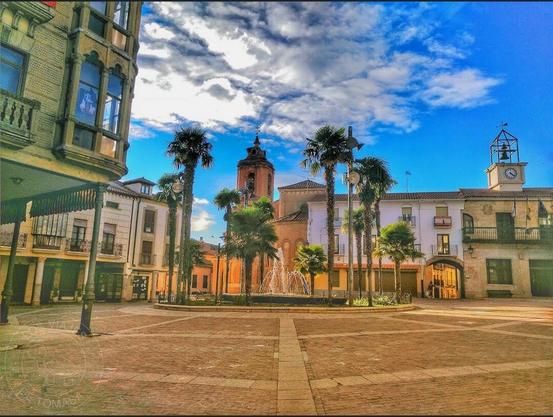
Hay palmeras centenarias y naturales en Castilla y León? Pues si... En torno a los primeros años de la década de 1920 fueron plantadas en la Plaza Mayor de Alba de Tormes, (Salamanca) procedentes según la documentación de Elda (Alicante). #salamanca #AlbaDeTormes #PlazaMayor #CyL