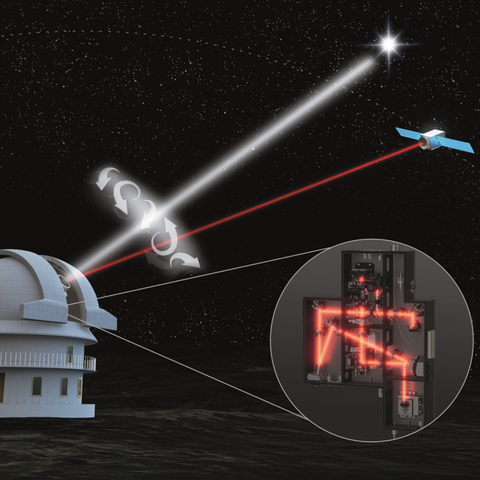
Adaptive Optics is a technique to compensate quickly varying optical aberrations in an #optical system 🔭. A limitation is that the correction is only valid in a very small patch of sky 🌌. Multi-Conjugate Adaptive Optics, or #MCAO uses several guide stars ✨ to measure the light wave aberrations in several directions. The corrected field of view is enlarged by a factor of 10 to 20 to obtain the most uniform output image quality https://mavis-ao.org/mavis/

#MAVIS #AdaptiveOptics #ESO #VLT

About

MAVIS public website

MAVIS

The MAVIS project is looking for a project manager to fill the Consortium Manager role: https://jobs.anu.edu.au/jobs/mavis-consortium-manager-canberra-act-act-australia-98c6641a-079d-40b2-87f4-be5f05288257

If managing scientific/engineering projects is your thing maybe you can come help us finish building this awesome astronomical instrument: https://mavis-ao.org/

#Astronomy #Astrodon #MAVIS #MAVISao #AdaptiveOptics #AstroJobs

MAVIS Consortium Manager - Canberra / ACT, ACT, Australia

Classification: Senior Manager 2Salary package: Competitive salary package plus 17% superannuationTerm: Full-time, Continuing (Contingent funded)  This position is continuing (contingent funded). The funding that supports this project has an expected end date of June 2028. Working at ANU This is an opportunity to work with a world class University that undertakes cutting edge research and has a strong tradition in research-led teaching excellence. We offer: Flexible working arrangements including hybrid arrangements working both on our beautiful, green campus and working remotely, Generous paid parental leave entitlements of up to 32 weeks. We are one of the leading employers in Australia for...

Building and Testing Deformable Mirrors for Adaptive Optics

Atmospheric turbulence can severely distort incoming light for astronomers, making accurate observations challenging. To counteract this, adaptive optics systems are employed, which use deformable mirrors that can change shape in real time. In a recent demonstration by Huygens Optics, a deformable m... [More info]

#news | Adaptive optics for astronomical measurements 🔭

Fraunhofer IOF is working with the Thuringia State Observatory in Tautenburg to develop a compact module with #adaptiveoptics. The new #FREEFIB research group is developing a system that can precisely couple starlight or laser light into an optical waveguide, even in small telescopes. 👉 A key technology for optical communication and modern telescoping – compact and cost-efficient.

Find out more here: https://lnkd.in/efKJ_mCU

“Raindrops in the Sun’s Corona”: New Adaptive Optics Shows Stunning Details of our Star’s Atmosphere - NSO - National Solar Observatory

Scientists from the U.S. NSF National Solar Observatory and New Jersey Institute of Technology produced the finest images in the Sun’s corona to date. Using a new 'coronal adaptive optics' system that removes blur caused by Earth's atmosphere, their ground-breaking results were recently published in Nature Astronomy and pave the way for deeper insight into coronal heating, solar eruptions, and space weather.

NSO - National Solar Observatory
Scientists Capture Sharpest Images Ever of Sun's Corona

You've never seen the Sun like this.

PetaPixel
Observations of fine coronal structures with high-order solar adaptive optics: https://www.nature.com/articles/s41550-025-02564-0 -> New #AdaptiveOptics shows stunning details of our star’s atmosphere: https://www.eurekalert.org/news-releases/1085173

While I'm dreaming about having MAVIS on the telescope, here's something rather more fanciful. MAVIS will consist of an adaptive optics system (to correct for the blurring effects of the atmosphere) plus two instruments, an imager and a spectrograph, but it's being designed with space for a 3rd instrument be added later. So... what if you put an eyepiece there?

Normally putting an eyepiece on a giant research telescope like the VLT would not work at all well because it's optically impossible to produce a magnification and exit pupil size that are suitable for viewing with a human eye. But if you've got an adaptive optics system on the telescope delivering diffraction limited images then that completely changes!

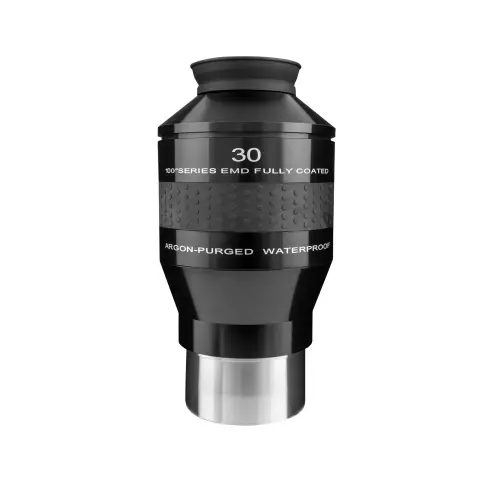
A quick search for really big eyepieces turned up this, and it actually would be almost perfect: https://www.explorescientific.com/products/100-30mm

At the 3rd instrument f/35 focus the 30 mm focal length would give a visual magnification of 9333x. The 52.2 mm diameter field stop would give a max on-sky field of view of 39 arcseconds diameter, which matches well with the 30 x 30 arcseconds field of view of MAVIS. With f/35 input the exit pupil of the eyepiece would be 0.86 mm diameter, so it would be easy to get all of the light from MAVIS into a dark adapted human eye with a ~7 mm diameter pupil. Maximum resolving power of the human eye is about half an arcmminute, and with the 9333x magnification that would correspond to about 3 milliarcsecond on sky, about 4 times better then the resolution of the images delivered by MAVIS. In practice that's a pretty good match, the image wouldn't look significantly over-magnified and blurry.

Because of the slow focal ratio/small exit pupil the visual surface brightness would be low so it would be rubbish for looking at nebulae or galaxies, but I bet planets would look amazing!

#Astronomy #Astrodon #VLT #AdaptiveOptics

Explore Scientific 100° Series 3" 30mm Waterproof Eyepiece

While pointing MAVIS at Jupiter and Saturn would produce the most spectacular images, MAVIS observations of the ice giants Uranus & Neptune may be more significant.

This image is about as good as the Hubble Space Telescope's views of Neptune got: https://esahubble.org/images/opo2059a/. Higher resolution images have been obtained with ground based telescopes and adaptive optics, but they've been at longer wavelengths (infrared) which reduces resolution. With adaptive optics at visible wavelengths on an 8 metre telescope MAVIS should provide the sharpest views of Uranus and Neptune since Voyager 2 flew by them in 1986 and 1989.

Those Voyager 2 flybys happened during my formative years and were a big part of what got me interested in space, so observing Uranus and Neptune with MAVIS would be significant to me personally, too.

#Astronomy #Astrodon #VLT #AdaptiveOptics

Neptune’s Curious Dark Spots

Neptune’s Curious Dark Spots

www.spacetelescope.org

I've been getting myself excited about getting the MAVIS instrument (https://mavis-ao.org/) on the telescope, even though that's still ~3 years off.

I was looking at this gorgeous image of Jupiter taken by the Hubble Space Telescope (https://esahubble.org/images/heic2017a/) and realising that MAVIS could do this with significantly higher resolution. Thanks to being on an 8 metre rather than 2.4 metre telescope MAVIS will have 3.3x the resolving power of HST, and the pixel sampling will be 5.4x finer (7.36 mas vs 40 mas).

I'm just looking at this 400% zoom crop and imagining a MAVIS image that's pin-sharp at the same magnification.

#Astronomy #Astrodon #VLT #MAVIS #AdaptiveOptics

MAVIS

MAVIS public website

MAVIS