2025: Year in Review

Introduction

What a year it has been. I thought I would do a breakdown of what I’ve written and published in this time, my highlights, and anything I’m carrying over into 2026.

First up – my goals for the year. I genuinely can’t recall what goals I set myself at the start of the year, but I always go off piste with those anyway. Much better to set none at the start, look back at the year, and retrospectively tick off all the things I’ve actually done and call it a day. I did have a lot of intentions that I developed over the course of the whole year, or at some point thought “ooh, it would be cool if…”, so I’m going to use those as my ‘2025 goals’ for the purpose of this post.

I wanted to publish my Gothicka Fantasia novel, and I also wanted to increase my earnings, and get more website traffic. I really wanted to join the Horror Writers’ Association (HWA), finally, as I’ve been putting that off for ages and I finally qualify as an Affiliate Writer.

I also wanted to sell a short story to a magazine or anthology, build a presence on Mastodon and Pillowfort, buy a bundle of ISBNs at last, and attend an in-person con.

I haven’t bought the ISBNs, I haven’t properly started engaging on Mastodon/Pillowfort, (I also have a Lemon8 account but I don’t have a consistent brand to build there), and I didn’t attend a con, but I have ticked off everything else.

I did achieve a bonus one, though: I also joined Diviniation Hollow as a monthly contributor, so expect more TV/Film/Book/Podcast content from me in the future. I can’t wait to share my faves with you all. So that’s a bonus that I didn’t expect to come out of this year!

Published Work

I’ve put out a lot this year, I would say! My 12 months of rewards for my Ko-Fi members can be downloaded in one handy eBook, so all the story arcs and individual extracts, standalones, etc, can be read in order and kept forever.

2025 Ko-Fi Letters – free to Seekers and Family members, £1.50 to Tip Jar members. ~29K words. That’s a lot! You can download this as either an ePub or a PDF, both files are included in the download.

You can keep updated with all my bonus content and Ko-Fi posts here.

As for other work, here it is in chronological order:

Feb 2025: I published my Dark Gothic Fantasy, Yelen & Yelena. This is a ~98K novel that was voted a 5* read for the Romancing the Gothic book club, and reached 1000 downloads on Bookfunnel.

She’s up for the Indie Ink Awards this year! Voting open until 31st Dec for:
Aromantic rep, LGBTQ rep, Best setting, Best friendship, Best audio narration.

Mar 2025: I edited and collated the Ricky Porter stories written for Ko-Fi members, and released a collection of them with The Sussex Fretsaw Massacre as an eBook. This new collection is called The Sussex Fretsaw Massacre & Other Stories.

Sep 2025: I entered a 200 word flash fic (Katy Porter themed) into a prompt competiton by Black Hare Press, and it was accepted. It is now in the flash fic anthology, Alone, entitled, “The Lonely Girl Dreams of the Dead”.

Oct 2025: my short story, “Along the Xylophone Road”, was accepted into the Black Hare Press body horror anthology, Occupying Bodies.

My story is a standalone short in 1st person POV, about a revenant dragging its rotting body along train tracks in the desert, seeking a long-distance lover whom they only knew online before they died, and never got to meet in person.

Nov 2025: I edited the 4-part dark fantasy short written for October’s #AScareADay, and turned it into a coherent dark fantasy short story, called Bone Puppets.

It is currently only available to buy as an eBook on my 3 personal shop platforms:
Ko-Fi, cmrosens.com/shop and Itch.io.

Writing Progress

Abysmal. Well – to me, anyway. But that’s not really true. I wrote aout 29K words for my Ko-Fi members, which is the length of a decent novella. Some of this was extracts from WIPs and so on, but that’s all fine, it counts.

Let’s look at my WIPs… you will notice that most were paused in June 2025, which correlates with the work issues escalating. I’ve spent the rest of the year in a state of burn out.

Pagham-on-Sea

Feed is still in progress, but I’ve cracked the midpoint now. I want to ensure that this one can be read as an entry point to the series, so I’m spending a lot of time going over the opening chapters. It’s currently at 57.9K words. These novels tend to be ~99K words. I don’t really want this one to be longer, so we’ll see what happens in edits and revisions. This is the only WIP I’ve picked back up after the long hiatus, and the one that is currently an active draft.

Gothick Fantasia

As Below, So Above is my Phantom of the Opera (but alchemists) X m/m Rapunzel, in an alchemist tower, structured along alchemical process lines. I’m a bit worried it’s nudging into the realms of Eggers’ The Lighthouse as well. I seem to have abandoned a draft at 9.3K words in June 2025, but I have worked out how to make this work better. It now has a lot of random experimental writing, and different ideas, and I think feels stronger to me as a piece. The worldbuilding is working very well. I’m tempted to remove the framed narrative and just write the initial idea.

Cold as Snow, White as Bone is the Wild Hunt X Snow White X Fall of the House of Usher, and another one I abandoned, this time in April 2025. I have a few different documents of experimental writing and potential outlines, and 2.2K words of a dedicated draft that I want to return to.

Contemporary Cosy Suspense

Best Friends Bury Bodies took up most of my year. I now have a complete draft of this novel, and it went through an alpha/early beta reader stage, which has convinced me to make some more major changes. I abandoned this project in 2023, and picked it back up in February 2025. It’s now on version 7.0, and the latest complete version (6.0) is 80K words. I last opened version 7.0 (the post-beta rewrite) in June 2025. I want the rewrite to be more in the region of 70K words, and to lean into the recovery journey of my MMC more, and also to strike a better balance with the Midsomer Murders influences.

Three for a Girl is the sequel to Birds of a Feather that will introduce the ‘Katy’ character to the AU, and I worked on this a little bit in March 2025. It’s still percolating. It’s also a bit of a murder thriller, with AU Carrie & Ricky taking a holiday in Scotland only to discover a murder on their campsite, and a missing teen girl. Katy in the AU will not be related to Ricky or Wes, and spells her name Katie, and will get very annoyed when people get the spelling wrong. There is no active draft for this, but there are mutiple documents of experimental writing.

Historical Fiction – Supernatural

Untitled WIP – 2.1K words of an occult adventure in Victorian London. Inspired by Arthur Machen’s The Three Imposters and Algernon Blackwood’s John Silence stories. The idea is a trio of misfits, each with their own backstory and lowkey psychic ability, are hired by shadowy clients to steal/retrieve/acquire various items of interest. They have just completed one such heist, and are having supper together in private. They each regale the others with their own tales, as each one has done a different thing, and spun their victim(s) various ghostly yarns to get them to hand over the item, or to gain their trust long enough to access what they’re after. So it’s a series of nested stories, with the supper as a framing narrative. I don’t know if I’ll finish this.

I haven’t worked on anything else this year, but see above for what I published!

Indie Author Earnings

I haven’t done a round-up of earnings before, but I’m seeing so many people in my timelines right now saying they want to take the self-publishing plunge, so I thought this might be of interest. If not, I’ve got some website stats further on, so just scroll on down!

This year is the first year I have earned, in total over 12 months, just under one month’s salary at my day job.

This is my first year of publishing for comparison, where the only book I had was THE CROWS (first edition). That Ko-Fi income in October probably came from a workshop or talk I did, not from selling the book. I hadn’t set up a Ko-Fi shop at that point.

2020AmazonDraft2DigitalSmashwordsOtherAdsProfitKo-Fi TipsRelease-January£33.89£3.86£12.07£25.68February£11.32£2.31£1.92£1.04£14.51March£12.83£3.03£32.00-£16.14April£3.55£5.44£14.00-£5.01May£11.56£5.83£17.39June£25.46£2.31£27.77July£14.30£1.44£1.73£22.00-£4.53August£13.29£1.33£14.62Sept£14.79£1.69£13.10Oct£12.77£104.77£92.00Nov£0.00Dec£11.78£11.78Totals£257.54£7.39£17.95£3.86-£ 82.80£203.94£92.00[Totals]£282.88

That whole year, minus the ad costs, and including the workshop/talk I did, my profit was £203.94.

Note that in that first year I spent £82.80 on ads (Facebook and Instagram), which came out of my total profit, and some months I made a loss rather than a profit.

Was it worth it? I think so. People started to recognise the cover and the book, and in 2021 when Thirteenth was released, I made over £150 in that one month (April). With 2 books out in 2021, and with plugging them consistently and building my social media platforms, sending out review copies, and pitching them to book clubs, I jumped from making £203 in one year to making just over £760 in one year.

Amazon was my primary market, where I earned the most money each month, despite being wide distribution. Draft2Digital covers all other eBook platforms, except Amazon and Smashwords. Nov 2020 I made absolutely no sales at all, not anywhere.

I have steadily increased this annual total each year, and this now includes royalties from Canelo, which I receive twice yearly.

Amazon has now been completely outstripped by my own Ko-Fi shop, with the new king of income being my monthly subscriptions, followed by my own shops – Ko-Fi, Itch, and my website here. Until the whole Itch debacle, I was earning a decent amount from bundles there.

This year, I’ve noticed an interesting trend across the other eBook platforms. Amazon was only biggest income in February (Yelen & Yelena‘s release month). This was the only month I earned over £50 there. May was the second biggest Amazon month, earning £21.71 (with currency conversion). All other months I have earned £12 or less, and usually a lot less. Still, I haven’t had a month on there where I’ve sold nothing.

Draft2Digital, on the other hand, encompasses all the library subs like Hoopla, OneDrive, and so on, and all the alternative eBook sites, like Kobo, Thalia, Smashwords (since they merged with D2D), etc. I’ve also gone wide with their print option, so there’s an alternative to Amazon for print as well, but this is more expensive and D2D take more of a fee. I also can’t edit my printed book very often, and they charge for changes once your free tokens are used up.

While you can see I didn’t even crack £30 all year in 2020 with D2D, Smashwords, and being hosted on a friend’s shop combined, this year I made £82.46 there, vs Amazon’s £156.69. So it’s catching up, but Amazon remains consistently more.

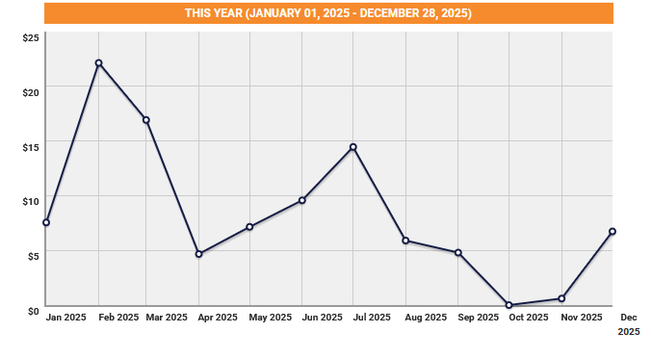
In the chart below, there has never been a month that has hit $25USD. In October, I earned nothing.

Draft2Digital Royalties 2025 – Screencap taken at 20 units sold

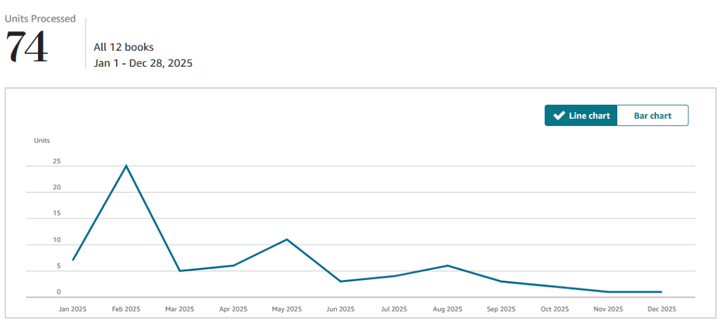
Amazon earned me £156.69 in total this year, which I think is also due to Amazon boycotts. I sold 74 books with them this year. You can see the dips, and that from July, where I sold 4 books and hit a peak of £12.29 in royalties, my royalties then declined with the sales, so that I never earned over £10 after September, and had a few months of earning £2-3, and December it’s now £1.72 for the month, for the sale of 1 book.

Amazon chart showing units sold per month

In terms of selling units, Draft2Digital is benefitting from the Smashwords End of Year Sale right now, where my books are 50% off, and one is free. I’ve sold 21 books there this month, but as you see from the royalties chart above, I’ve earned about £5.33 after currency conversion.

Sales figures aren’t useful for judging income if what’s selling is free, or you are only getting a few pennies for each unit from a library subscription. What you’re hoping for here is that people will actually read it, like it, and come back for more later. Perhaps mention you to someone else, who will try your stuff out, and tell another friend. It’s all about word of mouth as much as it’s about your own marketing! But there are no guarantees.

What’s fascinating is that as Amazon and D2D combined are not making me a lot of money, my own shops are.

People prefer to support me directly, where I get all of the royalties minus the PayPal/Stripe fee only, rather than 10-70% of the royalties depending on if it’s print or eBook, and then minus the fee of sending that money on to me.

In fact, I earned over £620 more in my shops and Ko-Fi membership income combined, than I did with Amazon and D2D combined. If I had just stuck with those major platforms, I would still be earning about £200 a year.

Takeaways for Indies

So, if there’s a takeaway from these figures and stats, or anything to be gleaned, I’d say it’s this:

  • Monthly memberships will provide a more regular income stream, so seriously think about what you can offer – make it work for you. Don’t try and set this up in your first year unless you’ve had a lot of success; float the idea early on, push it and gauge interest, research platforms, and launch it like you would another project. If it’s a slow build, so be it. A regular £10-20 a month is still money you didn’t have before, and it adds up over time.
    Some ideas:
    – Serialised first drafts, followed by ARCs of the edited final copy
    – Monthly flash fiction/micro-fiction (this can also be a good monthly writing exercise for you!)
    – Extracts from your WIPs and a group to discuss them, hype them up, etc.
    – Guaranteed ARC acceptance where you send author proof copies directly to the readers in exchange for hype and reviews
    – Member-only giveaways of signed copies/book boxes
    – Free downloads of all your eBooks/massive discounts
    – Access to your private Discord
    – Exclusive Q&A sessions
    – Live streams/recordings of your work, read by the author
    – Post/mail out things; postcards, character art prints (crediting the artist), birthday cards, holiday cards, handwritten notes, printed copies of your micro fiction.
    ~
  • Be prepared to be in the marketing game for the long haul. Don’t give up on a book because you don’t sell much in the first few months or first year. Send out review copies, spend money on ad campaigns if you have the money to spend (I capped mine at £10 per campaign). Pitch the book to book clubs. Offer discounts and free copies for book clubs and reviewers. Keep doing that. It can really help in the longrun.
    ~
  • Set up ways for your audience to directly support you, where you can control the prices, and you can bundle items together for sales. Use something like Universal Book Link or Bookfunnel landing pages to aggregate all the links, allowing your customers to choose where to buy. Highlight your own shops each time.
    ~
  • Don’t be afraid to hybridise. Self-publishing is not a barrier to traditional publishing, and you can approach small presses as well with a portfolio of work and a current audience ready-made. If you can get royalties coming in, that will help your income. Equally, unless you have a specific contract clause with your agent or publisher telling you otherwise, there’s no reason not to self-publish something, and see how that goes, if you can’t sell it. There are places that do take reprints, so you can get it out another way and at another time.
  • Future Goals

    My twice annual Canelo royalties have come in very handy as well. These are pretty modest, low 3-figures, and fluctuate, but they’re a nice little bonus. I’ve been giving these to charity for the past 2 royalty periods, but what I will do with the next one is put it towards buying a batch of ISBNs so that I can release print books via IngramSpark.

    In the UK, you can only buy ISBNs from Nielsen’s, and it’s £387 for a bundle of 100 ISBNs. Once I have my own, rather than the free ones from D2D/Amazon, and release via Ingram, my books will no longer be “firm sale” (no returns) and bookshops will be able to buy stock more easily.

    I will then keep back my next royalty payment to cover the cost of any stock returns, as the author covers the cost of this if books are returned by the vendor.

    It’s looking possible that I’ll make a full month’s salary across a whole year next year, but it doesn’t matter if I don’t, as I have a day-job that pays enough to cover my bills and some of my author expenses, and I’m not doing this for the income stream.

    Website Stats: 2025 in Review

    I imagine, if I had been thinking strategically, that gaining more website traffic and boosting my profile would have been a goal. I think we can tick this off.

    Including all the author spotlight interviews and podcast transcripts I’ve edited and posted for 2025, I posted a total of 144 posts, not including this one, and 233.5K words – two chunky epic fantasy novels worth of writing.

    My most popular months were January, September, October and November. October was the best month for views this year, most likely because I posted #AScareADay posts every day!

    This year, my website had 29.9K visitors, and 39.2K views.

    My most-read article was Rapunzel in Cinema 1897-2024, with 6.6K views, followed by Red Riding Hood in Films 1901-2024, with 3.1K views, and Werewolf Films 1910-1949, with 1.9K views.

    Last year, my site had 17.6K visitors, and 23.4K views, so you can see that’s a massive jump this year! I’ve been making more effort with SEO metrics, but I think my some of my articles have been linked as sources in Reddit threads, Wikipedia articles, and elsewhere, and that has really helped to drive traffic back to me.

    My top-read podcast interview transcripts were:
    Caitlin StarlingThe Death of Jane Lawrence, Starving Saints
    S.T. GibsonDowry of Blood
    Jackson P. BrownThe Reaper

    My top-read author spotlights were:
    Nat Weaver – Mercedes Masterson series (modern noir)
    Arden PowellFlesh & Bone (m/m Canadian Western novella)
    Lem McMillanmulti-genre Wattpad author of free-to-read SFF

    This year, my author spotlight series was a very popular one – I need to work on the SEO scores of these posts to try and drive more traffic to each one, but it would also help for readers to reblog, like, share, comment, and boost these authors any way you can. If you’ve been a contributor to the series, I would encourage you to boost your own interview, but also to boost your colleagues as well!

    Let me know if there is any content you would like to see more of, and I’ll give that a go for 2026!

    CONTENT TO COME:

    2026 Author Spotlights – posted on Wednesdays each month, giving authors of all genres a boost by spotlighting their work in a short interview. A spotlight is not a recommendation, endorsement, or a review.

    General Updates – posted as and when I have any updates, but always on Mondays/Fridays. These will also go in my Monthly Newsletter.

    Reviews of TV/Film/Books – posted Mondays/Fridays, which may be cross-posted from Divination Hollow Reviews, where I’m now a monthly contributor.

    Monthly Media Round-Up – does what it says on the tin; every month, I’ll post a round-up of the media I’ve consumed, with some brief thoughts. I may end up just posting my personal highlights of the month, as I get through A LOT of films sometimes. I don’t want these posts to get too long!

    See you all next year!

    #AScareADay #authorUpdate #indieAuthorLife #yearInReview
    #AScareADay – Day 31 – The Path She Sings by Vanessa Fogg

    October 31st – Vanessa Fogg – ‘The Path She Sings’ (2025)- Read it here.
    The whole challenge list: romancingthegothic.com/2025/09/21/the-scare-a-day-challenge-october-2025

    This one was heart-rending, too, and very much like Kaaron Warren – ‘Eleanor Atkins is Dead and Her House is Boarded Up’ for Day 25.

    I really enjoyed this one. The imagery is beautiful, and so sad. The loss and emptiness and stepping into another state of being you cannot comprehend from living outside it – all depicted really movingly within such a short space.

    I’ve got so many authors I want to read more from now, and adding Vanessa Fogg to my list!

    Today is the release day for OCCUPYING BODIES, the body horror anthology my sad revenant story is in! Here’s another snippet from that, and where to get the anthology.

    The premise here is a revenant whose last imprinted memory is of the long-distance partner they never got to meet in real life, after starting a relationship online. The revenant is now dragging themself along train tracks in a desert, on their way to where their partner used to live.

    Get it now

    You can escape your past, your fears, even your mind—but never the body you occupy.

    The body is the first prison, the final battlefield, and the one thing we can never abandon. Yet what happens when the flesh betrays us, when consciousness claws against its cage, when skin, bone, and blood twist into something unrecognisable?

    Occupying Bodies is a visceral anthology of body horror that explores the dread of living inside fragile, treacherous vessels. Within these pages, nightmares take the form of grotesque mutations, psychological unravelings, everyday afflictions magnified into terrors, and Cronenbergian transformations that defy imagination. Each story forces us to confront the inevitability of flesh—the aches, the ruptures, the decay—and asks whether escape is salvation or damnation.

    Curated by Bernardo Villela, this collection gathers diverse voices united by one chilling truth: no monster is more intimate, more inescapable, than the body you inhabit.

    Read on for a quote from my story:

    There is something inside my brain. It keeps me company as I move forwards, under the blanket of heat and light pressing down on my broken back. It doesn’t hurt. I can feel it moving inside my skull, tickling parts of me into spasm and sparking my emotions into life, like light hammers tapping on taut strings.

    I wonder if that is why the morning looks different today.

    There is something inside my throat. I am not sure if I want it there, and it stops me forming sounds the way I want to. I could barely say anything the first time we called, do you remember? We had gone beyond small talk and only the abyss was left, and I was afraid of the depths you wanted to plumb. I choked up words that I hadn’t told another soul, the way I choked up clots when it all went wrong. Now, I’m afraid I have no more words for you, but you have the ones I wrote down, and the song I wrote for you. And I am still choking, but I hope you’ll forgive me. I didn’t mean to leave it so long to see you, but I am coming now.

    I am coming.

    #AScareADay #AScareADay

    #AScareADay – Day 27 – Uncontainable by Helen Stubbs

    October 27th – Helen Stubbs – ‘Uncontainable’ (2016) – Read it here. Catch up on the challenge here.

    Wow, this did NOT go where I thought it was going. Not one for those who need a TW for baby death. Definitely on the changeling theme, but as I say, not where I thought it would go.

    I love the idea of evil beings or people, who really knows, being seen for what they are by a feral child. Also I loved the implication that if one goes, another arrives in the village to take their place, but doing a different job, and in a different guise.

    This reminded me of a short from the México Bárbero anthology (the first one – there is a second), Lo que importa es lo de Adentro, dir. Lex Ortega, where only the little disabled girl Laura can see the ‘harmless’ man in the neighbourhood for what he is – a bogeyman who kills children and harvests their organs for sale. This segment is a modern take on the folklore of El Coco / El Cucuy, the bogeyman in Spanish and Portuguese-speaking countries who eats children.

    In this story, Rochelle/Rachel’s uncanny perceptions and knowledge, combined with her aggression, rejection of gifts, violence, and spurning of the priest, sets her up as a changeling to me, so when the story took another, more macabre direction, I really appreciated the twist.

    I think this story might be vying for top place in my favourites. I’m really getting into Australian and Aotearoan writers and short horror fiction – see my interviews with Lyndall Clipstone and Mason Hawthorne for more ideas for what to read next.

    For my take on changelings and the horror of being the only person who sees things for what they are, see my short story THE SNOW CHILD.

    Instead of reposting extracts from that story again, I thought I’d post something else that I started a long while back, which is a changeling type story set in the Pagham-on-Sea universe, but not set in Pagham-on-Sea itself.

    TW for baby stealing and baby neglect and death.

    Experimental paragraphs as potential openers

    Ellie Jenkins hated mirrors. She’d seen a monster in one as a child, and never gotten over it. Of course, nobody believed her; Aunty Lisa hadn’t wanted to bring her sister’s kid up in the first place, and wasn’t interested in whether Ellie saw monsters or not.

    Nick Emlyn Hall loved mirrors. He’d seen a monster in one as a child, and never gotten over it. Only his foster-brother believed him, and that was because Cameron saw monsters in mirrors too.

    Nick and Ellie meet at a ballroom dancing class – but Ellie hates mirrors, and this class thankfully doesn’t have any, as it’s above a Private Shop (UK term for a shop that sells sex toys, etc.)

    I added this detail in because I went to a private one-to-one burlesque class for my hen, arranged by a close friend, which was above a shop like that, and upstairs all the rooms had numbers… you know. I had a great time, and by total coincidence, it was the same dancer I had already booked (unbeknownst to my mate) to belly dance at my wedding.

    Anyway, Nick and Ellie meet while ballroom dancing, and at some point Romance and Plot happens, and after their first time having sex (in a Wetherspoons toilets after Ellie discovers her boyfriend is having it away with her mum whom she is trying as an adult to reconcile with) they have this exchange at Nick and Cam’s house:

    Nick looked at Ellie, who was brimming with questions. “Do you own a full length mirror?”

    Ellie shuddered involuntarily, a distant memory of Aunty Lisa’s making her cringe. “No.”

    “You don’t like them, do you? Why not?” Nick swung his legs, much to Cam’s irritation, scuffing the cabinet doors with his heels.

    Ellie shrugged. “It’s stupid. When I was little, I thought I saw a monster in one.”

    Nick gave Cam a look of triumph. “There you go.”

    “That doesn’t…Ellie, what sort of monster?” Cam turned to her now too, the first time he had deigned to even look at her since she came into the kitchen.

    She didn’t feel like explaining something so childish. “I don’t know.”

    “Grey skin? Wrinkled? Massive eyes? Really long nails?”

    Th details were hazy now, but that description struck a chord. Her hesitation drew a sigh from him.

    “Small? Probably only about as big as you were?”

    “What…what are you saying?”

    The brothers exchanged glances.

    “Mirrors can show us what we really look like,” Nick said slowly. “If we approach them in the right way. It’s easy to do by accident.”

    Ellie wasn’t ready to hear that. She didn’t want to be seven years old again, having night terrors about the things she saw in Aunty Lisa’s mirror after spinning in front of it in a rare new dress. She could barely get her head around what he was saying to her.

    “Are you saying I’m not real?”

    “I’m saying you’re not really Ellie,” Nick said, and that was worse.

    The three characters have a chat about changeling lore here, and Ellie learns where changelings really come from. A lot of this is hinted at in my story THE SNOW CHILD as well, which uses similar lore to the bits I’ve used here, but I’m undecided as to whether I want to tie them all into the same universe. I think I probably will, so a lot of things may change. Or not. We’ll see. But this is a section from the changeling chat.

    Ellie is finally persuaded to see her real self in a mirror and face the monster she thinks she is.

    “Hey.” Nick crossed the room and touched her arm. “Do you want to see yourself properly? You are real, I promise. You just – you just wear this body like a shell. Like a set of clothes.”

    “And my personality?”

    “That’s all you. Bit of nature, bit of nurture, but all your version of Ellie Jenkins. It doesn’t change that part of you.”

    Ellie stood in front of the mirror, her back to it, and turned slowly anticlockwise. Her reflection was blurred, as if there was Vaseline on the glass. On top was Ellie, the human Ellie, the way everyone saw her. Underneath was…someone else.

    Ellie turned anticlockwise again for another full turn, heart pounding, hands clammy.

    This time, the thing underneath was closer to the surface, the mirror showing her more grey and less pale flesh. She turned around one more time, and there she was.

    Wrinkled grey folds of skin, stone coloured but tree bark textured, blotched with patches of moss and paler lichen, hung on a frame that matched hers in dimensions, her breasts full and drooping, rolls and curves all pretty much the same, and her face was much sharper and flatter than she’d expected to see. Hr nose almost didn’t exist at all, a nub of slit nostrils in the middle of her face, eyes huge and round, bugged slightly and taking up most of the space where her forehead had been. Her hair was dandelion down, sprouting delicately from the dome of her skull in wispy poofs of white.

    Nick and Cam appeared behind her, also naked, and when they turned three times, the family resemblance was unmistakeable despite the differences in their builds. It wasn’t their appearance, which was basically the same as hers; grey wrinkled skin like lichen-covered bark, both considerably mossier than she was, with short, dark green fronds sprouting over them in thick patches.

    Human beauty standards didn’t apply between them.

    Ellie looked down at herself, expecting to see the skin she was used to, but the glamour of human Ellie Jenkins had also been stripped from her body and the reflection matched the distorted reality.

    Everything made sense.

    There was no horror, although she’d anticipated there being something, some panic or tingle of fear, of disgust, but there was only a profound sense of fitting. She’d worried that she wouldn’t fit her real skin, but in fact, it made better sense to her than the human one she had.

    “Do you like it?” Nick asked.

    Ellie nodded, running her new – old? Real? – hands over her body, exploring the fibrous textures of her form.

    “What happens to the babies? The real Ellie? Where is she?”

    Nick winced. “Human babies don’t tend to live long in Faerie. They get taken because they look cute, but the new parents…get bored easily. Eventually, the stolen kids get mulched, and their bodies fruit into sprites, imps, that sort of thing.”

    Mulched?” Ellie stared at him in horror. “You mean…”

    “There’s a garden,” Cam said, without emotion. “They call it the Golden Green.”

    Ellie felt sick. “The Golden Green? Why…?”

    “Things rot really prettily in Faerie,” Nick said flatly. “Anyway, the real Ellie doesn’t exist anymore. She probably spawned a whole swarm of wood sprites and tooth fairies, if that’s any consolation. Like mayflies, you know? Except they live a bit longer.”

    Ellie covered her mouth, forcing down bile.

    “Look, none of that matters, because to all intents and purposes, you’re the only Ellie now, so that makes you the real one,” Cam said, in a manner that was meant to close the conversation, but didn’t actually help. “Like I’m the real Cam, and Nick’s the real Nick.”

    Ellie couldn’t take all this in at once. She ran her hands over her body, the one she had always had but never knew was there, and tried to take it all in.

    There was a slight concave pit in the middle of her chest, and no navel. “What’s this?”

    “From the seed pod,” Nick said, showing her his own. “They grow us in the Golden Green. Cam and me, we’re from the same pod. We sensed it the moment we met each other. You’re from a different one. Different bush, probably. I got a sense of connection to you the moment we met, so I suspected straight off you were one of us, but I don’t think we’re linked beyond that.”

    “So…we’re plants?” Ellie explored the dip in her chest, imagining a small stem burgeoning out of it, connecting her to sunlight and water and air.

    “Sort of.”

    Ellie ran her hands downwards, between her legs, and paused, surprised at the absence she felt. “Where’s my…?” She looked properly at the brothers. “Where are your…?

    “Cocks?” Nick’s sharp mouth split into a perfect triangle, giving him a wicked air. “Don’t need them. We don’t get rid of waste that way, and we don’t reproduce like that.”

    “So what are these?” Ellie grabbed her breasts, but they were hard and light, and rattled when she shook them. “Oh wow.”

    “Seeds.” Cam rattled his own, a little smaller than hers. “We all carry seeds. These are pods, really. They release when we die or we’re fully mature, but changelings don’t often live that long.”

    “How long?” Ellie jiggled her seed pods, listening to the percussive shake, feeling nothing. Unlike her human tits, she had no sensation there.

    “A hundred years.”

    “Oh.”

    “Most changelings don’t last a year,” Nick said. “Not in the bad old days, when people were wise to us. They’d kill their own babies if they thought they’d been swapped. It was all extremely grim. I went around a few times before my luck started to hold.”

    “Like, we reincarnate?”

    “No, that’s a specific worldview, isn’t it? This is more like…recycling.” Nick looked at Cam for corroboration. “When you kill a changeling, or one dies, or whatever, these seeds get released. They’re a part of us. Every seed you bear inside you is another you. The more you have, the better chance of being recycled.”

    “So…the seeds release, and they – what? They grow?”

    “Essentially. They get collected up first, because you can only regrow in the Golden Green.”

    “Where the human babies get…mulched.”

    “Yep. But that’s nothing to do with us, that’s how the sprites and small swarming things get born.”

    Cam nudged him. “The roots of our bushes feed on them too. What’s left.”

    “Oh, God.” Ellie felt sick again.

    “Oh, right. Yeah. Well, anyway, not really our fault. Circle of life, right?” Nick shifted from foot to foot, or rather, stump to stump, his belly round and ripe and rippling with the movement. Ellie found she was still attracted to him, so perhaps in her plant-changeling life her orientation was towards juicy, agendered fruit.

    Attraction was also a human thing, if she didn’t have the requisite parts to do anything about it, so maybe that tug towards him was something else she didn’t yet have a name for.

    “It’s pretty cool, isn’t it?” Nick asked, changing the subject and drawing her attention back to the mirror. “Look at us. Like a horror film.”

    “I really like it,” Ellie admitted, the strangeness of it ebbing the longer she remained fully exposed, filling every part of her form with herself. Her whole personality fitted into it perfectly, no need to hide or conceal or suppress any bit of it, no need to squash anything down or over-accentuate anything else. She was, for the first time in her life, both complete, and completely comfortable. “I think you’re a dead sexy goblin man.”

    Nick’s triangle smile made his big, globular eyes shine with a pale, sinister light, and she loved that even more.

    “Excellent.”

    Cam coughed.

    “Cam is allergic to fun,” Nick said.

    Cam sprouted thorns across his whole body, a savage gleam in his sunlit eyes.

    Ellie patted herself down, checking herself for similar protrusions. “Oh my God, that’s amazing. Can I do that?”

    Nick laughed. “No. I told you. We’re from different bushes.”

    “Why does everything you say sound mildly dirty?”

    Mildly?” Nick tossed his head, mock-offended.

    “You can probably sprout something,” Cam said, thorns retracting. “Try.”

    Ellie closed her eyes, double lids folding over her enhanced field of vision, and took notice of what was beneath her skin. Additional things that felt like muscles but probably weren’t flexed and relaxed in her shoulders, and something squeezed through slits that opened up like gills.

    She opened her eyes. “Any good?”

    The other two nodded, vaguely impressed. Her shoulders were covered in nettles, their stinging undersides not bothering her own skin, but shielding her head in a clump.

    That’s all folks! Let’s see if this experimental writing goes anywhere.

    If you like this, or any of the stuff I’ve posted so far, feel free to drop me a tip or join my membership and get new fiction once a month, plus loads of discounts and free eBooks, and automatic acceptance for ARCs!

    #AScareADay #AScareADay

    #AScareADay – Day 30 – Bleeding Hearts by Suzan Palumbo

    October 30th – Suzan Palumbo – ‘Bleeding Hearts’ (2024) – Read it here. Catch up with the Challenge list here.

    I loved this one. This is witchy and not scary, but very appropriate for the spooky season nonetheless. I love Palumbo’s stories, the way she mixes in so many layers to her short fiction, and weaves very human dramas in so few words. I really love the idea of grief diffusing into something that grows, and a garden of other people’s pain.

    I also really liked the ex-girlfriend’s misery (screw you, Rebecca) and how things develop between Ashley and Claire.

    I really loved the garden imagery, and the idea of plants growing from seeds of blood and tears, and diffusing heartbreak and grief, rather than ‘curing’ it. I also love that you can then do anything you like to the plant – let it grow, take it home, or destroy it, up to you. It’s your pain.

    I did an interview with Suzan Palumbo when her short story collection Skin Thief came out, and you can listen to that, or read the transcript, and grab her books now:

    https://open.spotify.com/episode/0OltzTC5ixUHVAOB1c8qwQ?si=3b52031c8c224a1b

    Read the Transcript Listen on your platform of choice

    This reminded me of the folklore around plants springing from people’s graves, and the tales where these trees then become home to the spirits of the dead in the form of birds, who sing about their murder and the abuse they suffered in life. The Germanic folktale, The Juniper Tree, comes to mind here.

    I thought about this as an ending to my necromancy story which has 3 parts so far, written for #AScareADay.

    The Yew Tree

    Faubert and Gaudin stood in deep, mutual sorrow, without words. What could they say? The dead numbered in the hundreds. The destruction was unimaginable, something that could only be seen and even then, could not be fully understood. Each person is a cosmos. A world. A thousand ripples in a lake of dark stillness. How can their loss be calculated, how can their absence be weighed? And hundreds at once – the collective horror upon the individual horror, the cumulative as well as the singular grief, the tragedy building like an unfathomable monster appearing from the primordial abyss. What could they say?

    Isabeau lay down in the grave they had dug for her. She had told them where to dig, of course, and all was done to her specifications. Even now, neither of the two friends could have possibly done this themselves. There was no question of breaking their bond with Isabeau: she was their flesh, their very lives, their greatest love.

    Isabeau had made the choice herself, and they had no choice, as ever, but to fall into line. Now she lay down in her chosen resting place, hands folded over her bosom, and lay looking upwards.

    “Start with the topsoil,” she said.

    They sprinkled the layers of soil in reverse, each layer with the life bled from it, spoiled and sewn through with salt, so that from it, nothing could grow. Isabeau did not cry out as it covered her beautiful face, but Faubert thought he saw it begin to crumble away into the soil it had once been, the soil used to resurrect her bones.

    As the grave filled, and Isabeau’s remains fell back through time, buried once more under the weight of it, a sapling began to sprout from the place the headstone would have been laid.

    Faubert felt Isabeau’s hold on him lift with the rising of that impossible tree. Gaudin must have felt it too, for he began to work with renewed vigour, backfilling the grave with all the power he could muster after the last layer of soil was sprinkled down, covering her gradual disintegration.

    The sapling kept pace with the backfill, pushing upwards as the hollow in the earth levelled out once more.

    When they stood back, it was a fully grown yew tree, spreading a sombre canopy of darkness above them.

    Gaudin looked at Faubert, but he said nothing.

    Faubert could not muster anything other than a long, slow blink of exhaustion. He had buried his words, his thoughts, his very self, with Isabeau. It would take a long time for them to come back to him, with the red berries of autumn, with the slow ripening of harvest. When the seasons rolled on, his Self would return again. All things healed, changed, found their way, given time.

    For now, there was no Faubert, no Gaudin, without the woman lost to the soil: nothing, except the yew tree growing from the salted earth.

    / Fin.

    #AScareADay #AScareADay

    #AScareADay – Day 29 – The Portrait of Sal Pullman by Lonnie Nadler and Abby Howard

    October 29th – Lonnie Nadler and Abby Howard – ‘The Portrait of Sal Pullman’ – Read it here.

    This is a brilliantly creepy comic! I loved the art, and I loved the play on Lovecraft’s 1927 story, Pickman’s Model, Mary Shelley’s 1818 novel, Frankenstein, or, the Modern Prometheus, and Oscar Wilde’s 1890 novel, The Portrait of Dorian Grey. I think it’s a very appropriate subject matter to depict in comic format!

    Pickman’s Model is a tale of an artist who paints the most horrendous monsters, and it turns out they are not from his twisted imagination… I made that connection first, and then read on as the tale morphed into a tale of self-fulfilling prophecy, and of terrible consequences.

    The black and white line art really leant itself to this story, and I thought the style meshed really well with the prose.

    I think this really struck me most with a sense of twisted self-image, and that made it incredibly sad and poignant for me. It feels almost like the way Lionel Pigot Johnson describes his own ‘Dark Angel’ in the poem for Day 10, this idea of some dark part of you being given its own life outside of yourself, and becomes an adversary to conquer or be conquered by.

    If you want more creepy comics, like I very much did, then dive into terror-town.com and check out The Door in the Kitchen, and their version of O Whistle, and I’ll Come to You, My Lad.

    For this story, I thought I’d have a go at telling a short spooky yarn via a different medium to my usual prose format. I’m inspired by the photography poem, You Are The Sky, which was intended to be a web comic but took on a life of its own, and kicked off a deeper appreciation for its creator, one of my Twitter followers back in 2015, and, long story short, we’re married now.

    The video embed is the comic form of The Condemnation of Starling Lane, originally written for a Monstrous May prompt in 2023. Hopefully you can fast forward. There is also a public view link to the ‘comic’ attempt you can view on Canva, where the slides are enlarged, and hopefully this is more accessible. To read the full text of the story this is based on, scroll down to find it.

    View the individual panels with alt text HERE

    View on Canva directly for larger slides: CLICK HERE

    The Condemnation of Starling Lane

    Read on below for the full short story this little attempt at a comic format is based on:

    The Condemnation of Starling Lane

    My neighbour has been dead for days, but I can still hear him coughing through the wall. It is a hollow, hard bark of a cough, forced from his chest cavity and vibrating over his voice box, but it isn’t him doing the breathing.

    Starling Lane is a long street behind a disused train track that once branched from the main line to the Barker Mill, and curved along past the village of workers known as Barker Crescent, which is several streets in curved rows set a short distance from the town, and arcing down to Pagham-on-Sea docks – not to be confused with the historic Pagham Harbour, which only shares the first part of the name.

    I moved there in the summer of 2007, when there were 58 terraced cottages, two for sale, three rented. It wasn’t a bad little place to live. It had storage heaters and hadn’t been decorated since 1984 – “authentically retro”, the estate agent said to me. I saw some mould in the attic. “Don’t worry about that,” the surveyor said. “It’s not dangerous.”

    The houses on the end of the row seemed to disagree; whenever I walked by, the curtains were speckled grey with it, hanging in the windows like limp rags. Paint peeled around the door frames. I never saw anyone go in or out of numbers 1-4 Starling Lane, and after a couple of years, I started noticing that 5-8 were also eerily quiet. No music, no dogs, no kids, no arguments. The lights stopped coming on. The cars remained in the parking spaces, but one day I got home from work and three of them were missing. Then another four cars, gone. Other neighbours parked there instead, leaving gaps for my Nissan Micra. I never parked in front of those houses, I couldn’t tell you why.

    Some sixth sense, perhaps. Well, I know now.

    In 2010, they knocked down numbers 1-10. There were skips in the street and around the corner, and I had a nose through some of the items – they were throwing away all the good stuff, coffee tables, kitchen appliances, curtains, bed linen, bed frames, bookcases. I took a few things for my house; I thought nobody would mind.

    I should have suspected something then, when my eczema flared and got worse, spreading over my hands and elbows and arms in rough, bleeding patches. But it settled and responded to treatment, leaving white, rough splotches behind, and I tried not to think about them. I covered up. Kept them dry.

    I saw a specialist when my skin began to change, when it began to harden, when small growths appeared. They were like boils, but solid, and underneath the hump of hard, bleach-white skin, was a layer of translucent jelly that clung into my flesh with tiny fibres. I managed to peel one off with a butter knife, the flat blade slipping in the gap and prising it away, leaving a shallow, bloody pit. It hurt, but it healed.

    I didn’t want to see another doctor. My skin didn’t want me to, so I didn’t go.

    Nothing filled the gap the condemned houses had left behind. Number 11 was empty, unsold. The people at Number 12 moved out six months later, then Number 23. I never knew them.

    At night, I thought I could hear a moaning sound, like someone in pain. A long, drawn-out groan in the early hours, right above my head. The attics connect, you see. All the way along. They’re all partitioned off, but the terrace was built in one long line, dividing walls put up on a shared foundation. Maybe the coal cellars all connect too – mine is a concrete box, far too damp for storage.

    I did investigate the moaning. I assumed at first it was someone’s TV, but couldn’t fathom what they’d be watching that sounded like that. I went up to my attic with a torch, and it was coming from the other side, but how far along I couldn’t tell. I went back downstairs and came out of the house in a dressing gown and slippers, walking slowly along the street in the dark.

    There wasn’t anything to hear from outside. Nothing except the scream of a vixen, strangled and eerie, somewhere in the woods behind the terrace. There was the rumble of distant traffic, reassuringly human and modern and civilised. But there was no moaning, no human-voiced groans. None of the other houses had lights on.

    I went back home, and the sounds had stopped.

    Not long after that, Numbers 13-15 had notices served. I didn’t actually see their tenants leave. Number 28 and Number 40 went up for sale. I asked the lady at 40 if they were moving somewhere nice. She just looked at me, as if I had asked her what the moon was really made of.

    I should have gone, too.

    But I didn’t.

    I don’t know why I didn’t.

    I blame my skin.

    When Number 40 was empty, things got worse.

    16-27 were silent. I never saw them. The moaning at night resumed, but it sounded different. Less human. More like the lowing of a cow, but a cow with a human throat. I don’t know. I couldn’t figure out where it came from.

    I picked off boil after boil that summer, packing the pits they left, in constant pain with the stinging that set my skin on fire. My eyes began to swell and itch. I found layers of the jelly on the undersides of my eyelids, eating into the raw pink underneath. It detached as I pulled my lower lid down in the bathroom mirror, thin and pale-grey, but rooted at the bottom. I tried to remove it myself with tweezers, and it came away painfully in gelatinous pieces. I couldn’t get all of it, and it came back. It rewarded me only when I left it alone.

    My second eyelids grew back after I tweezed them out, for that was the best way I can describe what they are. I had muscular control over them at first, two sets of lids that blink independently of one another. The lower set are now fused over my eyeballs, and I still see, but in a grey filmed glaze. It is restful, and better this way.

    Now, I do not have to look at myself, my skin, my situation, and see what has happened to me. It is easier to accept – and besides, there is no ‘I’ anymore. ‘I’ am we, we are me, and yet there is still some part that insists on an independent sense of self. The part of me still encased in this skin.

    They knocked down Numbers 11-30.

    We had inspectors come to visit the other properties from Environmental Health, but I refused to let them through the door. They said they’d be back with warrants and legal permission, and I called their bluff on that. They wanted to know if I had a skin condition. I shut the door. My skin stopped hurting so much after that. I began to nurture it. It liked me to moisturise. I stopped picking out the boils. They only came back.

    My toes fused first. Then my fingers. Webs of skin, fragile and soggy, linked the digits together. These were easily broken, like the thin covering of a blister, but when broken they itched maddeningly and the itching was impossible to relieve. I let them be, aired them, dried them, and they hardened. Only that brought relief.

    I noticed now that the patches were changing colour. There was a greenish-grey tinge to the skin. Some of those bleach-white patches were darkening to a kind of mushroom taupe, while others mottled into shades of light and dark, slate and lichen. When I could not get out of bed anymore, I knew that they would condemn our houses too, that this was not just me, but the whole street, and we would all soon be gone. I clung to the seconds of life like they were small eternities, moulded to the mattress and sheets with the jelly of my new flesh, feelers of it connecting to the rest of the street.

    That’s how I knew my neighbour was dead.

    I could taste him, if I tried. I could reach into his chest with my extremities, and pump his diaphragm as I feasted, keeping myself alive just that little bit longer, until they came for me.

    I could feel others, also still alive, doing the same to my living body. We nourished each other.

    It is strange that, in those final moments, we never exchanged words but we were more in community than we ever had been on our little street.

    Environmental Health are back. They have erected a cordon.

    My thick, spongey hide is no protection from what they will bring to finish us off. I am not afraid of the wrecking balls and the flamethrowers, though. I am ripe and ready. They do not yet know we need the heat and the fire. My hide is bursting with nuggets of life.

    They may destroy Starling Lane, wipe it off the town map like it was never here, but we will live on.

    Things like us always find a way.

    #AScareADay #AScareADay

    #AScareADay – Day 28 – Ten Excerpts from an Annotated Bibliography on the Cannibal Women of Ratnibar Island by Nibedita Sen

    October 28th – Nibedita Sen – ‘Ten Excerpts from an Annotated Bibliography on the Cannibal Women of Ratnibar Island’ (2019) – Read it here. This year’s challenge list is here.

    I loved this take on cannibalism, and I loved the fragments of academic writing, biography, letters, etc, that we got to piece together the situation and the discourse surrounding the Ratnibar.

    I thought this was really powerful, actually, and also the biting humour in the title of this segment:

    Gaur, Shalini. “The Subaltern Will Speak, If You’ll Shut Up and Listen.” Interviews in Intersectionality, by Shaafat Shahbandari and Harold Singh, 2012.

    (The title of the invented article is a play on the title of a seminal 1985 paper, ‘Can the Subaltern Speak?‘ by Gayatri Chakravorty Spivak, which is credited with transforming the analysis of colonialism.)

    I think Sen must have enjoyed coming up with the titles and author names of each fragment, because they are so well done.

    I also really love the engagement with diaspora identity, and literary criticism. There are so many layers to this one before we even get to the content, which touches on young love (lesbian), the giving of flesh as a (non-Christian) sacrament rooted in other traditions, the way the English girl didn’t perhaps understand the traditions she was trying to enact, and that she did it without the knowledge of her Ratnibar lover, motherhood and consumption, matriarchy and nourishment, Othering and exoticisation creating layers of legend and sensationalism… It goes on.

    This may now be my newest favourite of the challenge because every time I go back to it, I see something else in it.

    I definitely would like to read more by this author – she has an author spotlight in the 2019 issue of Nightmare zine, if anyone else would like to know more about her, and more of her work for Nightmare specifically is here.

    If you like the style of invented papers and fragments as a way of story telling, I have something like that for werewolves.

    It isn’t anything like as good as today’s use of it, and much more frivolous in tone, but I thought it might be worth a repost here, as that is the only time so far I have tried out this style to explore something.

    Historical Notes on the Village of Hangingstones, West Yorkshire

    1518

    A strange happening (Extract from R. E. E. Stubbs, ‘Hangingstones and other Villages, a short history’ (1898):

    Three days after they hanged Widow Harding at the hanging stones, there came upon the village nearby a terrible storm, so great the roof of the church fell in and the tower crumbled. Several of those huddled inside were killed, but those who escaped reported tales of a large black dog with deep red eyes like the burning pits of Hell who came amongst them and tore many limb from limb…

    Indeed, it was reported there that when the bodies were recovered from the church, they showed signs of tearing rather than crushing, as if they had been rent asunder by a wild, ferocious beast.

    Of the survivors of this terrible atrocity, it was said that they were never themselves after, and that on the nights of the full moon they could be seen on the tor capering around the stone circle there and shifting their shapes to roam the moors as beasts.

    There came a certain priest to that place to see if what was said was true, but he came away saying there was nothing to the tale but superstition and tragedy – but the priest himself was rumoured to have the power to shift his shape at will, a slur against his character levelled by the Protestants, and he was later burned at the stake for refusing to recant his Roman Catholicism.

    Nevertheless, the superstition has arisen that every hundred years or so (for these things are never terribly precise) the black dog with burning eyes is seen again, plaguing travellers and locals alike, sometimes to blame for the deaths of livestock and for spooking horses along the road, at other times driving people to madness, and still at others taking vengeance if called upon for this purpose.

    1620

    A curious tale from Yorkshire (Extract from R. E. E. Stubbs, ‘Hangingstones and other Villages, a short history’ (1898):

    While in Lancashire the Pendle Hill witch-trials were ongoing, in Hangingstones there was a coven who danced with the Devil on the tor, so they say, and they called upon the demon keeper of the hounds of Hell to release one of his creatures to protect them from the witchfinders.

    After their dark rites beneath the full moon, a howl rang out across the moors like the call of a mermaid or siren, irresistible and beautiful and terrifying. They followed the sound of the howl like ones possessed, witch-hunters and witches alike, leaping and dancing under the stars, and went straight into the gorge at Devil’s Drop and were never heard from again. But, that very night and for many nights afterwards, travellers spoke of a large black dog roaming the moors that spooked their horses, and farmers lost many livestock.

    1735

    A gothick mystery (Extract from the published Journal of Dr L. Fairweather, vol. 2, Travels Through the North Countrie (1730-37):

    28 August 1735

    A certain curate’s daughter, Alice Thompson, vanished from her home on the night of Wednesday last, after receiving a note from a stranger to the village.

    The stranger stayed the night at The George Inn, but no trace of him has been heard or seen since his sudden departure in the night. No blame could ever be attached to such a pure young lady as Miss Thompson, and her frantic parents and friends suspect foul play.

    The circle of standing stones on the tor above the village, where in the past miscreants from the parish were hanged upon the gibbet set there, are a gruesome and sinister sight, and scraps of bloodied cloth were discovered therein upon the grass, which appeared to be part of a lady’s night-gown with a fine lace collar.

    Her mother has identified the lace as belonging to the missing lady.

    No body has yet been recovered, but a local farmer claimed that he saw a large black dog with blood-red eyes upon the road and that this was the very night that both Miss Thompson and the stranger vanished. Their connexion to each other is still quite unknown.

    09 September 1735

    …Regarding the tragic tale of Miss Alice Thompson that I recorded previously: the remains of a young man were later recovered from Devil’s Drop, mauled and savaged beyond recognition. In his pack, recovered from the grisly scene, there were pieces of Miss Thompson’s jewelry and an ivory fan. Miss Thompson’s fate remains a mystery.

    1826

    A Tale of Terror (Local Newspaper Report)

    A terrifying tale from Yorkshire has set the imaginations of our most sensible gentlemen on fire of late, with several astonishing stories emerging from the survivors of Sir William Armitage’s hunting party.

    The party of experienced gamekeepers and less experienced gentlemen, became lost on the moors. Of the gamekeepers only Mr Daniel Haywood was left, staggering over the tor with Sir Thomas R———, whose leg was very badly wounded. They were with a young beater purported to be Mr Haywood’s son, Master Samuel Haywood, and Sir Charles L———.

    Neither of these eminent gentlemen are given to flights of fancy and are considered to be most sensible, redoubtable fellows, and yet the tale they told of ‘a great devil dog’ hunting them across the moor and devouring their hapless companions was fit for the most lurid of publications……

    1919

    Murder on the Moors (Local Newspaper Report)

    For some, the horrors of the Front are no mere memory. Lance Corporal Samuel Thackrey was shot dead last week in a tragic case of ‘shell shock’, a common affliction among the returning men.

    It is reported that Private Charles Bennett, who served in Thackrey’s regiment during the Great War, was ‘running wild’ on the moor in pursuit of the imagined enemy, and that the Lance Corporal was shot attempting to bring Bennett to his senses.

    For several days prior to the shooting, neighbours allege that Bennett had reported hearing howling on the moors and seeing ‘a girt black hound’ watching his cottage at night, and believed it to be a death omen of some kind. Bennett was seen limping after a dog-bite, apparently blaming the ‘black hound’.

    Bennett, who had grown increasingly disturbed since his return from France, became agitated after a small boy let off a firework on the village green, causing him to commence snarling, shouting, and threatening passers by. He accused Lance Corporal Thackrey, whom he did not appear to recognise, of being a German officer and many other fantastical things besides, before drawing his pistol and shooting the Lance Corporal in the head. The curious detail learned by this reporter is that Bennett shot Thackrey with a silver bullet, and no one can account for how he came by it.

    1940

    Ghost Stories and Death Omens of the North, C.B. Pickering, (Redcross Books, 1940)

    There is a curious set of superstitions around the village of Hangingstones. The village is a most isolated one, even in these days, with the Number 5 bus from Halifax going through it but once a week, on a Tuesday. It contains one public house, and a village shop that doubles as a post office. Of the tearoom and other such attractions for the daytrippers, it has never heard, and is no hurry to acquire such frivolous accoutrements.

    Its denizens are a curious lot, and quite taciturn in their way, but their favourite stories to tell the curious are all to do with the ‘girt black dogs’ that roam the moors. Not only are these death omens for anyone outside the village, but it would seem every villager has seen one, or has their own personal Black Dog, whose description differs ever so slightly from that of their neighbour.

    One man on the Number 5 bus told me rather jovially that he would not set foot in the village for all the tea in China, and what was more, on the late night bus one fateful night in October the previous year, he had found himself passing through Hangingstones with a full moon high in the sky.

    “I kept my head down and prayed we wouldn’t stop,” said my travelling companion, in a strong Yorkshire accent I would do a disservice to transcribe. “And I don’t mind telling you, a chill went right up my spine. Seems like every house has a dog, and every dog was in the garden. And it shook me right up, it did, as every single one was about the same size – big, they were, and dark fur, and all stood in the front gardens of the houses, dead silent like, watching the bus go by.”

    Indeed, if one were to listen to the gossip of the villages dotted round about these lonely, windswept parts, Hangingstones is a village of the damned, of apparitions, and of family curses, passed down in a long line from parents to children…

    1989

    The View from the Tor: Private Memoir of a Country Doctor, published anonymously in the West Riding Gazette, 1989

    It is no easy task, to take off one’s skin.

    First, because the skin you see is different to the skin you do not see, and it is much easier to peel something tangible from your body than it is to detach your very essence; second, because it hurts.

    Observe:

    A field in the witching hour, once deserted, now crawling with stripped bodies.

    Silver light gleams on a mass of undulating skin, writhing in the dark. The expanse of grass is now a lake of spines and cresting bodies, moving in waves and ripples of cracking, lengthening, shifting bones. Peach-white and gammon-pink meets and merges with earth tones and stone tones, golden, rich, mottled, grazed, stippled with psoriasis and acne, smooth and supple.

    Among the neat stacks of clothes on the field’s edge, humanity has been put aside, folded carefully with shirts and skirts and jeans and shoes, the shape of each person carefully stowed between layers of polyester and cotton.

    Upturned buttocks, reflecting the roundness of the orb above, undulate in various stages of painful eruption. A second hole opens above the anus, where there was a coin-shaped scar, now a coin-sized opening. The tailbone erupts through it, pushing to the surface and breaking the skin. Lengths of fur unfurl like fern-fronds, feeding through the broken holes where the skin is already raw from last month’s Turning.

    A forest of tails, curling and dark, some glinting with aged grey and some with youthful white, blossom upwards. Small ruby spots fleck the raised round cheeks, drips of claret leaving the curves tear-streaked.

    Ribs expand and crack. It is hard to breathe when the body knows it should not be this shape, this size. Reconfiguring contortions sweep the gathering, causing billowing humps of groaning flesh to surge and subside, slick with perspiration.

    One final push relieves them of their burdens, gives them full and final release.

    And now:

    The pack shake damp fur and trot into the dark, leaving their human layers behind.

    #AScareADay #AScareADay

    #AScareADay – Day 26 – The Right Foot of Juan de Oñate by Martín Espada

    October 26th – Martín Espada – ‘The Right Foot of Juan de Oñate’ (2015) – Read it here.

    The poem relates to this incident, an act of revenge and defiance for what the conquistador did to the Acoma Pueblo.

    There was a sense of grim satisfaction for me in this poem, the idea of someone trapped in his statue and forced to watch the growth of a people he tried to destroy, and having his own statue mutilated in ways he had others mutilated.

    There is a big gap in my knowledge around the histories of much of Central and South America, and also in the media from the different countries in this region. I can see a lot of the anxieties and tensions in drama and horror films from Argentina, Brazil, Guatemala, Colombia, Chile, and Mexico, and in the magical realism of Borges and other authors, for example, and I always feel like I need to know a lot more about the backgrounds of these books and films to properly appreciate their nuances and what went into making them.

    I really liked the image of the statue itself being an act of unwitting revenge, trapping the spirit of the man in bronze, so that he is trapped inside and unable to escape it.

    I thought about the imagery of someone being trapped somewhere after death, and thought that this might be another part to the necromancy idea. I started this in Day 11, and continued it in Day 21.

    My creative piece for today is on that theme.

    Bone Puppetry

    “This isn’t the same thing as real necromancy,” Isabeau told them patiently, as if she were teaching the basics of the alphabet to dull-witted children. “Necromacy is to bone-puppetry what puppet shows are to live theatre.”

    The corpses wore expressions of agonised horror. They saw themselves in the gilded mirror of the Blue Salon, and their mouths gaped wider in silent screams.

    “Do they know?” Gaudin whispered, as an enemy captain bayonetted his terror-stricken own men only for them each to rise as if on strings, and fall upon their still-living comrades. “Do they know what has become of them?”

    Isabeau cast him an amused glance. “Of course.”

    Throughout this whole episode, the breaching of the chateau, the rather one-sided battle raging in the outer ward, and the falling bodies of the small platoon that had been allowed to get this far inside, Lady Isabeau had remained calmly seated in her favourite spot in the bay window, a poetry book lying open on her lap. She had not allowed Gaudin to move from his chair and join the fray, and Faubert had not done anything but eat grapes from the fruit bowl and pass Lady Isabeau whatever she asked him for; the book of poems, an apple, her mirror and ivory comb. Outside, and now inside the very room, corpses performed their macabre dance of death.

    There were now only three soldiers left alive in the Blue Salon, fighting for every breath in the furthest corner of the room. Gaudin could not begin to guess how many were left outside these walls; from beyond the open window, the sounds of battle had died, and there was nothing now but an eerie, deathly silence.

    Gaudin, as strong and well-built as he was, felt that he could not rose to his feet now if his life depended upon it. His knees were dissolved, his marrow stiffened like cold granite, and his mind had forgotten even the notion of movement.

    Lady Isabeau hummed a soft tune to herself and examined the curled ends of her hair in the hand mirror. “They will all be released when I have no more use for them,” she said, as if this was of no consequence.

    The cries of the living men were dwindling, as one by one, they were overcome by their dead friends. Gaudin’s horror matched theirs. He could not imagine what he would do if Faubert was ripped from his company only to rise and come for him as a common enemy, a stranger, no matter how resistant his soul was to the irresistible manoeuvres of his corpse.

    Faubert’s eyes were unhealthily pink and glassy. His full cheeks flared pink and feverish. Gaudin caught his own distorted reflection in the silverware set before him at the little inlaid table, where Lady Isabeau had insisted they dine. He, too, looked ill, but his cheeks had the greenish palor of sickness, in contrast to Faubert’s heightened flush.

    “They deserve it,” Faubert said, in a voice that Gaudin barely recognised as belonging to his friend.

    Lady Isabeau said nothing, as charming and mild as a painter’s subject, and it didn’t matter to her whether the screaming dead deserved their fate or not.

    “They make such sad music,” she said wistfully, then met Gaudin’s eyes with her calm stare, all the power of the forest and the earth in the depths of the mosaic shades drawing him away from all horror around him and into her sanctuary. “Don’t you think?”

    Something ice cold clutched Gaudin’s heart, as he realised he loved her more than life, more than Faubert, more than anything.

    “Yes, my lady,” he heard himself say, in a voice he barely recognised as his own. “Deeply sad.”

    Lady Isabeau smiled. “It will end soon,” she said. “As all things must.”

    Gaudin nodded, greener than ever, and Faubert sat back in his seat facing their lady, ruddier than ever, and Lady Isabeau hummed a few lines of an old tune as the screaming faded away, and all that was left was the muted thudding of bone puppets hitting the ground, out of time.

    #AScareADay #AScareADay

    #AScareADay – Day 25 – Eleanor Atkins is Dead and her House is Boarded Up by Kaaron Warren

    October 25th – Kaaron Warren – ‘Eleanor Atkins is Dead and Her House is Boarded Up’ (2014) – Read it here. Catch up with the challenge here.

    Well that was pretty emotionally devastating as well, hot on the heels of yesterday…

    This one pushed a lot of my buttons regarding the passing of time, the changing seasons of life, becoming a person you never thought you would become and not even noticing. It’s desperately sad. I really liked it, but it hollowed out my chest. I’m glad the ghosts are happy.

    My response to this one is a short reflective piece that might make its way into a book or story at some point.

    It’s a Pagham-on-Sea piece again, featuring Eglantine Pritchard and Beverley Wend.

    If you haven’t read any of the books, Beverley Wend is the matriarch of a family of eldritch abominations, while Eglantine Pritchard is the one who kept stopping their early ambitions to open a portal for their progenitor to come fully into our world and destroy it. 

    In this piece, Beverley and Eglantine are at the end of their decades-long drama, a lot of people are dead, and equilibrium has been reached. Ko-Fi members can read Eglantine’s story in the monthly posts and eBooks available to download. 

    They sat beside one another while not really sitting beside one another, two elderly women on a bench overlooking the promenade, one at each end. They were each dressed for the weather, but neither dressed the same; Beverley had on a blouse and high-waisted, ankle-length skirt with a dark red woollen shawl about her shoulders, fresh from the hairdresser. Eglantine had her usual tweed ensemble, bottle-green skirt covered in terrier hairs. She never bothered with the hairdresser. Her hair was as thick and long as it had been on the day she moved to town, in 1923, coiled at the back of her head in a bun.

    Beverley didn’t say anything. Neither did Eglantine. Seagulls called and hovered over the pier, which was closing down. The sandwich kiosk was closed. The ice cream van was looking dismal, but still optimistically open.

    A few girls in mini-skirts and boots up to their knees came by arm-in-arm, quite obviously bra-less in the autumn chill under their knitted tops, hair so stiff with sugar and spray that even the stiff breeze coming off the Channel couldn’t budge it.

    Eglantine and Beverley tsked in unison, then looked in opposite directions, unwilling to share even a moment of mutual displeasure. Still, it was common ground.

    “Young people today,” Beverley said at last, by way of an olive branch.

    Eglantine sniffed. “We wouldn’t have dreamed of that in my day. Going about with everything showing. She’s bound to catch a chill, and then she’ll be sorry.”

    “You can’t tell them,” Beverley said, picking off the stray cat hairs in her lap. “They won’t take to be told, these days.”

    There was another long silence, as both women gathered their thoughts, unused to being in each other’s company in public, and at peace.

    “I was very sorry to hear about your sister,” Eglantine said at last. “Sisters, I mean. And your – great-nephew, too.”

    “Great-grandson.” Beverley corrected, then tightened her jaw, but forced herself to answer. “Can’t be helped,” she said.

    “No,” Eglantine agreed after a while. “I suppose it can’t.”

    “I didn’t mean for it to happen,” Beverley said suddenly. Her voice cracked. She cleared her throat, and reached into her handbag for a cough sweet. Eglantine already had hers in her hand, and held them out to her.

    There was a pause, and then gloved hand touched gloved hand, the fleetest of touches, and Beverley accepted a lozenge from the proffered packet.

    “Thank you,” she said gruffly, and partially unwrapped it. She left it in the paper, gleaming sickly yellow in the sunlight, and contemplated it for a while.

    Eglantine returned the packet to her own lap, and looked out over the sea front.

    “I don’t want to say I told you so,” she said at last, with a tight, prim expression, “But I did tell you.”

    Beverley shot her neighbour a smouldering glance of hatred, but the redness in her pupils faded as quickly as it had flared. She couldn’t deny that. This was her fault. Hector had been a wonderful weapon, but she had been so caught up in perfecting him, trying to bring out his potential, that she had lost sight of the fact that at his core he was, and forever would be, a scared and lonely little boy. It had been a weakness she couldn’t strengthen, a stain on his soul she couldn’t scrub out, no matter how vigorously she tried. His mind had gone, in the end. That was her fault, too. And he had taken her sisters, and then torn himself apart, afraid of anything that would hurt Beverley, his tormentor, his matriarch, his world.

    Eileen, of course, couldn’t have lived. Beverley knew that. She had always been wild, and age had made her both wild and bitter. Always thwarted, always scheming, always trying to move mountains for her own grand ends. No, it was a good thing that Hector had taken her.

    But Olive…

    Unthinkingly, Beverley tipped her head and fixed misty eyes on the space between her and Eglantine, where Olive-in-the-middle would have sat. Hector had simply got the wrong end of the stick, there. He thought Olive was a traitor to the family for her clandestine friendship with their tweedy nemesis. He didn’t know that was with Beverley’s grudging blessing, because she couldn’t admit that without the meddling Welsh woman, she couldn’t keep Eileen in line.

    Olive’s absence left a hollow in her chest.

    “All over now,” Eglantine said, firmly. “I won’t be having reason to meddle anymore.”

    “Two curses are quite enough,” Beverley agreed. “I think you’ll find us quite…” she looked for a word, and fixed upon the terrier hairs sticking to Eglantine’s unbrushed thighs, “…neutered.”

    But you will die, Miss Pritchard, Beverley thought to herself. You will die, and then we may not be so neutered anymore.

    First, Eglantine had cursed away the family’s ambitions of greatness – you will all be no better than you ought to be – and then, she had taken away their shrine. It was the only way, after the things Eileen used it for, and the things Beverley allowed it to be used for. Everything had got out of hand, was all.

    Eglantine nodded sharply. “I’m sure the family will all fall into line neatly enough.”

    Of this, Beverley was certain. “Oh, I’m sure.”

    It was a strange afternoon, the kind where rain was promised but never quite got around to falling, the kind where the air was on the turn with the season but not fully decided which season it wanted to be. Some people were wearing coats to the pebbled beach, others were still in their shirt-sleeves, and some carried umbrellas they didn’t yet require.

    Beverley didn’t like it.

    She breathed in, catching a waft of vinegar.

    “I never thought it would turn out like this,” she said aloud, more to Olive, who wasn’t there. “I thought there would be dancing, and parties, and I’d be daring like the fashionable ladies who had those short skirts, you know. Them as showed your ankles.”

    Eglantine did not pass comment, but remained still, back stiff and straight, staring out to sea.

    “It wa’n’t even my idea, really.” Beverley shook her head, and laughed as a sudden absurdity came back to her. “Do you know, I used to make people call me ‘Belle’ for short? Belle. I was a one. No, I never imagined this would be how it was. I wanted to be an artist, and marry one of them painter chaps from a good family and live in Paris, and then I wanted to marry a lad from one of the farms over our way, but he died. And then I thought I’d find me a rich gentleman.” She shook her head. “We found a rich gentleman, all right, the three of us, didn’t we? Not what we wanted at all, in the end.”

    Eglantine, who had never in her life wanted any kind of man, gentle or otherwise, pursed her lips at this, and did not commiserate.

    Beverley might have been peeved at this some ten or twenty years earlier, but now she took it in good part. “I never did go to Paris,” she said.

    “I wouldn’t bother,” Eglantine said. “I had no looks on it myself.”

    Beverley tutted. “I hardly think it was at its best during the War, dear.”

    “The river smells,” Eglantine said bluntly, the wind picking up so that Beverley strained to hear, “And if I wanted to eat wet p-sies in the rain, I can do that just as well in Llandudno.”

    Beverley didn’t catch that word, and coloured. “Wet what, I beg your pardon?”

    Pastries.” Eglantine gave her a look, and her double chin quivered.

    “Wasn’t it romantic?” Beverley asked, recovering from this misunderstanding, her youthful reminiscences getting the better of her. “Like the pictures?”

    Eglantine shrugged, large bosom rising and falling, and threatening the strained buttons with violent eviction from their moorings. “I suppose it depends if you think straight lines are romantic,” she said dismissively. “I never found romance in uniformity, myself.”

    “Where did you find it, then?”

    Eglantine shook her head. “Not where I expected,” she said after a while, and her voice was husky. “But that’s the way of it, I dare say.” She took a lozenge for herself, unwrapped it, and put it in her mouth.

    Beverley crinkled the paper of her own lozenge, and followed suit.

    They sat sucking their cough sweets in silence.

    “Well,” Beverley said after a while. “I shan’t keep you.”

    Eglantine nodded, folding her arms against the intensifying breeze.

    Beverley stood and wrapped her shawl closer about her shoulders. “Don’t sit out here too long,” she said. “You’ll catch your death.”

    “Then I’ll have to throw it back again, won’t I?” Eglantine quipped, although she didn’t crack a smile.

    Neither did Beverley, although she had to concede that was a pretty good one.

    Beverley left her rival on the bench, and made her way stiffly back up the steps to the town, and her own little cottage, and the family who adored her, and she had never felt more unmoored and alone.

    Eglantine sat on the bench for an hour longer, by herself, knowing Gwendoline would be at home by the time she got back, and was quite content.

    #AScareADay #AScareADay

    #AScareADay – Day 24 – Sweet Subtleties by Lisa L. Hannett

    October 24th – Lisa L Hannett – ‘Sweet Subtleties’ (2012) – Read it here. Listen here. Challenge list here.

    This one fucked me up, honestly, I read it a few times and it’s just worse each time. Needless to say, I really like it and it is one of my favourites from the whole challenge so far.

    This is Pygmalion from the statue’s point of view, if the statue was made of confectionary. It speaks to October 3rd – E.T.A. Hoffman – ‘The Sandman’ (1817) – (post here), with regards to Olimpia and Nathaniel’s relationship.

    The whole story also reminded me very strongly of the song ‘The Doll People’ by Sofia Isella, and Suzan Palumbo’s short story ‘Her Voice, Unmasked’, which can be read in her collection Skin Thief. (Listen to my interview with Suzan here, transcript here.)

    https://www.youtube.com/watch?v=PD-uRFa2qkE

    But this is also a story of obsession and a refusal to let go – a constant recreation of a wife now dead. There are loads of stories like this, but this one really got me, and I think because:

    (Click for spoiler)

    he made her entirely edible and then allowed people to eat her.

    There are a lot of Vore vibes in this, in fact, which sets it apart from other stories I can think of, such as books like The Perfect Wife by J.P. Delaney, and films like Archive (2020) dir. Gavin Rothery, and Wifelike (2022) dir. James Bird.

    (Click for spoiler)

    “Let’s make a perfect replica of my dead wife out of dessert, and let her give shows where men can suck candied cherries out of her vag” has a completely different feel to it than robots or AI, I think.

    I loved how it all fell apart when her family wanted to see her. The inherent eroticism of a wife made of confectionary was never going to work in front of her parents and her sister. But also – the horror of knowing you, as the confectionary wife, are replaceable, and one in a long line of Unas who will, herself, be replaced, because you are not a good enough replica of Una, and your existence repulses your audience, is the real kicker here for me.

    There is something very conveyor belt and capitalist/consumerist about this, added to the fact she literally has a shelf-life. I feel like this is straying into The Substance [(2024) dir. Coralie Fargeat] territory as well, with those sorts of vibes – a woman with tuberculosis replaced by a perfect, yet equally perishable, version, that can be replaced with a new version once she comes to the end of her Use By.

    It’s also a confectionary version of cosmetic surgery, and there are parts of this that parallel surgical horror, which made me deeply uncomfortable.

    I think the best thing I’ve got for this is a short story I’ve published in my collection, The Sussex Fretsaw Massacre & Other Stories.

    This is from the creator’s point of view, and it riffs on the ideas of control, of usefulness, and of puppetry. I thought I’d post this story also because of the cake in it.

    Gerald

    HE COULDN’T EVEN THINK of her name anymore without remembering how she’d tasted.

    He filled the oil lamp for his father, remembering Mrs Antram and her kind eyes, the lines around her mouth, her grey sheep’s curls, and the slippery ridges of her brain, a similar shade of grey threaded with blood vessels, hidden underneath. He remembered the creamy, jelly-like texture that held its shape in his mouth until he chewed, the raw animal aftertaste on his tongue, but reminding him of eggs. Mrs Antram had taught him the words for all the parts of the oil lamp, and now they nestled in his head rather than hers.  

    His father nodded, made him wash his hands, and said it was time for dinner.   

    Ricky wasn’t allowed to eat too much dinner. Everything his mother cooked was dry and plain, boiled mercilessly to steam in the pans, but his father ate stoically without complaint and Ricky had to, too. At least today there was something. There usually was when Dad got Mum a new girl. She should be dead by now, and he didn’t know her name either. 

    There was even a slice of Victoria sponge cake for dessert but he wasn’t supposed to have any. To him, it smelled impossibly sweet, the edge of forbidden fructose driving every other thought out of his head. The dead girl got a slice of cake taken to her on a small china plate. 

    Ricky didn’t dare look over his shoulder as his mother hummed a little excited tune on her way down to the cellar. He focused on the sticky table edge, and the dark stain taunted him with shiny jam-thick glaze and the forbidden image of moist light flesh, sugary and risen to perfection, bleeding raspberries and clots of fresh cream. Maybe he could have what the ants left, when it was stale and crumbling to biscuit dust on the plate. Maybe the insects would fill him with cake he wouldn’t ever taste, like Mrs Antram had filled him with words he didn’t know. 

    Maybe the dead girl would taste all the sweeter for rotting. He wouldn’t be allowed to find out. 

    He wondered what her name was, or at least, what name his mother was using for her, but he wasn’t supposed to ask.  

    There wasn’t any meat left in the outhouse. He’d cleaned up too thoroughly. His stomach gurgled, and all he could think about was cake. It clogged his farsight as surely as if he’d had a taste, pulling his focus away. His concentration was always worse as the days got lighter. He could read livers and the slippery parts of an animal easily in the darker, colder months, when the sharp blade of winter opened him up to the secrets steaming out of the guts in the frostbitten air. But now everything was hazy with the flourishing of Spring, everything thick and fertile and vital, and he was just as cold and dark inside and nothing matched, nothing fittedhe didn’t fit, and he couldn’t see the future, only wished he could crawl out of his own skin. 

    There was something under his skin, he knew. Something waiting, something strong, something he had grown to love. Like everything he loved, he couldn’t touch it. He kept it jealously, his nameless secret, not wanting anyone else to give it a name or explain it to him, because that would feel like they were putting their grownup fingers on what should only belong to him. 

    He clung to his secrets, hoarding them like stolen sweets. One day the big secret inside him would emerge, and then he would be whole, complete, and every season would feel right, and he would be able to see whatever he wanted. The Voice in his head told him so, but it didn’t speak to him often. That was a secret, too – and so was this, his taxidermy practice, something his father could be proud of him for. Ricky wasn’t sure which he was more excited about, the hope of an approving nod, or the prospect of his completed companion. Ricky had taken to his father’s hobby with intense interest, learning how to make other creatures as hollow as he was and fill them back up, and how to thread needles that stabbed through his own flesh just as easily as their skins. Like everything else, he learned the hard way. 

    The dog’s forelimbs were ready to be attached to the body, his masterpiece. The rest of the dog was a bit useless with all the meat scraped off, so he had stuffed the bones and other bits he wasn’t sure how to get rid of into the skin of the donkey that made up the main mass of the stuffed chimera.  

    The donkey had been a trusting old thing. It let him get right up to it, let him pat it and bury his fingers in its scraggy mane, as if it thought he was going to take it for a ride along the beach. Ricky knew at once this was the one. The other donkeys in the pen had showed their yellow teeth, brayed at him, snorted. Not this one. This one was friendly, and that was exactly what he wanted. 

    Ricky had read enough to know this was what friendliness looked like. He decided he wouldn’t need to read books like that anymore, once he had a friend of his own. He could read other things, real things, factual things with diagrams and big colour pictures. He didn’t need books about other children and all the adventures they went on without him. They were silly, anyway. Nobody ever died in them. 

    He’d realised some time ago that if he was going to make a friend, like in the books, he’d have to do it himself. 

    He had managed to lead the donkey out of the stall and rode him all the way home, getting used to the smell of him, the soft feel of the hide under his hands and cheek. The donkey fitted in the outhouse pretty well, and Ricky had tied it up with the knots his father used on the girls. 

    He’d ripped through the tough throat with his best, sharpest knife, all his weight behind the first thrust to break the hide, and it had nearly crushed him against the wall as it tried to shake him off and fell to the ground. 

    His father had whipped him bloody with his belt for it, but let him keep it as butchery practice, and something Ricky could stuff by himself. 

    Hacking the donkey’s head off had been hard work, but every time he saw it, he felt sick. It was a writhing kind of sickness deep in his belly, the cold and heavy kind. Ricky hated it. He couldn’t understand why it made him feel that way now, when the donkey’s expressive face had been so welcoming to start with. 

    He got rid of the head and felt a little better. 

    A deer skull, with two majestic antlers, would be a good replacement. It was his favourite thing after the smell of the donkey hide, now properly cleaned and treated. 

    He sewed on the dog limbs with clumsy stitches, struggling to see and having to stop to wipe his eyes more than once. 

    It didn’t have a name yet. 

    That was worrying him. 

    He needed to give it a name, or else it wasn’t a real friend, was it? But you didn’t name your friends in books, they told you what their names were, or someone else introduced you. His chest fluttered, tight. What if it didn’t want to be his friend when it was finished? What if – what if it thought he’d done something bad? 

    Ricky couldn’t finish sewing it up. 

    “I never,” he told it, and his voice came out in a tiny little croak. “I never.” He didn’t know what he was denying. He never really did. 

    People said he did things wrong a lot, but no one ever explained why. He’d concluded that adults just made things up in their heads, the way they thought things should be, and then forgot to tell him. He couldn’t understand how his cousins seemed to play along, like they had been taken aside and someone had explained the rules of some game Ricky had never learned how to play. 

    He wiped his nose on the back of his hand and sniffed. 

    With one limb left to sew up, the creature was now very real and nearly ready. 

    But Ricky didn’t know if it would tell him its name. He couldn’t bear the silence, the not knowing. No names came to mind – Ricky’s imagination drew a blank.   He ran out of the outhouse and snuck back into the cottage before his mother came back from giving the girl some cake.

    Read More

    #AScareADay #AScareADay

    #AScareADay – Day 23 – Itsy Bitsy by John Ajvide Lindqvist

    October 23rd – John Lindqvist – ‘Itsy Bitsy’ (2011) – Read it here. Catch up with the challenge list here.

    The title evoked the spider nursery rhyme before I started reading it, and I guess the futility of climbing into the bushes every day with your camera to get a shot you can’t take is definitely evocative of the itsy bitsy spider’s Sysphean drainpipe climb – plus, the water as the spider’s nemesis.

    However, as I read it, I realised it’s meant to be evoking the title of the song, Itsy Bitsy Teeny Weeny Yellow Polka Dot Bikini, and then I just felt silly.

    BUT I reckon there’s room for both interpretations!

    I really enjoyed this modern take on Nordic shapeshifting water spirits, which I think is what is going on here, as much as it is about the psychological descent of an obsessed and desperate photographer looking for his money shot.

    It kind of reminded me of Русалка. Озеро мертвых / The Mermaid: Lake of the Dead (2018) dir. Svyatoslav Podgaevsky.

    (This is the same director behind Пиковая дама: Черный обряд / Queen of Spades: The Dark Rite (2015) which is meant to be based on the Gogol story but really isn’t at all, it’s a Russian take on Bloody Mary, and also Яга. Кошмар тёмного леса / Baba Yaga: Terror of the Dark Forest (2020). So if you’ve seen either of those, you’ll know what you’re getting into.)

    This naturally sent me down a fun little rabbit hole about Nordic merfolk. I didn’t know much about them, except Hans Christian Anderson’s tragic pining gay man allegory, but I learned some cool bits and pieces about the Havsrå and the näcken.

    In Wales, we have mythical figures connected to the sea, like Gwenhidw, and mermaids who appear in local folktales, like this one from Pembrokeshire. We also have the morganed, also known as morgen, morgan, and mari-morgans, who are common to us and our cousins in Brittany. Our Cornish cousins call them morvoren.

    I thought I’d do a short piece with the hardshell merfolk again for this one! Love those little guys. If you are wondering what I’m talking about, you can read a piece on them here, and one on someone being trapped in their cave and turned into a living egg sac for their young here.

    More Ko-Fi posts are available: here’s the masterlist.

    If you’re a one-off supporter, you can access the following posts for 30 days: click here.

    The Last Lobster Pot

    Big Ben had been minding the pots for a long time, out in the Solent. It was rough work on bad nights, but the payoff was worth it. Nobody checked lobster pots for anything but lobsters, and nobody thought much of it when boats came and went at odd times of the night.

    By day, Big Ben ran a sandwich bar on the strand. By night, he took his boat out to the pots, and picked up the packages in the pots. Kilos of snow, wrapped tight in their waterproof bags, and occasionally a few actual crustaceans.

    This was a good night for it – clear and calm, with a good moon to see by. He took out his boat, the Green Jenny, and headed for the buoys.

    Big Ben had never liked the sea. He had never wanted to be a lobster man like his uncles, and he didn’t enjoy sailing. This was a means to an end, like most work, and he had never expressed his dislike of it to another living soul. He kept it to himself, a sullen lump of distaste lodged firmly in his gullet whenever the hard-shelled things swivelled their stalk-eyes at him, their tails like woodlouse armour, the crawling insects of the seabed.

    Tonight, he picked up the drop without much bother, and checked the other pots for their contents. The snow went into the false bottom of the crate with a bit of MDF and tarpaulin on top, and the lobsters went in on top of that, so it looked like lobster all the way down.

    It was coming up to three in the morning when he brought the last pot to the surface. It was hard work bringing it up – he thought perhaps it had snagged on something, or something heavy had gotten entangled with the line. Big Ben heaved, sweat standing out on his brow, until the pot finally came up, and he saw the biggest lobster he had ever seen. It was so big, it had smashed through the wicker sides and was wearing the pot around its midsection, like a strange folk costume.

    Ben turned the pot around, and two human eyes looked back at him from either side of the lobster’s head. Behind the glaze of the protective, transparent rostrum, the pupils widened all the way into twin black holes, and a thin circle of blue around each one. The orbs were otherwise white, not black, and crazed with pale blue blood vessels.

    He dropped the pot on the deck, and it smashed apart.

    The creature unfolded itself. Ben wasn’t great with animals, but it was only the size of a small-ish dog, nothing he couldn’t handle.

    Its carapace was the stomach-churning blotched grey of spoiled salmon. Its antennules sprouted from a hooded face, pinched and pointed, but horribly human, even with the eyes bulging on either side. It had claws instead of hands, as a lobster does, but then he saw the other legs were ended with weird, splayed, flexible-jointed things, that looked uncomfortably like spindly six-fingered hands.

    Big Ben grabbed an oar to smack the thing back into the sea, but it reared up, balancing on its tail. It had a full plate of armour on its underside, and this was a feverish pink, oozing with an unhealthy secretion that stank like a fishmonger’s wares in the sun. Sea-lice scuttled away into crevices on its body.

    Ben brandished the oar, palms sweating and about to throw up. The lump of distaste he had for the sea and all the crawling things beneath it had turned into a churning witch’s brew of revulsion and fear, crawling up his throat.

    It was ridiculous, he thought, to be menaced by something this size.

    The boat gave a violent shudder that threw him off-balance, and the creature snapped its claws at him as he hit the deck hard. Pain lanced through his shoulder. The boat rocked from side to side, and as he thrashed about for something to right himself, the sound of the waves was drowned out by a chittering and clicking.

    The sound of large bodies dropping to the deck and scuttling across it made Ben struggle to his feet, but there were hundreds of them now. The boat rocked again, nearly capsizing, and Ben was flung against the rails and smacked his head. Dazed and pained, he struggled to keep his footing.

    Something ran up his leg. It was as big as a cat, but twice as heavy. He flung it over the side, and his hands came away smeared with something sticky and vile-smelling.

    The deck was heaving with shapes, and Ben couldn’t see where one body stopped and another began.

    Something snipped through his achilles tendon, and he went down screaming.

    His scream was cut short as something burrowed into his open mouth. It tasted like burial at sea.

    Nothing was found of Big Ben except his boat, Green Jenny, and half a dozen lobster shells, picked completely clean. Authorities found the cocaine haul in the false bottom of the crate, and concluded that this was a deal gone bad.

    An environmental expert was called upon for their opinion about the effect of drug-smuggling on the local marine ecosystem, and the County Press ran a quote as the headline: “COCAINE IN THE WATER IS A PROBLEM OUR LOBSTERS JUST DON’T NEED”.

    #AScareADay #AScareADay