American Physical Society, did you miss "Science Explorer: ADS for All #NASAScience" at #APSsummit25?

#ADSabs ➡️ SciX, an #openscience #digitallibrary providing #physicist w/ advanced search, visualization, & citation tools!

Access #physics, #heliophysics, #earthscience, #planetaryscience, #astronomy & more w/ familiar ADS features!

https://doi.org/10.5281/zenodo.15054991

Science Explorer: ADS for All NASA Science

For over 30 years, the Astrophysics Data System (ADS) has been the indispensable digital library for astrophysicists. Building on this success, ADS is evolving to support more scientific disciplines. With the growing demand for open science resources, NASA directed ADS to cover planetary science, heliophysics, earth science, comprehensively, and NASA-funded research in the biological and physical sciences. As a result, ADS is becoming an interdisciplinary platform, the Science Explorer (SciX), unifying the physical sciences. SciX discipline-specific interfaces allow researchers to use their preferred terms to search a vast multidisciplinary database for relevant scholarly literature, data sets, and software. Links to the publisher’s version of record and open access versions, such as preprints, ensure access for all scientists. SciX visualizations map relations among authors and concepts, encouraging exploration of collaborations and themes across disciplines. Advanced functions suggest review articles, trending papers, and similar research, essential for tracking rapidly evolving topics. With robust SciX citation metrics and bibliographic tools, scientists can track their impact and identify key papers. Exporting custom libraries streamlines drafting articles, grant proposals, and literature reviews.  For ADS users, the SciX astrophysics interface is familiar, even offering the “classic” form. ADS and libraries are unchanged, while SciX expands to serve a broader community.

Zenodo

American Physical Society, Did you miss did you miss "The Physics in the Astrophysics Data System" at #APSsummit25 last week?

SciX #digitallibrary (based on ADS) is the ultimate #openscience resource for #physicist — 13M+ journal articles, preprints, conference proceedings & more!

Advanced search functions, citation metrics, & visualizations that map research connections make your literature reviews more efficient & comprehensive.

https://doi.org/10.5281/zenodo.15054921

#NASAscience #physics

The Physics in the Astrophysics Data System

The Astrophysics Data System (ADS) is a gateway to over 13 million physics journal articles, preprints, conference proceedings, and books, one of the most comprehensive open science resources available to physicists world-wide. The digital library designed for NASA science indexes Physical Review ABCDEFMPRSX, Physica ABCD, Journal of Physics ABCDEFG CS, Physics Letters AB, Nuclear Physics AB, Journal of High Energy Physics, and more refereed journals plus non-refereed publications. In ADS, physicists can build complex queries of author, affiliation, title, keyword, or other metadata to find scholarly literature, data sets, and software. Links to the publisher’s version of record and open access versions increases access for all physicists. ADS visualizations map connections among authors and concepts, so physicists can pinpoint collaborations, influential works, and emerging trends quickly.  Advanced ADS functions suggest review articles, trending papers, and similar research, essential for following rapidly evolving areas. Citation metrics and bibliographic tools allow physicists to track their impact and identify key papers. Custom libraries exported from ADS help physicists draft articles, grant proposals, and literature reviews. NASA directed ADS to cover planetary science, heliophysics, and earth science comprehensively. Therefore, ADS is expanding into a multidisciplinary search platform, the Science Explorer (SciX), which reveals commonalities across the physical sciences.

Zenodo

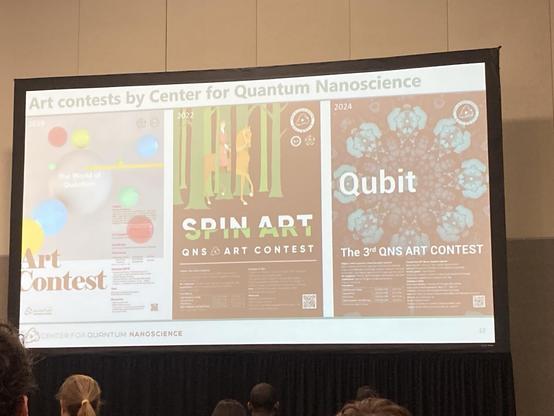
The #Quantum NanoScience Center in South Korea apparently sponsors an annual art contest with really high-level entries like dance performances and art installations. I learned this today at a session entitled Science Meets Art at the APS Global Summit in Anaheim.
Also, I learned South Korea has the third highest number of private art museums, after the US and Germany.

https://qns.science/kr/art-contest/

#art

#americanphysicalsociety
#APSSummit25

(slides from the talk by Jinkyung Kim)

Art Contest – qns.science

APS colleagues Time is Running out!

Visit @BartlettAstro & Mike Kurtz in #APSsummit25 exhibit hall (booth #1310) before 1 PM PDT to explore what SciX can do for your #physics research

#library #openscience #NASAscience #heliophysics #planetaryscience #earthscience #astrophysics

Rock'n Roll Physics Sing-Along

#americanphysicalsociety
#APSSummit25

[The DESI] incongruence could spark an era of “chaos cosmology,” says Abazajian… “No matter what, we are discovering new physics here… There’s nothing in the standard physics that allows for an evolving dark energy.” #cosmology #physics #APSSummit25

https://www.scientificamerican.com/article/frozen-cosmic-sound-bubbles-suggest-dark-energy-is-shockingly-changeable/

Frozen Cosmic Sound Bubbles Suggest Dark Energy Is Shockingly Changeable

A new map of cosmic expansion suggests that dark energy evolves over time, hinting that the universe doesn’t work the way we thought it did

Scientific American

Spin Qubit Art Installation

#APSSummit25 #americanphysicalsociety

1980s video arcade machines at the #americanphysicalsociety #APSSummit25 ... next to the booths of the quantum companies...

My summary slide at the #APSSummit25 on Monday of evidence for dynamical dark energy, which I’ll share as we wait for the DESI Year 3 results this afternoon.

Paper led by Ryan Keeley @rkeeley: https://arxiv.org/abs/2502.12667

#physics #cosmology

The Preference for Evolving Dark Energy from Cosmological Distance Measurements and Possible Signatures in the Growth Rate of Perturbations

In this study, we use a flexible parametrization of the equation of state of dark energy to explore its possible evolution with datasets from the Dark Energy Spectroscopic Instrument (DESI), Planck cosmic microwave background, and either the 5-year Dark Energy Survey (DES) or the Pantheon+ (PP) supernova (SN) compilation. This parametrization, called transitional dark energy, allows for rapid changes in the equation of state but also changes like that in the Chevallier-Polarski-Linder parametrization. We find a 3.8σ preference for evolving dark energy over ΛCDM with the DES dataset and a weaker 2.4σ preference when using the PP dataset. This corroborates the finding of the DESI Collaboration, who found that their baryon acoustic oscillation data preferred evolving dark energy when fit with the CPL parametrization of the equation of state. Our analysis reveals no significant outliers in the DESI data around the TDE best-fit, while the data is asymmetrically distributed around the ΛCDM best-fit model such that the measured distances are on average smaller. The DESI and SN data both prefer an expansion history that implies a higher dark energy density around z=0.5 than in the Planck-ΛCDM model, with the inferred equation of state being greater than -1 around z=0 and close to or below -1 at z>0.5. We show that when the expansion rate is greater than that in the Planck-ΛCDM model (around z=0.5), the growth rate calculated assuming General Relativity is suppressed relative to the Planck-ΛCDM model, and it rebounds as the expansion rate differences between the models become smaller closer to the present time. The resulting flattening of the $fσ_8(z)$ curve compared to the ΛCDM model could be an independent signature of the temporal evolution of dark energy.

arXiv.org