I thought I would unwind after filling my brain with econ at #2022APPAM by watching "Crazy Rich Asians" on the flight home, not realizing that the protagonist was an econ professor.
#econtwitter #econodon #APPAM2022

Just got home after seeing all of #Econ #EconTwitter #EconTooter at #APPAM2022

My God I am tired.

Our Aaron Sojourner on research exploring policies designed to support parental work, reduce the burden of child care costs and foster school readiness by increasing access to high-quality care. #2022APPAM #childcare #buildbackbetter #APPAM2022
If you're at #APPAM2022 or #ARNOVA22 and thinking about where to submit that big new paper, consider Social Service Review!

I'm sorry to be missing #APPAM2022 #2022APPAM. It is my first and favorite conference because it (and #JPAM) are distinctive places that feature high-quality social-science research that can also center public-policy relevance as a motivation—without apology.

I hope #APPAM and #JPAM join Mastodon soon (and maybe run an instance?).
#twittermigration #academia #policy #EconTwitter #EduTwitter @educationecon #EdPolicy #educationpolicy

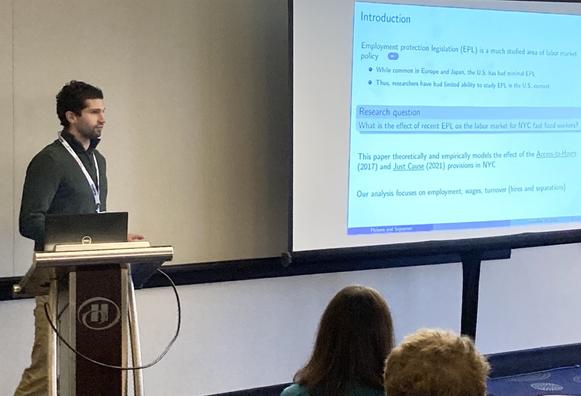
Joey Pickens of University of Minnesota presents paper with Aaron Sojourner on the New York City Fair Workweek Law. #2022APPAM #APPAM2022 (paper 45431)
Posting some pics of #Appam2022 testing features of mastodon

#2022APPAM #APPAM2022 I will be in two more great sessions today, come check them out if you're interested!

Job Loss, Unemployment Insurance and Inequality at 8:30am

Immigrant Classification and Enforcement Policies at 10:15am

#APPAM2022 is on --- right now Alex Hoagland (U-Toronto) is presenting our draft paper on the role of temporal information mis-estimates on the role of health care spending.

Hi Everyone! I'll be at #2022APPAM #APPAM2022, if people want to chat. Also check out today's session (11/17) : Chutes and Ladders: Disparities and Administrative Burden Among U.S. Safety Net Programs at 3:30pm


https://tinyurl.com/39ast274

Chutes and Ladders: Disparities and Administrative Burden Among U.S. Safety Net Programs

Research shows that participation in the federal safety net programs, such as the Temporary Assistance to Needy Families (TANF) and the Supplemental Nutrition Assistance Program (SNAP), is associated with higher educational attainment, better health outcomes, and improved social and behavioral skills among those living in income poverty. However, not all eligible families and individuals have the same experience when interacting with these programs. Program access, services, and outcomes may look different along many different dimensions such as gender, race, rural status, and else. In order to better serve all eligible families, it is important to understand what these differences look like, the mechanisms through which these differences may arise, and ways in which both policy and implementation may be improved. For this to happen in an equitable way, it is necessary to capture the perspectives of both clients and practitioners. One of the theories as to why these differences may arise points at administrative burdens placed on the applicant in order to receive benefits, but given the complexity of these programs, burden may manifest in a variety of ways for different groups of individuals.   The papers in this session catalogue exactly this. The first paper focuses on differences in TANF participation rates by race and ethnicity, within a conceptual framework that highlights the importance of considering families’ financial needs in assessing whether differences constitute disparities. The second paper then turns to one of the mechanisms through which SNAP applicants deal with administrative burden, in this case eligibility interviews, and finds an alternative intake process that increases participation rates during a field experiment. Finally, the third paper captures on-the-ground implementation practices from the perspective of practitioners delivering TANF and helps inform observed differences in uptake by race and ethnicity of income-eligible applicants.   Together, these studies shed light on the ways in which administrative burden may present itself and how it may impact different groups resulting in disparities. It also highlights the importance of cataloguing experiences from different stakeholders. These results have important implications for policy design and implementation across a variety of means-tested programs and may help propel families towards the economic stability and mobility that they seek.

APPAM - 2022 APPAM Fall Research Conference