"[W]hile [astronomers] continue to work on satellite interference issues, they are expanding their work to other topics broadly associated with space sustainability. These issues range from the threat of obtrusive space advertising and reentries that interfere with their observations to the danger of confusing asteroids with flying Teslas."

Comprehensive reporting by @jeff_foust for @spacenews_inc on Dark & Quiet Skies at #AAS245.

https://spacenews.com/as-the-night-sky-grows-crowded-astronomers-face-a-growing-problem/

#Space #SpaceSustainability #DarkAndQuietSkies #SpaceAdvertising #SpaceDebris #Reentry #PlanetaryDefense #Astronomy

As the night sky grows crowded, astronomers face a growing problem

For more than five years, astronomers have sounded alarms about the effect satellite megaconstellations would have on their observations. The launch in 2019 of the first Starlink satellites, initia…

SpaceNews

Thanks to @skyandtelescope for publishing this story about light pollution and satellite impacts on the night sky resulting from our AAS Committee for the Protection of Astronomy and the Space Environment press briefing at #AAS245.

https://skyandtelescope.org/astronomy-news/space-industry-adds-threats-to-astronomy-light-pollution-remains-a-big-problem/

#Astronomy #LightPollution #DarkSkies #Space #Satellites

And that's it for #AAS245.

I will now go back to a more sane posting volume.

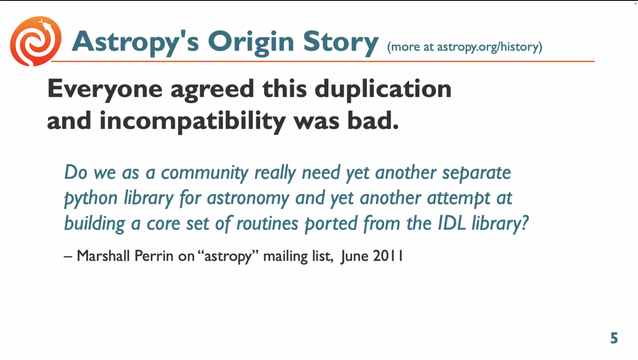
And the final talk of #AAS245 was the Berkeley Prize Lecture by Erik Tollerud, Clara Brasseur, and Kelle Cruz on Astropy.

In 2011, Tollerud was a grad student who wanted to write a unified library of astronomy packages. There were many astronomy packages, leading to duplicated work and incomparableness.

This somewhat naive desire started a discussion that eventually became the Astropy project.

Next up the Heineman Prize Lecture at #AAS245 by John Carlstrom: Past, Present, and Future Cosmic Microwave Background Surveys.

I took an intro astronomy course from Carlstrom as an undergrad, so it was cool to see him up on the stage!

And wrapping up my #AAS245 posts - Day 4

We started off the morning with Stella Offner's plenary Lecture: The Star Formation Engine.

Offner is part of the STARFORGE collaboration, which simulates the star formation process.

Star formation involves a lot of physics at a lot of scales — from gravity, magnetic fields, and turbulence that influence how gas collapses into stars, and stellar feedback processes that destroy the surrounding nebula.

Found a photo of me from the American Astronomical Society's gallery this week at #aas245.

Even from the back, there's no doubt that's me.

Found a photo of me from the American Astronomical Society's gallery this week at #aas245. Even from the back, there's no doubt that's me.
Bluesky

Bluesky Social

Wrapping up day 3 of #AAS245 with the JWST town hall (yes, I know that it was Wednesday. In my defense, there was a lot going on).

JWST is awesome, working better than expected, scientifically productive, and has more than 20 years worth of propellant.

They don’t know what the ultimate lifetime will be, but want it to be multiple decades. They are confident all of the moving parts will work for at least 10 years.

Next up at #AAS245 was the Newton Lacy Pierce Prize Lecture: The Evolution, Influence, and Ultimate Fate of Massive Stars by Maria Drout.

The study of massive stars has a long history. AAS is celebrating 125 years. Looking back at the first talk of the first meeting, it was on the spectra of stars.