
@SciBry Are you doing the upcoming winter meeting? For the 245th AAS Meeting: 12–16 January 2025, Gaylord National Resort & Convention Center, National Harbor, MD? Also did you speak last year? If so which video number are you? https://vimeo.com/showcase/10963814

#outerspace
#aas243

AAS 243 Plenaries

Vimeo

If you missed "Searching for Protoplanets in the PDS-201 System with Aperture Masking Interferometry" at #AAS243, check it out on NASA ADS or @SciXCommunity

https://scixplorer.org/abs/2024AAS...24310608Z/abstract

#planetaryscience #planets #astronomy #AASNOLO #ExploreAstronomy #USNA #USNavy #womeninSTEM

Searching for Protoplanets in the PDS-201 System with Aperture Masking Interferometry

The disks surrounding young intermediate-mass stars commonly show substructure. A recent adaptive-optics imaging survey of such systems with LBTI/LMIRCam resolved the disk in the PDS-201 system. Evidence from the spectral energy distribution and the new adaptive optics imaging suggests the presence of a large gap in the disk. A leading theory for opening wide gaps in protoplanetary disks includes dynamical interaction with forming giant planets. The architecture of PDS-201 is strikingly similar to the PDS-70 system which includes two imaged accreting planets. We targeted PDS-201 using Aperture Masking Interferometry (AMI) with the LBTI/LMIRCam instrument. AMI allows us to look closer to the star than full aperture adaptive optics imaging, enabling a probe of the disk gap. To analyze the data, we modify both the Amical and the SAMpy AMI data processing pipelines to operate on LMIRCam AMI data. We will report our initial findings.

NASA/ADS

If you missed "Searching for Protoplanets in the PDS-201 System with Aperture Masking Interferometry" at #AAS243, check it out on NASA ADS or @SciXCommunity

https://scixplorer.org/abs/2024AAS...24310608Z/abstract

#planetaryscience #planets #astronomy #AASNOLO #ExploreAstronomy #USNA #USNavy #womeninSTEM

Searching for Protoplanets in the PDS-201 System with Aperture Masking Interferometry

The disks surrounding young intermediate-mass stars commonly show substructure. A recent adaptive-optics imaging survey of such systems with LBTI/LMIRCam resolved the disk in the PDS-201 system. Evidence from the spectral energy distribution and the new adaptive optics imaging suggests the presence of a large gap in the disk. A leading theory for opening wide gaps in protoplanetary disks includes dynamical interaction with forming giant planets. The architecture of PDS-201 is strikingly similar to the PDS-70 system which includes two imaged accreting planets. We targeted PDS-201 using Aperture Masking Interferometry (AMI) with the LBTI/LMIRCam instrument. AMI allows us to look closer to the star than full aperture adaptive optics imaging, enabling a probe of the disk gap. To analyze the data, we modify both the Amical and the SAMpy AMI data processing pipelines to operate on LMIRCam AMI data. We will report our initial findings.

NASA/ADS
With many thanks to the American Astronomical Society (AAS), we are happy to report that abstracts for #AAS243 are now available in the NASA Science Explorer (SciX) library! Interested in more holdings updates? Check out the latest release reports here: https://s.si.edu/3SX5KLF
What's new

What's new

We're reminiscing on a great week in New Orleans for #AAS243 🀩

Reminisce with us in our latest news postπŸ‘‡
https://rubinobservatory.org/news/rubin-represents

Rubin Represents in New Orleans

Rubin Observatory team members joined scientists, students, and astronomy enthusiasts at a recent meeting in New Orleans

I’m quoted in this Scientific American story about a possible primordial dark/low surface brightness galaxy detected in the radio at #GreenBankObservatory, presented at #AAS243. They took out all the careful caveats of course! (But I know to expect that)
#Astronomy #RadioAstronomy

https://www.scientificamerican.com/article/bizarre-dark-object-could-be-first-known-empty-galaxy-from-the-early-universe/

Bizarre Dark Object Could Be First-Known 'Empty' Galaxy from the Early Universe

A serendipitously discovered object nearly as massive as the Milky Way appears to be made of primordial gas that has formed almost no stars

Scientific American

BZ (Well done), #midshipman!
Thank you for sharing your #NRL #research

"Searching for Protoplanets in the PDS-201 System with Aperture Masking Interferometry"

with #AAS243

#planetaryscience #planets #astronomy #AASNOLO #ExploreAstronomy #USNA #USNavy #womeninSTEM #latinxinSTEM

My abiding memory of #NewOrleans is that drivers don’t stop for pedestrian crosswalks even when the lights are flashing until you step in front of their two tons of speeding metal, and sometimes not even then. And then shout at you for making them stop. A thoroughly unpleasant city. #aas243 #NOLA
New Orleans - for #AAS243 - was scientifically a blast. But the city remains amazing. So much good music (wjblues.com yoshitakaz2tsuji.bandcamp.com amongst many others) & so much good food. Stand out: the blackened redfish at Coop's Place (www.coopsplace.net) which I had a decade ago, and have been craving ever since.
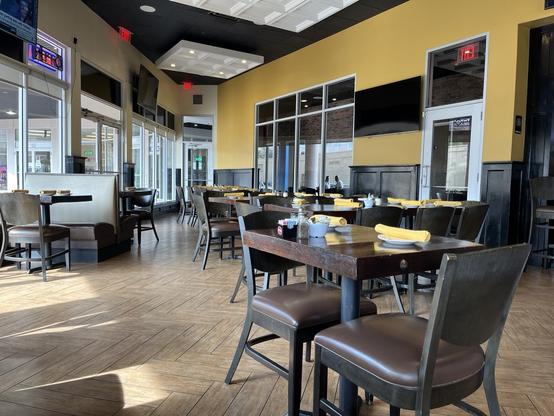
The #aas243 crowd has left town. We have the restaurant opposite the conference centre to ourselves at 12:10pm!