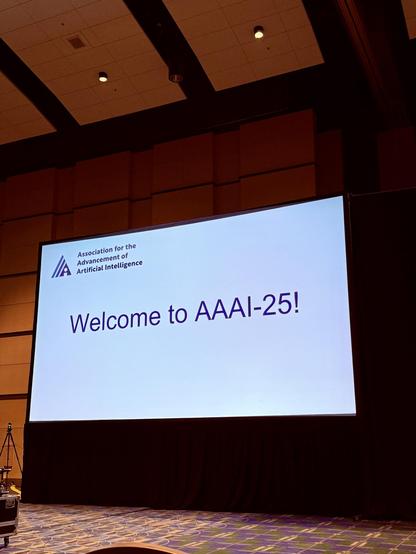
Wrapping up an amazing #AAAI2025 in Philadelphia 🇺🇸

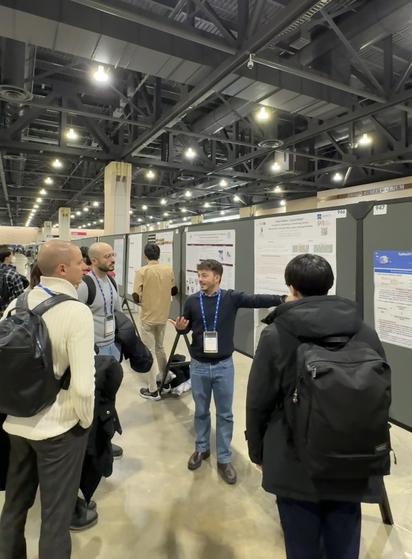
We presented our work "Open Models, Closed Minds? On Agents Capabilities in Mimicking Human Personalities through Open Large Language Models"

📝 https://arxiv.org/abs/2401.07115

Grateful to everyone who engaged with our work for the valuable feedback!
Open Models, Closed Minds? On Agents Capabilities in Mimicking Human Personalities through Open Large Language Models

The emergence of unveiling human-like behaviors in Large Language Models (LLMs) has led to a closer connection between NLP and human psychology. Scholars have been studying the inherent personalities exhibited by LLMs and attempting to incorporate human traits and behaviors into them. However, these efforts have primarily focused on commercially-licensed LLMs, neglecting the widespread use and notable advancements seen in Open LLMs. This work aims to address this gap by employing a set of 12 LLM Agents based on the most representative Open models and subject them to a series of assessments concerning the Myers-Briggs Type Indicator (MBTI) test and the Big Five Inventory (BFI) test. Our approach involves evaluating the intrinsic personality traits of Open LLM agents and determining the extent to which these agents can mimic human personalities when conditioned by specific personalities and roles. Our findings unveil that $(i)$ each Open LLM agent showcases distinct human personalities; $(ii)$ personality-conditioned prompting produces varying effects on the agents, with only few successfully mirroring the imposed personality, while most of them being ``closed-minded'' (i.e., they retain their intrinsic traits); and $(iii)$ combining role and personality conditioning can enhance the agents' ability to mimic human personalities. Our work represents a step up in understanding the dense relationship between NLP and human psychology through the lens of Open LLMs.

arXiv.org
Andrew Ng mentions a processing cost of up to $40 for a gpt4-o-mini request in his #AAAI2025 invited talk about AI, Agents and Applications. I did not fully get what this price includes. Is there any publicly available information about costs of a gpt4-o-mini prompt?

Here are the slides of today's presentation of @AnnaJacyszyn at AI4SC@AAAI2025

AI4DiTraRe: Towards LLM-Based Information Extraction for Standardising Climate Research Repositories
https://zenodo.org/records/14925185

#knowledgegraphs #AI #ditrare #aaai2025 #responsibleAI @fiz_karlsruhe @fizise @shufan @GenAsefa #digitalization

AI4DiTraRe: Towards LLM-Based Information Extraction for Standardising Climate Research Repositories

In the petabyte-era of climate research, harmonising diverse environmental and geoscientific datasets is critical to improve data interoperability and support effectiveness of interdisciplinary studies. This paper presents an idea of designing an LLM-based tool to extract and standardize metadata from climate research repositories. The solution leverages the adaptability of LLMs that are able to understand contextual nuances. By addressing common inconsistencies such as varying parameters (observation types), units, and definitions, the proposed tool will significantly improve effective data integration. It will be the first step to facilitate the creation of a unified metadata schema adhering to the FAIR principles.

Zenodo

Please keep fingers crossed for our colleague @AnnaJacyszyn who will present our paper "AI4DiTraRe: Towards LLM-Based Information Extraction for Standardising Climate Research Repositories" today at the AI4SC@AAAI AAAI Bridge on Artificial Intelligence for Scholarly Communication workshop in Philadelphia, USA.

https://sigmoid.social/@DiTraRe/114036539658314068

@fiz_karlsruhe @fizise @shufan #llm #aaai #aaai2025 #ai4sc #climateresearch #AI @GenAsefa @KIT_Karlsruhe

DiTraRe (@[email protected])

Attached: 1 image Next week, our colleague and project coordinator @AnnaJacyszyn will present our paper "AI4DiTraRe: Towards LLM-Based Information Extraction for Standardising Climate Research Repositories" at the AI4SC@AAAI AAAI Bridge on Artificial Intelligence for Scholarly Communication workshop in Philadelphia, USA. paper: https://zenodo.org/records/14872359 @[email protected] @fizise @shufan @GenAsefa @[email protected] #llm #aaai #aaai2025 #ai4sc #climateresearch #AI

Sigmoid Social

Qi is going to present our method, HARVEY, in Philadelphia at #AAAI2025 on Sunday March 2, 2pm. See you there! 😎 (5/5)

🌐 https://aaai.org/conference/aaai/aaai-25/program-overview/

AAAI-25 Program Overview and Schedule - AAAI

Learn more about the AAAI-25 Program Overview and Schedule on our website...

AAAI

I'm excited to share that our paper "Two Sides of the Same Coin: Learning the Backdoor to Remove the Backdoor" got accepted at #AAAI2025 as oral presentation (top 5%). Qi Zhao did an amazing job! 💪 @kastel @KITInformatik @KIT_Karlsruhe (1/5)

🗞️ https://intellisec.de/pubs/2025-aaai.pdf
💻️ https://intellisec.de/research/harvey

Next week, our colleague and project coordinator @AnnaJacyszyn will present our paper "AI4DiTraRe: Towards LLM-Based Information Extraction for Standardising Climate Research Repositories" at the AI4SC@AAAI AAAI Bridge on Artificial Intelligence for Scholarly Communication workshop in Philadelphia, USA.

paper: https://zenodo.org/records/14872359

@fiz_karlsruhe @fizise @shufan @GenAsefa @KIT_Karlsruhe #llm #aaai #aaai2025 #ai4sc #climateresearch #AI

AI4DiTraRe: Towards LLM-Based Information Extraction for Standardising Climate Research Repositories

In the petabyte-era of climate research, harmonising diverse environmental and geoscientific datasets is critical to improve data interoperability and support effectiveness of interdisciplinary studies. This paper presents an idea of designing an LLM-based tool to extract and standardize metadata from climate research repositories. The solution leverages the adaptability of LLMs that are able to understand contextual nuances. By addressing common inconsistencies such as varying parameters (observation types), units, and definitions, the proposed tool will significantly improve effective data integration. It will be the first step to facilitate the creation of a unified metadata schema adhering to the FAIR principles.

Zenodo