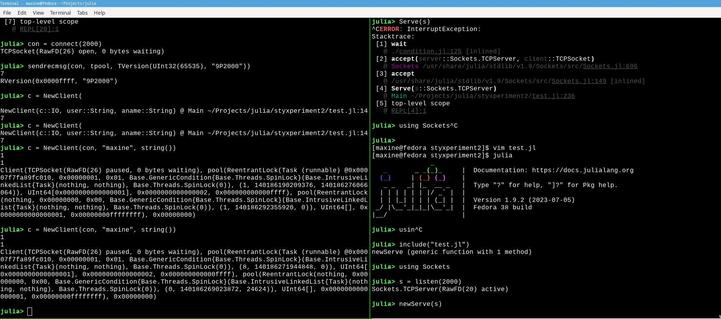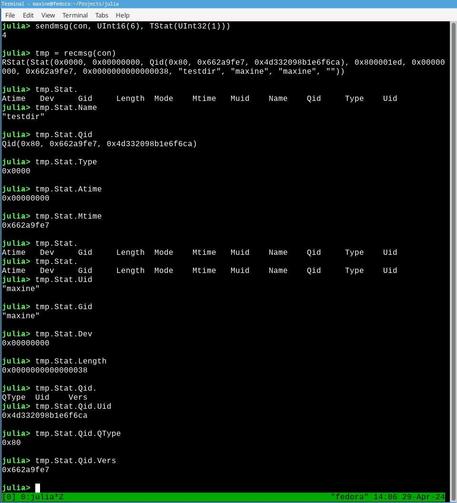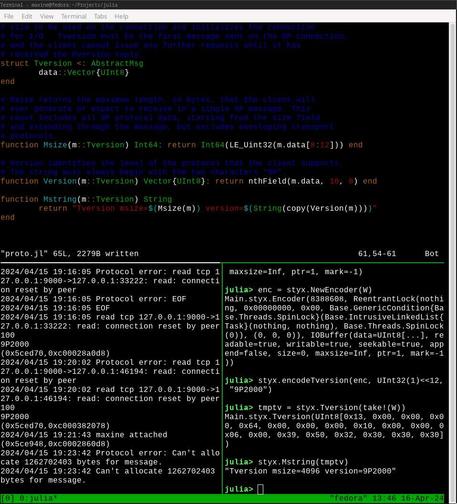
I have a basic client and server 9P2000 implementation in Julia now. The server only handles 2 messages at the moment. Tversion and Tattach. The client is able to handle any message by using a couple lookup tables. The server uses a couple functions to parse client messages. I want to experiment with making a general purpose IO API, so I can easily adapt the protocol to communicate over stdio. That's where the fun begins since that gets me started with plugin management and RPC.
#Julia #9P2000 #Development

I have a basic client and server 9P2000 implementation in Julia now. The server only handles 2 messages at the moment. Tversion and Tattach. The client is able to handle any message by using a couple lookup tables. The server uses a couple functions to parse client messages. I want to experiment with making a general purpose IO API, so I can easily adapt the protocol to communicate over stdio. That's where the fun begins since that gets me started with plugin management and RPC.

#Julia #9P2000 #Development

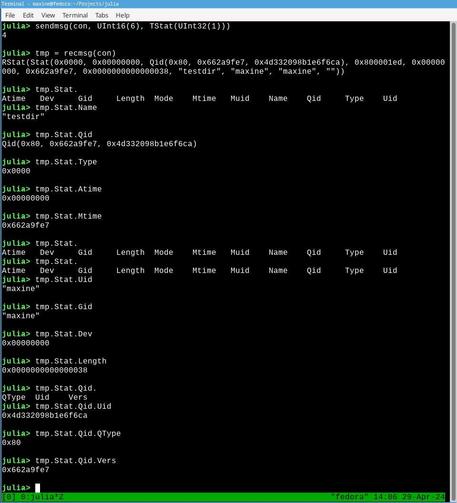
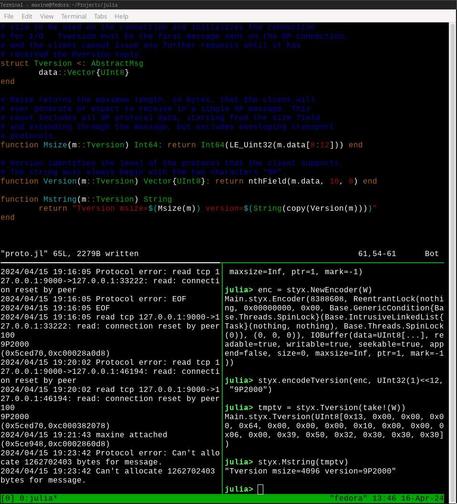
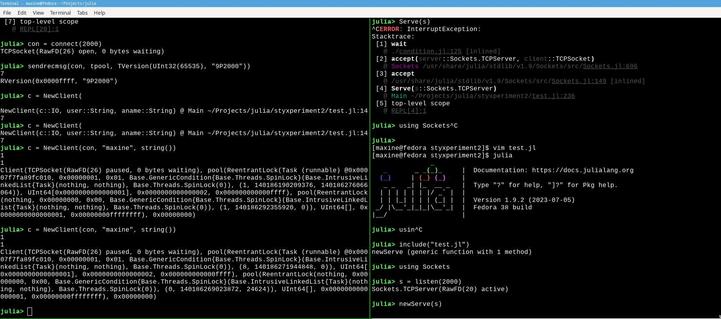
I've got a very simple and easy to use 9P2000 library going in Julia now. On the REPL I'm communicating with a server from Go9p written in Golang.

My library is around 530 lines of Julia. I want the library to be kinda like a "micro library" that's meant to be imported into projects which want to make custom 9P servers and clients.

This may tie into some EL tooling I'm thinking about doing. For right now I'm working toward a plugin management system designed around the protocol.

#Julia #Golang #Development #9P2000

I've got a very simple and easy to use 9P2000 library going in Julia now. On the REPL I'm communicating with a server from Go9p written in Golang.

My library is around 530 lines of Julia. I want the library to be kinda like a "micro library" that's meant to be imported into projects which want to make custom 9P servers and clients.

This may tie into some EL tooling I'm thinking about doing. For right now I'm working toward a plugin management system designed around the protocol.

#Julia #Golang #Development #9P2000

I've been working on a 9P2000 library for Julia as a way to refresh my brain from all the Oela Box work I've been doing. Needed something different to do for a bit to help the creativity and problem solving skills flow.

This is for the most part a translation of another 9P2000 implementation written in Golang. I find it pretty neat how similar Julia and Golang are. A lot of the code requires very few changes to get working.

#9P2000 #Julia #Golang #ProblemSolving

I've been working on a 9P2000 library for Julia as a way to refresh my brain from all the Oela Box work I've been doing. Needed something different to do for a bit to help the creativity and problem solving skills flow.

This is for the most part a translation of another 9P2000 implementation written in Golang. I find it pretty neat how similar Julia and Golang are. A lot of the code requires very few changes to get working.

#9P2000 #Julia #Golang #ProblemSolving

@syntacticsugarglider

Also see some #9P2000 (argably little) issues that becomes evident with time: http://aiju.de/plan_9/9p2020

@0gust1

9P2020 (or 9P200X?)

@xj9

... over #9p2000?

@ekaitz_zarraga

Through a simple file system protocol, #9P2000 that you can use to create/export/mount/bind file systems and a consistent design where every service is controlled through a uniform API (a file system).

You can represent anything with a file system and once it's a fs you can both share access to it or mount it wherever you want.

Devsegment for example let you allocate a memory segment that can be also accessed (and thus exported) as a file.

@amz3

Better ideas? From me? 🀣

http://jehanne.io http://www.tesio.it

To be honest the ONLY application of #GNUnet I would like to try is a #9P2000 filesystem over #CADET.

Once I see that it's doable and usable, I would implement a #FP filesystem over it (FP is an experimental file system protocol that I designed to replace 9P2000 in #Jehanne but also #HTTP, #NFS, #SMB, #SFTP and #RDP in the rest of the planet).

But I'm much more crazy than it seems: http://www.tesio.it/documents/HACK.txt

@ng0

Jehanne

Jehanne, an operating system derived from Plan9.