
@lattera 20 years ago we used WiFi for that. City wide communities built private networks spanning hundreds or more nodes.

Nowadays we have new standardized protocols like #HaLow or the #6LowPAN family for low powered devices (802.15.4).

Also BPv7 (RFC9171) for delay tolerant networking and https://en.wikipedia.org/wiki/Tor_(network) for privacy.

Mesh* are great experiments and good learning tools. But wont replace internet. LoRa was never meant for that. Sub 100kbps speed? Common, be realistic.

Tor (network) - Wikipedia

EDHOC, the lightweight key exchange for #IoT devices, is now published as #RFC 9528. It enables state of the art elliptic curve based security after exchanging 3 messages of only a bit over 100 bytes in total, thus fitting in even the lowest power networks such as #6LoWPAN and #LoRA.
Thanks and congratulations to Göran, John and Francesca for making security more affordable.
https://www.rfc-editor.org/rfc/rfc9528.html
RFC 9528: Ephemeral Diffie-Hellman Over COSE (EDHOC)

This document specifies Ephemeral Diffie-Hellman Over COSE (EDHOC), a very compact and lightweight authenticated Diffie-Hellman key exchange with ephemeral keys. EDHOC provides mutual authentication, forward secrecy, and identity protection. EDHOC is intended for usage in constrained scenarios, and a main use case is to establish an Object Security for Constrained RESTful Environments (OSCORE) security context. By reusing CBOR Object Signing and Encryption (COSE) for cryptography, Concise Binary Object Representation (CBOR) for encoding, and Constrained Application Protocol (CoAP) for transport, the additional code size can be kept very low.

Contiki NG, Linux WPAN and 6LoWPAN | mk16.de

Can Contiki NG and Linux communicate via 6LoWPAN / IEEE 802.15.4?

After a year of work, mainly by @jia200x, we now have support for #OpenDSME in our development branch. This implementation of the DSME mode of 802.15.4 allows #6LoWPAN devices to stay available in low power sleep modes without the elaborate central control of timing and channels.
@train Give it a try, it's not that hard once you let go of v4 preconceptions – and enables nice applications like #6LoWPAN ("real" #IoT 😃) that can do only v6 and is really awkward to use without a v6 uplink.

I've just thrown this little page together…

http://vk4msl.com/2023-backburn/

I'll probably get rid of it once the backburning is passed, but this is the raw data along with the current conditions. The current conditions update each minute (self-refreshing).

I might see if I can get a chart going on it, the data's there.

Data flow is from the data logger → #6LoWPAN mesh → #CoAP proxy → #WideSky back-end → #pyhaystack → JSON files to be served up by #OpenHTTPD

The pyhaystack script runs from `cron`.

2023 Back-burn air quality data

Okay… got the thing awake. I've flashed it with full-thread device firmware so it won't go to sleep… it's running on a bench supply so it won't run out of power.

I'll tweak some settings on here, see if I can get minute-by-minute samples of the air quality.

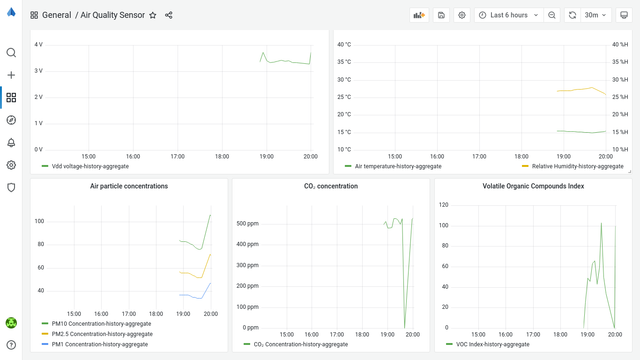
The CC2538-based device is pushing data via a #6LoWPAN network to a #CoAP server which proxies the request to a HTTP back-end. #Grafana is plotting the output.

TIL about BeagleConnect™, which makes it possible for #mikroBUS based Click boards to be connected wirelessly (e.g. via #6LoWPAN over
802.15.4) to a #linux gateway.

A virtual bus is created on the Linux gateway (e.g. /dev/i2c3) that sends "bridged PHY" #greybus messages to the remote #IoT node. The remote node runs #zephyr firmware on an MCU that speaks the Greybus protocols and translates those messages into I2C, SPI, GPIO, etc on the Click sensor (no drivers on MCU!)

https://git.beagleboard.org/beagleconnect/freedom

BeagleConnect / Freedom · GitLab

BeagleConnect Freedom long-range, low-power wireless connectivity to 1,000s of sensors, actuators and indicators

GitLab
Technical Lead Framework IOT (Rennes, France) - Acklio

About Acklio, fournit des solutions innovantes aux concepteurs d’objets, aux intégrateurs et aux opérateurs Télécom pour faciliter l’intégration des objets connectés avec les standards du monde IP et garantir leur interopérabilité. Description du poste En tant que leader technique, vous aurez la mission de piloter le développement d’un framework IOT

Acklio

RFC 8352: Energy-Efficient Features of Internet of Things Protocols

Les objets contraints, engins connectés ayant peu de capacités ont en général une réserve d'énergie électrique très limitée. L'usage des protocoles de communication traditionnels, souvent bavards, épuiserait rapidement ces réserves. Ce #RFC étudie les mécanismes utilisables pour limiter la consommation électrique, et faire ainsi durer ces objets plus longtemps.

http://www.bortzmeyer.org/8352.html

#InternetDesTrucs #6LoWPAN

Blog Stéphane Bortzmeyer: RFC 8352: Energy-Efficient Features of Internet of Things Protocols