The Alwac / Wegematic Computer Factory in Tyresö
Living in Stockholm means you’re never far from the sites of important events in Swedish history. For instance, the country’s two first computers, BARK and BESK, booted up for the first time in 1950 and 1953 at Drottninggatan 95A, just a few blocks from the city library and from two of the members of my RPG group.
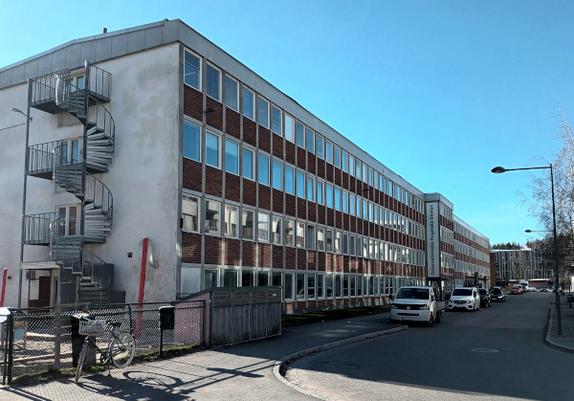
But I learned recently that there’s computer history to be had even closer than that to my home in the suburbs. The accompanying photos show the front facade of the management building of ABN/Alwac, a short-lived computer factory at Bollmora in Tyresö, just half an hour’s bike ride from my house. Construction started in 1958 and the business closed down in 1961.
ABN/Alwac is part of the sad story of the collapse of Axel Wenner-Gren’s (1881-1961) enormous industrial fortune. He made it through the company Electrolux that manufactured vacuum cleaners and fridges successfully for decades starting in 1919, until A.W-G. sold it in 1956. By that time he was 75 years old and had already been making erratic and poorly researched investments for over a decade. His last few years, including the ABN/Alwac venture at Bollmora, proved catastrophic. When he died of cancer aged 80 in ’61, the magnate’s estate turned out to have more debts than assets. He had just barely avoided bankruptcy by dying.
ENIAC, the first programmable, electronic, general-purpose digital computer, had first booted up at UPenn in Philadelphia in 1945. In 1952, Wenner-Gren bought into Logistics Research, an IT startup based in the LA suburb of Redondo Beach that made drum memory computers under the brands Aslap and Float. They had some success with the 1955 model Alwac III-E / Wegematic 1000. But the company never got its next model, the Alwac 800, to work outside the development labs – neither in LA nor at Bollmora after 1958.
ABN engineer Tor-Olle Christiansen told Pär Rittsel in 2004:
“It was a big machine with core memory and a working speed of 500 KHz. It worked in a lab environment, but when assembled on site, the length of the cables meant that the separate units lost track of the timing. All the circuits were fed from a central high frequency generator and there was crosstalk between the circuits. The idea was good, very good. On a single chip it would have worked brilliantly; with metres of cable it was a fiasco. The first customer in the US was the Federal Reserve and the contract set strict requirements for delivery time and functionality. We couldn’t meet either of these and the deal became expensive. The factory in the US was closed down, and we had to back out of the orders we had in Sweden. Bo Nyman, our boss, had duped everyone, and I think he probably ended up fooling himself and mistaking his imagination for reality.”
A.W-G. depending on Nyman was typical of the magnate’s increasingly confused final years. The company name in Bollmora, ABN, actually meant Aktiebolaget Bo Nyman, “Bo Nyman Ltd.”. He had started out in northern Sweden selling lumber that he didn’t own, and was known as “Beautiful Bosse, the mythomaniac”.
Pär Rittsel:
“In the Wenner-Gren biography The Dance Around the Golden Calf there are hair-raising examples of how Birger Strid and Nyman deceive and confuse the then 80-year-old Wenner-Gren. He is fed fantasies about orders for three Alwac 800s and 50 Wegematic 1000s. In addition, a huge project for the Swedish Census, worth SEK 107 million, new transistorized models, drum memories, intercoms (those were actually made), carrier-wave devices for the military and a number of even crazier projects such as an ionization engine for missiles, hovercraft and a gravity compensator!”
Not very many computers were ever manufactured at the Bollmora facility. But A.W-G., in typical magnanimous fashion, donated the ones that were actually made to universities around the Nordic countries. That’s what secured the plant at Bollmora a place in history. Finland’s first computer, the first computer at Oslo University, early computers at the technical colleges in Stockholm and Gothenburg – all were made at Bollmora.
And the factory buildings were solidly built. They were taken over in 1963 by the phone switchboard manufacturer Ericsson, who employed up to 1,400 people until 1993. Later the office building was used by the municipality’s adult education programme, and since 2014 it is home to one of Sweden’s most notorious profit-motivated schools.
#62 STREET ART UTOPIA
 Aardvarchaeology - by Dr. Martin Rundkvist
 Lex Friedman
 fortune
 Lollipop Cloud
 せのお (妹尾 賢)