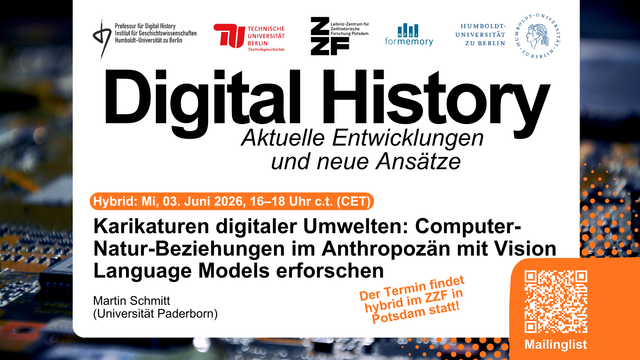
📯„Karikaturen digitaler Umwelten: Computer-Natur-Beziehungen im Anthropozän mit Vision Language Models erforschen“ präsentiert Martin Schmitt (Universität Paderborn) im #DigitalHistoryOFK in dieser Woche.

Anhand von 1.250 Computerkarikaturen zeigt er, wie Computer-Vision-Modelle neue Perspektiven auf digitale Kulturen und #Umweltgeschichte eröffnen.

📅3.06.26, 16Uhr (CET), im ZZF & online
ℹ️https://dhistory.hypotheses.org/13713
#4memory #VLM

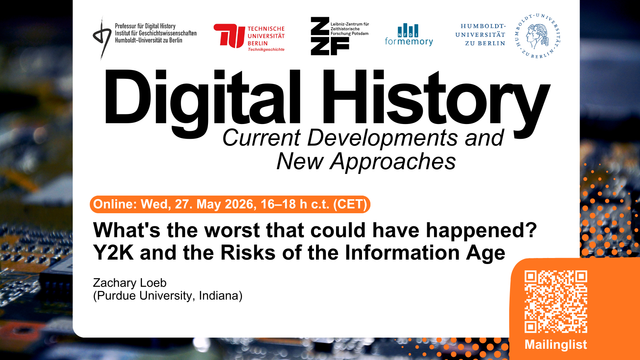
📯#DigitalHistoryOFK: Zachary Loeb (Purdue University) explores “What’s the worst that could have happened? Y2K and the Risks of the Information Age.” This talk asks how Y2K was treated as a crisis aiming to help us better understand and navigate technological risks today.

📅Wed ,27 May 2026, 4–6 pm (CET), online
ℹ️https://dhistory.hypotheses.org/13480

#4memory #DigitalHistory #HistoryOfTechnology #CriticalInfrastructure #STS
@historikerinnen @histodons @digitalhumanities

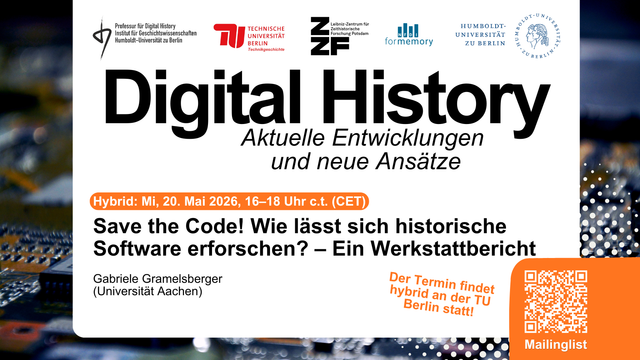
📯Diese Woche im #DigitalHistoryOFK zeigt Prof. Dr. Gabriele Gramelsberger (RWTH Aachen) in "Save the Code!", wie historische wissenschaftliche Software erforscht und bewahrt werden kann.

Software wird als fragiles Kulturerbe digitaler Wissenschaft diskutiert und das Projekt „Edition wissenschaftliche Software“ zur Sammlung und Edition historischer Software (1950–2010) vorgestellt.

📅 Mi, 16 Uhr c.t. (CET), online
ℹ️ https://dhistory.hypotheses.org/12989

#4memory #DH #Wissenschaftsgeschichte
@histodons

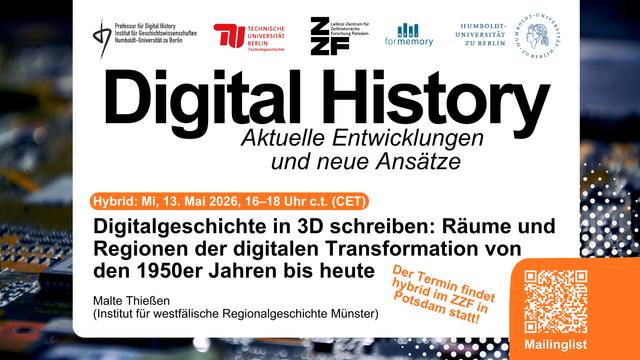
📯#DigitalHistoryOFK welcomes Malte Thießen (Institut für Westfälische Regionalgeschichte) on “Writing Digital History in 3D: Spaces and Regions of Digital Transformation from the 1950s to the Present”.

Using North-Rhine Westphalia as a case study, he explores how computers shape infrastructure & urban relations highlighting the potential of #RegionalHistory for #DH.

📅13 May 2026, 4-6pm (CET), online
ℹ️https://dhistory.hypotheses.org/13416
#4memory
@historikerinnen @digitalhumanities

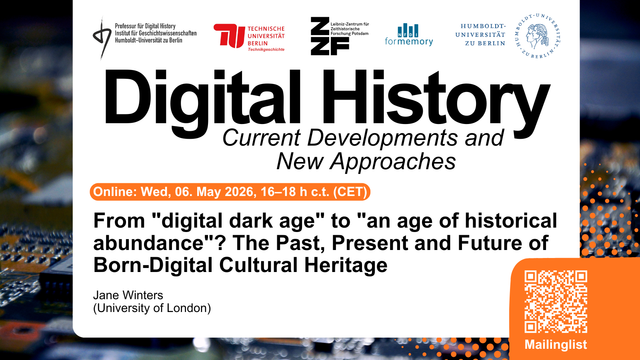
📯This week in #DigitalHistoryOFK: Jane Winters (University of London) presents “From ‘digital dark age’ to ‘an age of historical abundance’?” on born-digital cultural heritage. Exploring web archives, social media & personal data, the talk reflects on preservation, infrastructures & historical value.
📅6 May 2026, 16–18 CET (Zoom)
ℹ️Info: https://dhistory.hypotheses.org/13238
#4memory #WebArchives #DigitalPreservation
@historikerinnen
@histodons
@digitalhumanities

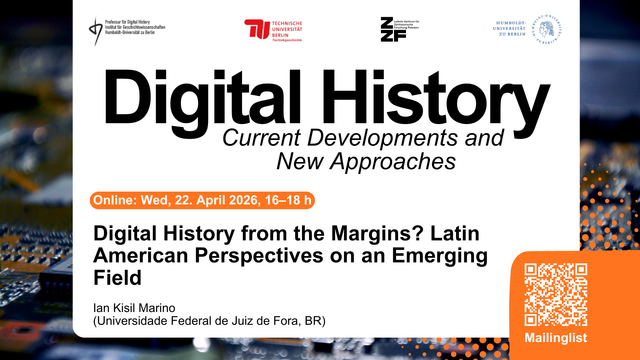
📯#DigitalHistoryOFK: @iankismar (Universidade Federal de Juiz de Fora, BR) presents "Digital History from the Margins? Latin American Perspectives on an Emerging Field"

The talk examines how inequality in infrastructure, skills & institutions shapes digital history, challenging assumptions of universal digital methods.

📅 22 April, 4pm c.t. (CET), online
ℹ️ https://dhistory.hypotheses.org/12913

#DigitalHistory #4memory #DigitalHumanities
@historikerinnen
@histodons
@digitalhumanities

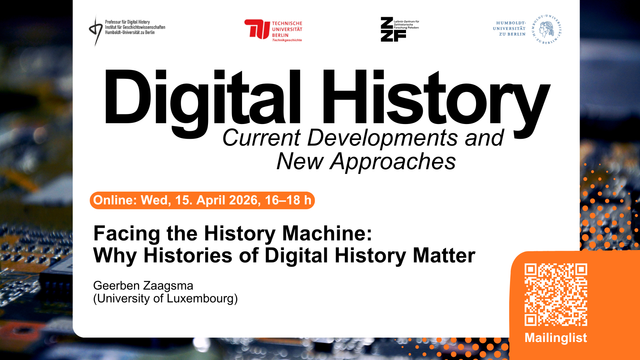
📯 This week’s #DigitalHistoryOFK: @gerbenzaagsma (C²DH, Univ. of Luxembourg) presents “Facing the History Machine: Why Histories of Digital History Matter”. The talk advocates for the central role of historiography in digital history by showing how technologies shape and have shaped knowledge production across the historical discipline.
📅 15 Apr, 4pm CET
ℹ️ Infos: https://dhistory.hypotheses.org/12800

#4memory #DigitalHistory #DH
@histodons
@digitalhumanities

📯Diese Woche im #DigitalHistoryOFK: Inga Lange, Holle Meding, Nicole Dresselhaus, Noah Baumann & Philipp Schneider präsentieren „Digital-historisch Promovieren“. Im Vortrag stellen sie ihr White Paper aus dem @nfdi4memory-Promovierendennetzwerk Digital History vor und diskutieren Infrastrukturen und Dissertationskulturen digital-historischer Forschung.

📅 Mi., 4. Feb., 16:15 Uhr (CET), online (Zoom)
ℹ️ Abstract & Infos: https://dhistory.hypotheses.org/12585

#DigitalHistory #4memory #DigitalHumanities

📯Diese Woche präsentiert Noah Baumann (HU Berlin) im #DigitalHistoryOFK: „Wandel Verstehen: Dynamische Netzwerkmodellierung & Analyse zur Rekonstruktion urbaner Mobilität im geteilten Berlin (1945–1989)“. Unter dem Prisma der Accessibility verbindet der Vortrag Infrastruktur und räumliche Ungleichheit, modelliert durch bi-temporale Property-Graphen.

📅 21. Jan., 16–18 Uhr (CET), online
ℹ️ https://dhistory.hypotheses.org/12510

#DigitalHistory #4memory #UrbanHistory

Noah Baumann: Wandel Verstehen: Dynamische Netzwerkmodellierung & Analyse zur Rekonstruktion urbaner Mobilität im geteilten Berlin (1945-1989)

Wie formte städtische Infrastruktur den Zugang zu Chancen im geteilten Berlin? Dieser Vortrag stellt einen Ansatz vor, der „Accessibility” (Erreichbarkeit) als historisch-analytische Kategorie für die Verkehrsgeschichte entwickelt um als Brücke zwischen Infrastrukturgeschichte und Fragen räumlicher Ungleichheit zu dienen. Das methodische Kernproblem besteht in der Integration heterogener Quellen, darunter Fahrplanbücher, Statistische Jahrbücher und parlamentarische Dokumente. Die … „Noah Baumann: Wandel Verstehen: Dynamische Netzwerkmodellierung & Analyse zur Rekonstruktion urbaner Mobilität im geteilten Berlin (1945-1989)“ weiterlesen

Digital History Berlin

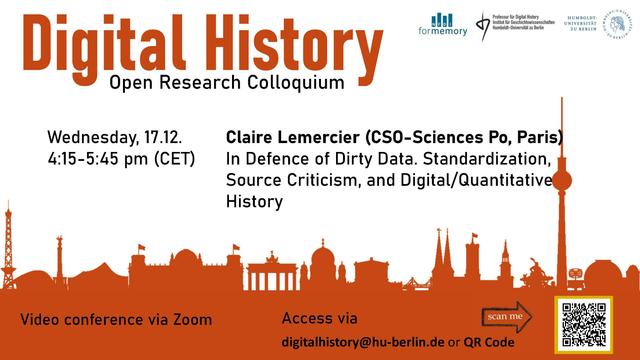
📯How can contradiction, ambiguity & missingness enrich historical interpretation? Join us at #DigitalHistoryOFK as Claire Lemercier (CNRS) presents "In Defence of Dirty Data. Standardization, Source Criticism, and Digital/Quantitative History". A reflection on source criticism and DIY quantitative history.

📅 17 Dec., 4.15–5.45pm (CET)
ℹ️ Details:

#DigitalHistory #4memory #QuantMethods #DataCriticism
@historikerinnen @histodons @digitalhumanities