Inside Canon’s Impressively Stocked Olympic Pro Camera Service Facility

The 2020 Olympics in Tokyo are well underway and despite changes that had to be made because of the COVID-19 pandemic, Canon -- like Nikon -- has set up a fully-staffed Olympic camera repair and loan facility that is home to a massive arsenal of cameras and lenses.

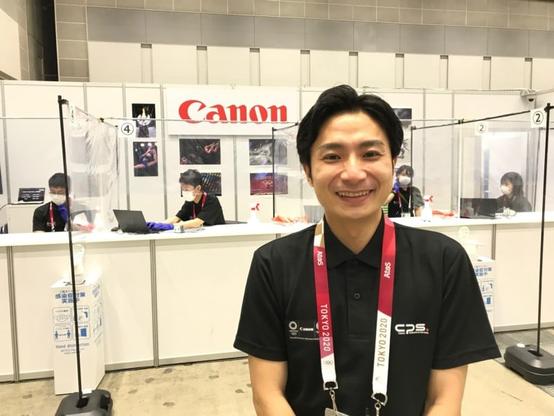
Riki Kakizaki, one of Canon's Global Sports Event Professional Support Department leads, gave PetaPixel a tour of its facility while also answering questions about the steps the company has taken to assure the safety of both photographers and its staff. The back of the facility shown in the photos below is normally off-limits to visitors.

Riki Kakizaki, Global Sports Event Professional Support Department, Photo Imaging System Marketing Headquarters

"Because the Tokyo 2020 Olympic and Paralympic Games are being held without spectators, the value of press photography is greater than ever," Kakizaki tells PetaPixel.

"We at Canon are doing our utmost to provide support for photographers so that they don’t miss a single moment of the athletes’ performances. We look forward to photographers capturing historic and powerful moments of the Games with Canon cameras. We also believe there will be a variety of use cases and photography styles made possible by such equipment as remote image capture systems."

Canon has taken dramatic steps to operate efficiently and within expectations despite the issues brought on by the pandemic and the repair facility is working on a 24-hour turnaround schedule despite all the restrictions.

"In order to provide complete service (repair, inspection, cleaning, loaning of equipment during repair), we select a location as close to the event as possible and dispatch our most highly skilled staff. In addition, we provide the necessary parts and components for the current most popular/widely used equipment so that we can make complete repairs," Kakizaki says.

"This enables us to provide speedy service, complete most repairs and return equipment to photographers in 24 hours or less. In the case of inspections and cleaning, we can generally return equipment within one hour. The greatest benefit to us is that photographers are able to continue capturing photos, without interruption, using the equipment they are most familiar with."

Photographers who bring in equipment for repair or service can expect to pick up that equipment the next day and are given a loaner camera or lens in the meantime. Additionally, Canon can provide loaner equipment if there are other issues.

"In the past, there was an incident in which a photographer’s equipment was stolen, and we specially provided them with loaner equipment so they could continue shooting," Kakizaki says. "In another case, a photographer’s equipment was damaged when an athlete accidentally collided with them. We were able to fully repair the equipment and return it to the very grateful photographer within 24 hours."

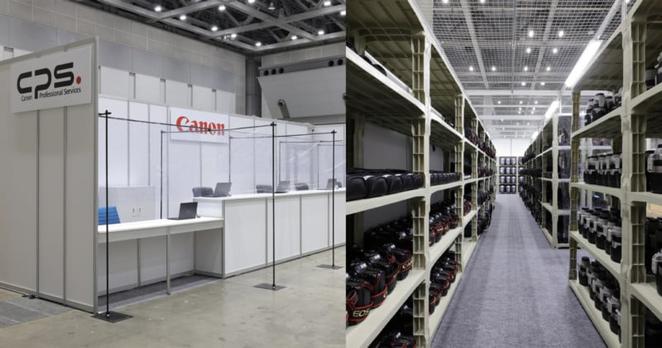
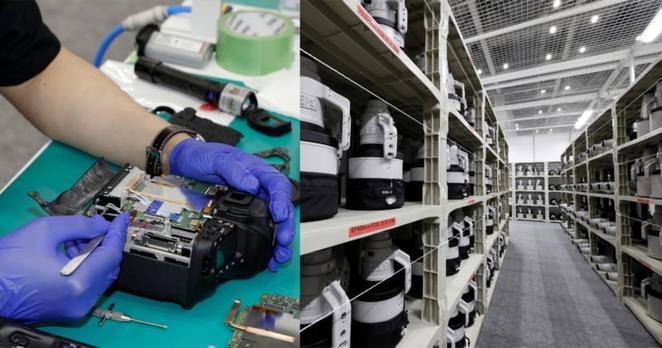
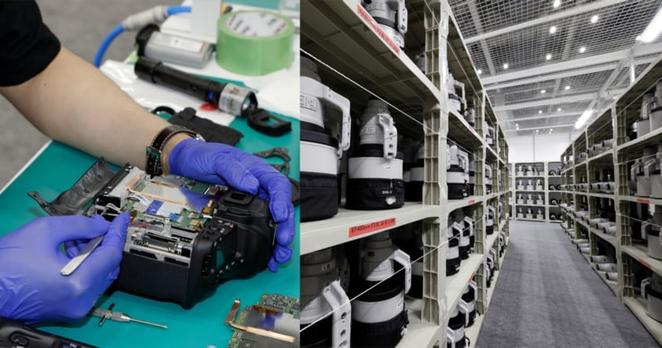
While Canon declined to comment on how many cameras and lenses it has on hand, the photos provided by the company another from Jeff Cable (who has a detailed blog post about the facility on his website) show that Canon stocked the facility fully despite early indications showing that there would be limitations on how the company could operate. This turned out to be exceptionally fortuitous, as, at the eleventh hour, Canon was allowed to operate its facility in full, though loans are only provided as replacements for equipment that is currently being repaired.

While the Canon 1DX Mark III is the primary camera used by professionals and as such Canon has the most of that model available, Kakizaki says that the company has a huge number of super-telephoto lenses, zoom lenses, and EOS R5 and R6 camera bodies available. During the tour, he showed that the most popular lens that has been requested for loan is the EF 200-400mm f/4L, the shelf for which was empty.

Photo by Jeff Cable

It is well known that there are multiple photographers at the Olympics who are currently testing Canon's forthcoming EOS R3 camera in order to have real-world testing take place so that photographers can provide feedback to Canon on how the new equipment operates. Those tests have revealed the camera will feature a 24-megapixel sensor. While Kakizaki did agree that the cameras are being tested, he and Canon stopped short of providing details on what exactly the company is hoping to hear from photographers about the R3 and what the company might do with that information. That said, the feedback will prove valuable.

"We highly value the feedback given to us by photographers who use Canon equipment, and going forward, we will continue to make every effort to respond to such feedback when developing products," Kakizaki says.

During the tour, Kakizaki showed the various levels of protection that are in place to keep the odds of contracting the virus low.

"Various measures have been taken in order to comply with regulations intended to prevent the spread of COVID-19 infections," Kakizaki says. "Due to travel restrictions, we could not bring in staff from overseas. Instead, the staff providing support at this year’s service booth are all Japanese."

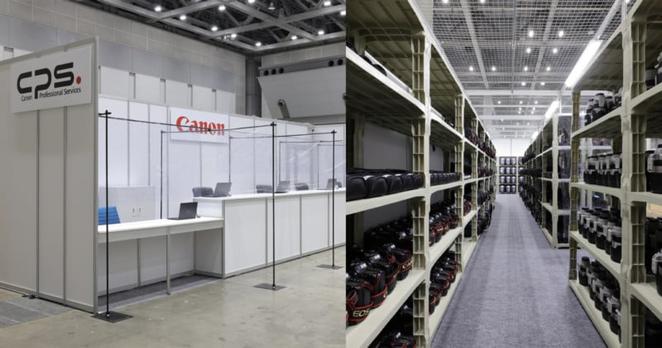
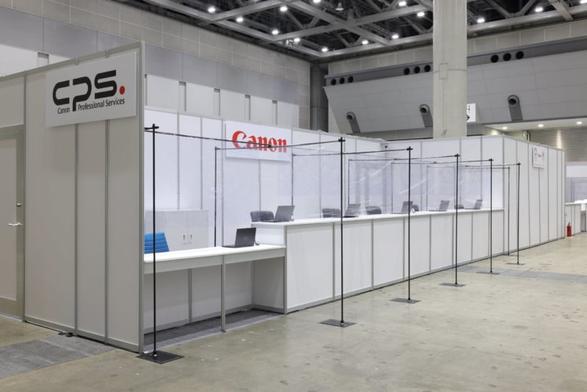
Photographers, of which over 100 regularly visit the booth daily, wait in a line that has socially distanced points along the side of the booth. There are multiple display monitors that request the use of masks, hand washing or sanitizing, and social distancing as well. When called up, the main front counter is divided into multiple sections that are cordoned off with plastic partitions. Photographers place any equipment that they want to have serviced into a basket, which is then taken to the back. In this way, there is no direct contact between a Canon staff member and the photographer. The entire surface area is also disinfected between photographers.

The repair center itself is impressively staffed, and each technician is required to wear masks and gloves while working. Additionally, plastic partitions are in place between each staff member's workstation. Canon was unable to explain exactly what happens to equipment from the point a photographer drops it off to the time it is picked up the next day, but Kakizaki did show the different stations within the facility where cameras are repaired, cleaned, tested, and stored.

The Canon Olympic professional photo service Center looks deceptively small from the front of the booth, as behind those closed doors there are racks of camera equipment and various spaces where the company's technicians can work. Canon has several specific areas that allow them to test the performance of longer focal length lenses, for example, as well as an area that can be made fully dark to allow the staff to test a camera's sensor performance in various light conditions.

For more photos that go behind the scenes at Canon's photo service center at the Tokyo Olympics, Jeff Cable has additional photos worth checking out.

Image credits: Photos provided courtesy of Canon aside from those that are specifically noted.

#features #news #2020ne #canon #canoneosr3 #jeffcable #olympics #olympics2020 #photojournalists #sportsphotographers #sportsphotography #summerolympics #tokyo #tokyoolympics
Inside Canon's Impressively Stocked Olympic Pro Camera Service Facility

Get an inside look at Canon's Olympic professional service center.

Canon to Have Olympic Gear Rentals Despite Contact Tracing Concerns

Canon has announced that it has established a full professional photo service center inside the Tokyo 2020 main press center to support Olympics photographers despite the complications with how this would affect contact tracing.

Last week, photographer Jeff Cable explained that he was told that photographers would need to supply their own camera equipment to cover the Olympics, breaking from the tradition where camera companies would have elaborate booths with huge libraries of cameras and lenses available to check out.

Just last week, Cable told PetaPixel that he is bringing all of his own equipment to Japan and has been told to only expect Canon to have enough equipment there in support in dire cases, such as if a camera or lens were to break. This requirement was supposedly imposed by the IOC to reduce the complications with contact tracing should an outbreak of COVID hit the games.

But the rules or regulations appear to have changed in the last two days, as Canon has announced that it will have a full-service booth for press photographers to take advantage of.

Canon -- who is a major sponsor of the games -- would not make such a grand announcement if it was not given permission by the IOC to do so, which means that within the last few days the rules for photographers have changed yet again.

"Canon has provided on-site support for press photographers, including camera and lens maintenance and technological support, behind the scenes at major sporting events around the world," Canon writes. "The Tokyo 2020 Games are no exception -- there too, Canon will apply its professional support know-how acquired over its long history in order to provide flexible and appropriate support for photographers and the various requests and equipment troubles they may have."

The photo center will operate under what Canon calls a "zero downtime" model, which means that photographers will offer extremely fast camera service, equipment repairs, and loans of new equipment so that photographers can always be ready and in the best possible condition.

"The Canon photo service center will provide such equipment as the company's professional flagship camera, the EOS-1D X Mark III, as well as the EOS R5 and EOS R6 mirrorless cameras and super-telephoto lenses. In addition, elite and highly trained staff will be working on-site to support photographers until the end of the closing ceremonies of the Tokyo 2020 Games," Canon continues.

Canon says that the service center will take "thorough precautions against the spread of COVID-19 infections" in order to ensure that photographers and staff may use and operate the booth safely. In photos, dividers and plastic barries are visible around the booth between those who might be standing in line and those who are behind the desks.

In a blog posted two days ago, Cable again states that his expectation was to provide all his own equipment.

"This is the first Olympics where I need to take everything with me, since Canon is not allowed to loan products to photographers (due to Covid protocol) unless it is a dire emergency. And yes, this has caused me a little extra stress this time around," he writes.

As the opening ceremonies for the games inch closer, the turbulent nature of the situation may be concerning. For example, in addition to the sponsors who pulled out of major aspects of the games last week, Toyota has announced that it is pulling out its games-related TV ads and won't take part in the opening ceremonies despite being one of the major corporate sponsors.

For photographers, the main concern thus far appears to be related to communication and what they can expect once on the ground. Answers to questions such as which forms they need to have, how those need to be submitted, what the exact regulations are surrounding movement restrictions, and when newcomers will be allowed to leave their hotel room quarantines all appear to be vague. Changing the rules around gear rentals this late in the schedule is yet another confusing communication decision that, while ultimately it is helpful for photographers, shows how fluid the situation in Japan currently is.

_Image credits: Photos by Canon Global and used with permission. _

#equipment #industry #news #2020ne #canon #canoneosr3 #jeffcable #olympics #olympics2020 #photojournalists #sportsphotographers #sportsphotography #summerolympics #tokyo #tokyoolympics
Canon to Have Olympic Gear Rentals Despite Contact Tracing Concerns

Canon photographers will have access to rental equipment, despite contact tracing concerns.

Photographers Covering the Olympics Faced With Mounting Challenges

The 2020 Olympics is set to officially begin on July 23, 2021 and while the Olympic committee is forging ahead with the event, photographers are being saddled with challenges that will make documenting it harder than ever before. As the Olympics inch closer, the pandemic looms large.

As the event inches closer it is clear that preparations are not going smoothly. Photographer Jeff Cable will be arriving on the ground on July 20 and has written a detailed blog about the evolving situation that is taking place, even now. Additionally, he spoke to PetaPixel and explained that at least for him, a team of one, the situation is thus far hectic and at times, confusing.

"I leave for Tokyo in a week and a half and I do so with very mixed emotions. Normally I am super excited to get to the Olympic city and start my preparation for the three-week adventure," he says. "But this time around is really different. I am still excited to go, but this is also mixed with the apprehension of an Olympics with major pandemic precautions."

Cable says that in preparations for the event, communication has been challenging as the situation has been changing rapidly and sometimes without warning. For example, before last week some fans were expected to be in attendance. But last Thursday, it was suddenly announced that there will be no fans at all at any of the Olympic events.

Olympic organizers are set to ban all spectators from the #Tokyo2020 Games, the Asahi daily said, as Japan declared a coronavirus state of emergency for Tokyo that will run through its hosting of the event to curb a new wave of infections https://t.co/6gt5kx1675 pic.twitter.com/J028JaSF6l

-- Reuters (@Reuters) July 8, 2021

Additionally, Cable says that there has been a slew of different forms that he has needed to fill out, return, and keep log as the Olympic organizers aren't tracking who has submitted what application.

Neither Japan nor the Olympic Committee is requiring vaccinations to attend the events, either. While he and other photographers were asked if they had been vaccinated, that information was not being disseminated and it does not appear to affect how the photographers will be treated in travel to the island nation. The Olympics appear to be operating as if no one is vaccinated, and the organizers are attempting to get everyone into a "bubble" to avoid any possible transmissions of the virus.

Cable, who is fully vaccinated, has been instructed to get multiple COVID tests before boarding the plane and will also be required to take more upon arrival in Japan and intermittently through his time there for at least two weeks.

"In the days leading up to my flight, I have to get Covid tests 96 hours and 72 hours prior my departure. Then, when I land in Tokyo, I will have to go through 10 checkpoints and have another Covid test before being let out of the airport. They say that this process at the airport could take 3 hours or more," he says.

The number of precautions and tests is in response to a rising COVID infection rate in the country. According to the Center for Systems Science and Engineering (CSSE) at Johns Hopkins University, Japan reported 2,032 new cases of the virus on July 11, the most since June 6. the number of new cases in the country has been trending upwards since June 21.

Tokyo entered a new state of emergency following a surge in coronavirus cases less than two weeks ahead of the Olympic Games https://t.co/Hg8CfL8qar pic.twitter.com/orvFmzkFvP

-- Reuters (@Reuters) July 12, 2021

As a result, Japan has entered into a new state of emergency as of July 12, and opinion polls have consistently shown that the Japanese public has major concerns about holding the international event amidst a growing wave of infections, Reuters reports.

But the Olympics are unlikely to be canceled, and instead, more restrictions are likely to be imposed on those making the journey.

Cover of the Olympics Press Playbook, courtesy of Jeff Cable.

The travel to Tokyo even from the west coast is arduous. The flight is long -- at least 10 hours, sometimes more -- and the travel into Tokyo from Narita International Airport can take an additional hour or two. The addition of three to five more hours of checkpoints at the airport will leave photographers physically and mentally drained even before arriving at their hotels.

Once there, photographers are required to quarantine for three days, except for tasks that are "deemed essential." What those essentials are, is not clear. For example, it's not known if a photographer must stay in their hotel for the full three days or if they can go out and retrieve press credentials or meet with photo managers to plan shooting locations at the specific venues. Cable in particular not sure if he will even be allowed to attend opening ceremonies, as that takes place on his third day of quarantine after arrival.

While Cable's is just one perspective, it is not unique.

Reuters reports that sponsors are "frustrated" with the lack of clarity and communication as well as upset with last-minute changes from organizers, and many have canceled or significantly scaled back booths. Of those, Canon has scrapped plans to set up promotion booths along the Olympic Promenade, two people familiar with the matter told Reuters.

According to the report, the area on Tokyo's waterfront was supposed to be a major feature open to spectators and non-ticket holders, but the Olympics organizers' new directive urges what few spectators there are to travel to and from venues without any detours, which is a major factor to multiple companies pulling out of booths. Reuters also reports that no less than 14 companies have canceled or dramatically scaled back events that were planned around the Olympics.

But it's not just public booths that are being scaled back. For photographers, the iconic "check out" booths for camera equipment are expected to be dramatically reduced over what is expected from previous events. Cable tells PetaPixel that he is bringing all of his own equipment to Japan and is only expecting Canon to have enough equipment there in support in dire cases, such as if a camera or lens were to break. Otherwise, photographers are apparently being asked to bring their own equipment.

Here are Canon's and Nikon's crazy DSLR stockpiles at the 2018 Olympics: https://t.co/XovlGiGbfE pic.twitter.com/2S0hbmQEPr

-- PetaPixel (@petapixel) February 12, 2018

"Not only will there be fewer photographers, but the support will also be much less than ever before. If you have followed my Olympic adventures from years past, you saw the room full of cameras, lenses, and other accessories that Canon (and other companies) would bring as loaners," Cable says. "That will not be the case this time around. Due to contact tracing, [the Olympic committee] does not want items being used by different photographers each day. That means that I will be traveling to Japan with A LOT more equipment than I usually have."

With this many issues cropping up still weeks before the event is slated to begin, it's unclear how smoothly the event will go. It's possible that once everyone is in place, the Olympics will recover from these bumps and will carry on without issue. But it seems that just as likely that the issues will continue to persist especially considering the state of Japan's infection rate and the public's disapproval of the event taking place at all.

All this in mind, Cable says the challenges for photographers "are building."

Jeff Cable, pictured with a pre-production EOS R3 that he will be testing in Japan during the Olympics. | Photo by Jeff Cable and used with permission.

In addition to his photo work at the event, Cable says he plans to blog daily to paint a vivid picture of what it's like to actually work the event. Those who want to follow along with what photographers are dealing with at the 2020 Olympics can subscribe to Cable's blog.

#culture #news #2020ne #canon #canoneosr3 #jeffcable #olympics #olympics2020 #photojournalists #sportsphotographers #sportsphotography #summerolympics #tokyo #tokyoolympics

Photographers Covering the Olympics Faced With Mounting Challenges

As the Olympics Inch Closer, The Pandemic Looms Large