🔗 "Olympics in Milan: The RARE LOOK inside Canon's room full of loaner equipment!"

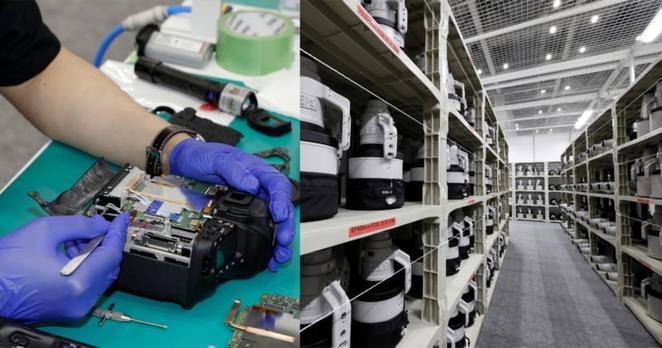
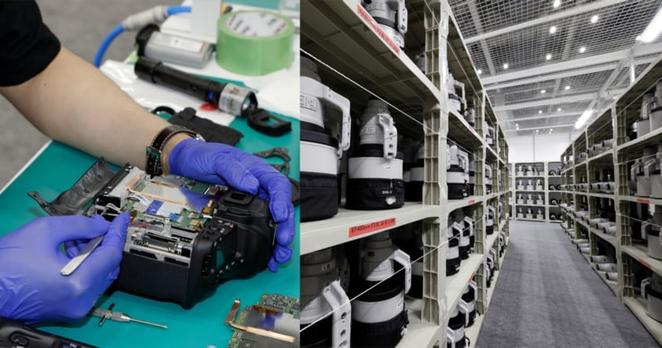
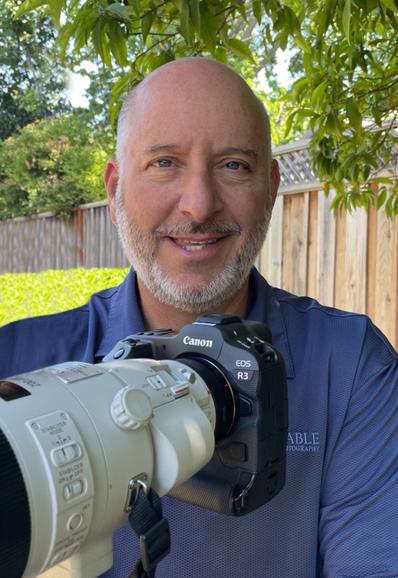
Jeff Cable took some behind the scene pics of a Canon equipment room at the Olympic Games in Milan.

👉 https://kevingimbel.de/link-blog/re-https-blog-jeffcable-com-2026-02-olympics-in-milan-rare-look-inside-html

#linkblog #SuggestedRead #Photography #OlympicGames #JeffCable #Italy
Olympics in Milan: The RARE LOOK inside Canon's room full of loaner equipment! | kevingimbel.de

A digital garden of sorts; always growing 🌱

A Rare Look Inside Canon's Incredible Winter Olympics Gear Room in Milan

"Millions of dollars of cameras and lenses."

PetaPixel
A Glimpse of Canon Heaven at the 2024 Paris Olympics

Look inside the Canon Professional Services (CPS) at the 2024 Paris Olympic Games to see the vast numbers of cameras and lenses.

PetaPixel
Jeff Cable interview talks about real-world EOS R3 use and Canon's secrecy around new gear releases - DIY Photography

We’ve posted a lot about the Canon EOS R3 over the last few months, even before its official release announcement. We’ve heard a lot about it from Jeff Cable, too, although for some of that, he couldn’t admit that it actually was the Canon EOS R3 he was using at the time. Jeff’s spoken a […]

Jeff Cable opens up about shooting the Canon EOS R3 - Is it really any good? - DIY Photography

Digital Photo Pro has posted an interesting interview with photographer Jeff Cable who recently had the opportunity to give the new Canon EOS R3 a good workout during the Tokyo Olympics. There’s been a lot of hype about the camera since it was initially announced, but does it live up to it? This is why […]

How I Review 2,000 Olympics Photos and Deliver 25 Right Away

I was joking with someone yesterday about the craziness of the Olympics, and the pressures that we are all under during the Games. We were talking about how the world has different time zones and maybe they should add another just for the Olympics. For the media here, there is absolutely no consistency to our eating and sleeping patterns and time is just different.

When a bus is 10 minutes late at home, it usually is no big deal, but here at the Olympics, when you are under deadlines all the time, ten minutes seems like an eternity. And those deadlines can be really daunting.

Editor 's note: Photographer Jeff Cable has been covering the 2020 Tokyo Olympics and documenting his journey on his fantastic personal blog.

When I first photographed the Olympics, there really was no such thing as social media and the deadlines were in the hours, not the minutes. I remember being in Beijing and people were saying, take your time getting us images because it is still in the middle of the night back home. But those days are long gone, and we live in a world of immediacy.

The team does not want to wait for hours to get my photos, they want them as quickly as I can deliver them. And I am not alone in this. The media here are either working for entities that expect images right away, or they are freelance and competing to get their images picked up by the different news outlets around the world, therefore earning them an income.

I am in a different situation, in that I do not upload my images to any of the wire services, I am shooting for the team and to post on the blog. But the team has high demands, and I don't want to let them down. So I crank out my images as fast as I can.

The good news is that the new cameras have incredibly fast frame rates and I can shoot at up to 30 frames per second. The bad news is that, since I am shooting at these crazy fast burst rates, I end up with a lot more images when the competition is over. In a typical one-hour-long water polo game, it is not uncommon for me to shoot more than 2,000 images. And I need to go through all of them, find the best ones, retouch those and get them uploaded to the team FAST! And here is how I do it:

The Cameras and Memory Cards

I am shooting with Canon cameras, using a combination of the pre-production Canon R3 and a Canon R5. Both of these cameras are really fast, and both cameras write to CFexpress memory cards. These are the fastest memory cards on the market. Not only do they allow the camera to write to them quickly, but they also let me download the information very fast.

I am currently using ProGrade Digital memory cards and ProGrade Digital memory card readers which are the fastest and highest quality on the market. The other thing I like is that the ProGrade readers attach snap onto my laptop using a small magnet, so the reader is not dangling loosely by the cord.

The Download Process

I am using a MacBook Pro 16″ from Apple and this laptop is really fast. I have two of the ProGrade Digital readers connected via USB-C and can usually download the 2,000+ images from any event in less than 3 minutes. I download all the images into Photo Mechanic because it is just blazing fast. Unlike other programs, I don't have to wait for the images to render, I can just start jamming through them, I have yet to see any photographer at the Olympics who is not using this software. I usually start the download process, grab another bottle of water, run to the bathroom, and then come back to start the culling process.

Culling the Images

Once everything is downloaded, I have two different workflow methods, depending on the urgency of the team.

1. If the team needs a couple of images immediately, I will make a pass through the photos and color code the best of the best, and get to work on those right away. I have been doing this a long time and I can spot the keeper images really fast.

2. If I have a little more time, I make a really fast pass through all the images and tag the ones that are throw-aways. These images are either not sharp enough or not showing anything of value. There are times when I will fire off a burst of images because I am expecting a big play, and it never materializes. While I am going through and selecting the throw-aways, I am also color-coding the top images. To go through 2,000 images and make these selections takes me about 15 minutes. I then select all the tagged images and delete them. I then rename all the images (which takes seconds in Photo Mechanic) to something like "USAWP-Men-vs-Japan-0001". I then filter out anything that is not color-coded and this leaves me with my keepers.

Retouching the Images

Now that I am looking at only the top images that I have selected in Photo Mechanic, I start to determine which ones actually need to go to the team. I may have 60 images that were ranked high, but some might be redundant or not tell the story that they need. Heck, sometimes I have a killer image of the goalie but the ball is behind them, where they got scored on, and the team probably does not want to highlight that.

So, I cruise through the top images and determine which ones will be retouched. If I only highlighted 25 or 30, I will retouch them all. In Photo Mechanic, I hit the "E" key and it automatically opens the image in Adobe Photoshop. I then make adjustments to the exposure, shadows, and highlights, crop the image if need be, and I will also straighten the photo if it is slightly crooked (which is almost all the time).

I then save the new JPEG file with "Edit-" in front of the file name. The Olympic Committee does not allow us to clone or make any changes to the images, because otherwise people might create images that do not reflect the reality of what we are seeing here.

Upload the Images to the Team

In the past, I created Dropbox folders for the team and uploaded all images to those folders. This year, USA Water Polo has me uploading directly to their new image cataloging system. If they need a couple of key images immediately, I can generally have them retouched and sent to them within 5 minutes. If I am delivering all the retouched images from the game (assuming I am delivering 25 or 30 photos), this can take about 20 minutes.

When they are all retouched, I select all of them, resize them to 1800 pixels and upload them to the USAWP portal. When I get home from the Olympics, at some point I will upload all the full resolution files to them as well.

Selecting Images For Me

Once I deliver images to the team, then I do a couple of other things with them. I take my ultimate favorites and move them to a Dropbox folder called "Best from Tokyo Olympics" so that I know they are safe in the cloud. I also take those same images and move them to my website. Lastly, I take the images I want to use for the blog and I save those to 900 pixels with my watermark (also done in Photo Mechanic) and upload those to the blog site. I usually add the text later, while on a press bus or in my hotel room.

Backing Up Here in Tokyo

Once I get back to my tiny little hotel room, I power up the MacBook Pro and connect a 2TB Crucial x8 SSD to the laptop to back up the day's images. I do this to at least two SSDs before I feel comfortable reformatting the ProGrade Digital cards for the next day. This way I have all the images in at least 3 places, once on the internal SSD of the laptop and on multiple SSDs.

Permanently Backing Up

When I get home from Tokyo, the first thing I will do (regardless of how tired I am) is take ALL the images from the Olympics and back them up to my Drobo 8D RAID system. This is a direct-attached hard drive system that is connected to my workstation. And then I will take all of those images and copy them over to my Drobo 810n NAS drive. This way they are backed up on my working drives for safekeeping. The cool thing is that my Drobo 810n remotely synchronizes every night at 11pm to another Drobo 810n that is located hundreds of miles away at my relative's house in the Sacramento area. This way, if I ever have a fire or something bad happen at the house, I have every digital image I have ever taken that is stored off-site.

All in all, this process does take a lot of brain processing power, and to do it numerous times a day is exhausting. But it is also fun to cull through images to see what I got after each shoot. Now I need to run -- I have more images to go through.

You can find more of Cable 's fantastic Olympics coverage and behind-the-scenes reports on his blog.

About the author : Jeff Cable is a photographer based in the San Francisco Bay Area. You can find more of his work on his website, Facebook, and Instagram. This article was originally published on Cable's blog.

#walkthroughs #behindthescenes #delivery #jeffcable #olympics #photojournalism #sports #sportsphotographer #tokyo2020 #workflow

How I Review 2,000 Olympics Photos and Deliver 25 Right Away

Photographer Jeff Cable shares his workflow at the 2020 Tokyo Olympics, where he shoots thousands of photos a day and rushes out a handful.

Olympics photography workflow: Going through 2000 images to deliver 25 selections asap - DIY Photography

I was joking with someone yesterday about the craziness of the Olympics, and the pressures that we are all under during the Games. We were talking about how the world has different time zones and maybe they should add another just for the Olympics. For the media here, there is absolutely no consistency to our […]

Inside Canon’s Impressively Stocked Olympic Pro Camera Service Facility

The 2020 Olympics in Tokyo are well underway and despite changes that had to be made because of the COVID-19 pandemic, Canon -- like Nikon -- has set up a fully-staffed Olympic camera repair and loan facility that is home to a massive arsenal of cameras and lenses.

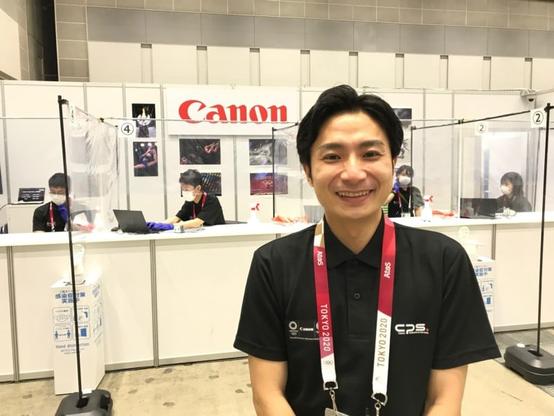
Riki Kakizaki, one of Canon's Global Sports Event Professional Support Department leads, gave PetaPixel a tour of its facility while also answering questions about the steps the company has taken to assure the safety of both photographers and its staff. The back of the facility shown in the photos below is normally off-limits to visitors.

Riki Kakizaki, Global Sports Event Professional Support Department, Photo Imaging System Marketing Headquarters

"Because the Tokyo 2020 Olympic and Paralympic Games are being held without spectators, the value of press photography is greater than ever," Kakizaki tells PetaPixel.

"We at Canon are doing our utmost to provide support for photographers so that they don’t miss a single moment of the athletes’ performances. We look forward to photographers capturing historic and powerful moments of the Games with Canon cameras. We also believe there will be a variety of use cases and photography styles made possible by such equipment as remote image capture systems."

Canon has taken dramatic steps to operate efficiently and within expectations despite the issues brought on by the pandemic and the repair facility is working on a 24-hour turnaround schedule despite all the restrictions.

"In order to provide complete service (repair, inspection, cleaning, loaning of equipment during repair), we select a location as close to the event as possible and dispatch our most highly skilled staff. In addition, we provide the necessary parts and components for the current most popular/widely used equipment so that we can make complete repairs," Kakizaki says.

"This enables us to provide speedy service, complete most repairs and return equipment to photographers in 24 hours or less. In the case of inspections and cleaning, we can generally return equipment within one hour. The greatest benefit to us is that photographers are able to continue capturing photos, without interruption, using the equipment they are most familiar with."

Photographers who bring in equipment for repair or service can expect to pick up that equipment the next day and are given a loaner camera or lens in the meantime. Additionally, Canon can provide loaner equipment if there are other issues.

"In the past, there was an incident in which a photographer’s equipment was stolen, and we specially provided them with loaner equipment so they could continue shooting," Kakizaki says. "In another case, a photographer’s equipment was damaged when an athlete accidentally collided with them. We were able to fully repair the equipment and return it to the very grateful photographer within 24 hours."

While Canon declined to comment on how many cameras and lenses it has on hand, the photos provided by the company another from Jeff Cable (who has a detailed blog post about the facility on his website) show that Canon stocked the facility fully despite early indications showing that there would be limitations on how the company could operate. This turned out to be exceptionally fortuitous, as, at the eleventh hour, Canon was allowed to operate its facility in full, though loans are only provided as replacements for equipment that is currently being repaired.

While the Canon 1DX Mark III is the primary camera used by professionals and as such Canon has the most of that model available, Kakizaki says that the company has a huge number of super-telephoto lenses, zoom lenses, and EOS R5 and R6 camera bodies available. During the tour, he showed that the most popular lens that has been requested for loan is the EF 200-400mm f/4L, the shelf for which was empty.

Photo by Jeff Cable

It is well known that there are multiple photographers at the Olympics who are currently testing Canon's forthcoming EOS R3 camera in order to have real-world testing take place so that photographers can provide feedback to Canon on how the new equipment operates. Those tests have revealed the camera will feature a 24-megapixel sensor. While Kakizaki did agree that the cameras are being tested, he and Canon stopped short of providing details on what exactly the company is hoping to hear from photographers about the R3 and what the company might do with that information. That said, the feedback will prove valuable.

"We highly value the feedback given to us by photographers who use Canon equipment, and going forward, we will continue to make every effort to respond to such feedback when developing products," Kakizaki says.

During the tour, Kakizaki showed the various levels of protection that are in place to keep the odds of contracting the virus low.

"Various measures have been taken in order to comply with regulations intended to prevent the spread of COVID-19 infections," Kakizaki says. "Due to travel restrictions, we could not bring in staff from overseas. Instead, the staff providing support at this year’s service booth are all Japanese."

Photographers, of which over 100 regularly visit the booth daily, wait in a line that has socially distanced points along the side of the booth. There are multiple display monitors that request the use of masks, hand washing or sanitizing, and social distancing as well. When called up, the main front counter is divided into multiple sections that are cordoned off with plastic partitions. Photographers place any equipment that they want to have serviced into a basket, which is then taken to the back. In this way, there is no direct contact between a Canon staff member and the photographer. The entire surface area is also disinfected between photographers.

The repair center itself is impressively staffed, and each technician is required to wear masks and gloves while working. Additionally, plastic partitions are in place between each staff member's workstation. Canon was unable to explain exactly what happens to equipment from the point a photographer drops it off to the time it is picked up the next day, but Kakizaki did show the different stations within the facility where cameras are repaired, cleaned, tested, and stored.

The Canon Olympic professional photo service Center looks deceptively small from the front of the booth, as behind those closed doors there are racks of camera equipment and various spaces where the company's technicians can work. Canon has several specific areas that allow them to test the performance of longer focal length lenses, for example, as well as an area that can be made fully dark to allow the staff to test a camera's sensor performance in various light conditions.

For more photos that go behind the scenes at Canon's photo service center at the Tokyo Olympics, Jeff Cable has additional photos worth checking out.

Image credits: Photos provided courtesy of Canon aside from those that are specifically noted.

#features #news #2020ne #canon #canoneosr3 #jeffcable #olympics #olympics2020 #photojournalists #sportsphotographers #sportsphotography #summerolympics #tokyo #tokyoolympics

Inside Canon's Impressively Stocked Olympic Pro Camera Service Facility

Get an inside look at Canon's Olympic professional service center.

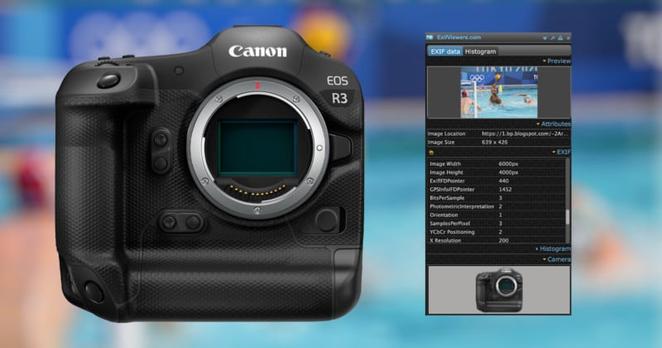
Canon R3 to Have 24MP Sensor, EXIF Data Reveals

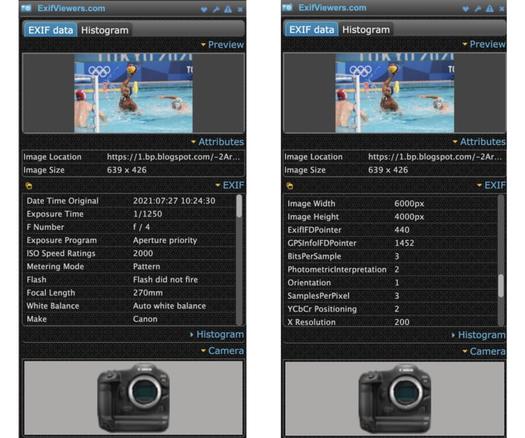
As part of ongoing testing of the Canon EOS R3 at the Olympics, photographer Jeff Cable has uploaded many photos that he has taken with the camera and EXIF data remained. As a result, the resolution of the new camera has been revealed: 24-megapixels.

EXIF data isn't visible when photos are downloaded and viewed through a program like Adobe Bridge, but the Chrome plugin EXIF Viewer Pro does work. Using that plugin, a member of the CanonRumors forum discovered that Cable's photos weren't stripped of their data and therefore the images revealed full information about the camera and lens he is using. Not only does it show that he is indeed using the unreleased R3 -- which Cable has previously confirmed -- but it also shows that the original resolution of the files was 6,000 pixels by 4,000 pixels: exactly 24-megapixels.

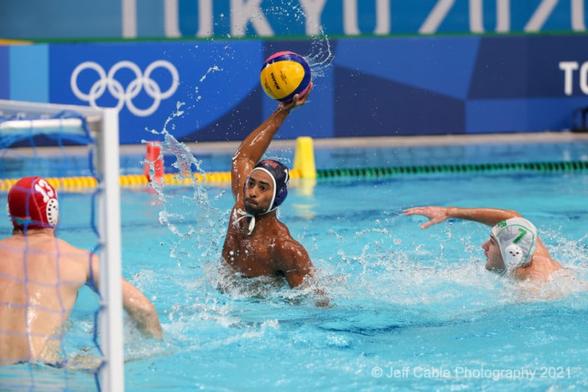
USA Water Polo - Men’s vs Republic of South Africa | Photo by Jeff Cable

PetaPixel reached out to Canon for comment, but the company declined to make a statement about the camera's resolution at this time.

The resolution of the Canon EOS R3 has been a topic of debate since Canon announced that it was developing the camera earlier this year. Multiple early reports incorrectly guessed the camera's official announcement window while others, much more strongly believed, said the camera would be at least 30 megapixels which led to wild rumors that Sony actually was developing the sensor, not Canon. Canon quickly rebuffed those rumors.

Its resolution is one of the few major specifications that Canon did not share about the R3 in either the initial development announcement or the follow-up that came two months later. While the company has publicly stated other major hardware features like eye-control autofocus, supposed low light performance, new autofocus detection modes, and the fact that the sensor would be an in-house backside-illuminated design, the actual resolution remained a mystery.

In speaking to PetaPixel , Cable said that he was not instructed by Canon to scrub the EXIF data from any photos he uploaded to his blog, and presumably, that means the company also gave him permission to upload as many as he liked while covering the Olympics. This makes a lot of sense, as too heavy of restrictions on the camera's use would make it difficult for testers to make use of any of the images they capture for events they are covering.

It was trendy to immediately compare the R3 to Sony's flagship Alpha 1 camera without knowing full specifications or waiting for a public release of the camera, but such a comparison was not particularly fair (just as those who compare the R5 to the Alpha 1 are not particularly fair either). As shown by its name, the R3 may be a sports-focused camera, but it was not going to be Canon's highest-end mirrorless model -- that is reserved for the one-series line. The R3 was likely to, at best, compete with the Sony Alpha 9 line, and sports photographers actually prefer the lower resolution because it allows them to have faster workflows with media outlets that do not require more resolution for web or print news. There is room for both classes of camera to exist from multiple manufacturers.

The confirmation that the R3 will feature 24-megapixels further solidifies that it is Canon's answer to the Alpha 9, not the Alpha 1. It may be some time yet before fans will see Canon's version of a true flagship in a mirrorless body.

_Image credits: Water polo photo by Jeff Cable and used with permission. _

#equipment #news #24megapixels #canon #canoneosr3 #canonr3 #canonrf #canonrfmount #confirmed #eosr3 #jeffcable #resolution #rf

Canon R3 to Have 24MP Sensor, EXIF Data Reveals

Resolution confirmed.

This Photographer Has a Canon R3 at the Tokyo Olympics

Photographer Jeff Cable has covered the last 7 Olympic Games for Team USA, so its no wonder that Cable is one of the few lucky photographers Canon has selected to test out the upcoming Canon R3 mirrorless camera. Cable is currently shooting with the camera at the Olympic Games in Tokyo.

Cable revealed on his blog earlier this month that he was given a pre-production R3 to test and that he was hoping to put the camera through its paces at the 2020 Olympics.

"There are all kinds of new features (that have yet to be disclosed to the public), but the camera is distinctly Canon, which makes it easy to pick up and start shooting with," Cable writes. "It is like upgrading from a familiar car to a new model with all the buttons and dials where we expect them, but with more horsepower and better handling."

Cable tells us that can't say much about the camera due to the nondisclosure agreement (NDA) he signed with Canon, but he's apparently still able to share little tidbits and sample photos here and there through his blog.

A couple of weeks ago, Cable shared a photo of the camera gear he would be bringing with him to the Games:

Four camera bodies can be seen in the photo: two Canon R5 cameras, a Canon R3, and a Canon 1D X Mark III (to serve as a backup camera in addition to the three mirrorless cameras).

Cable has been documenting every step of his Olympic journey this year in great detail, from arriving at the airport in Japan and the 20-hour quest to get to his hotel to arriving at the press center at the Games and getting settled in.

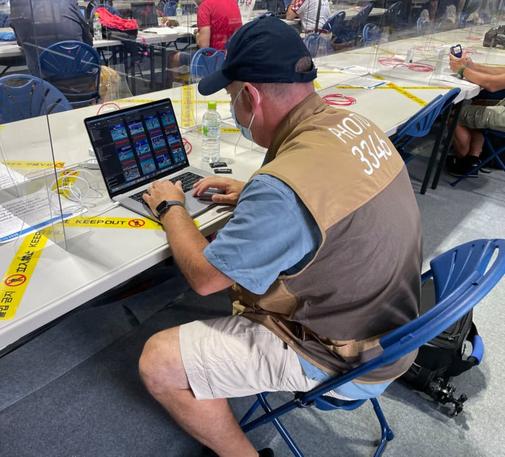
The Canon CPS help desk in the photographers' work area. The photographers' work area.

Last week, as the Games were about to be underway, Cable took the Canon R3 out for some casual testing and shooting.

"I took the camera out last night after sunset to have some fun," Cable writes. "I was just outside my hotel (since I have a 15 minute time limit due to quarantine), so I decided to try some motion pans as the cars went by in front of me.

"I saw this taxi coming by with the Olympic logo and fired off some shots. I had the camera set to ISO 800 at f/4 which gave me 1/20th of a second for my shutter speed. I moved the camera and Canon RF24-105mm lens at the exact same speed as the oncoming taxi and got this photo."

Shot with the Canon R3.

Cable then visited the Olympic Park and photographed the USA Water Polo women's team practicing.

Shot with the Canon R3. "This is one of my favorite shots of the practice, utilizing the super fast burst rate of the new camera to capture Ashleigh Johnson in the peak of action," Cable writes.

After photographing the Opening Ceremony, Cable has been hard at work covering the Games and sharing select photos and stories on his blog.

Cable at the Opening Ceremony at the 2020 Tokyo Olympic Games. Opening Ceremony

While Cable isn't stating which photos were shot by which camera, it's quite clear that at least some of them were shot with the R3. (The photos below may or may not have been captured with the R3.)

USA Water Polo Women vs Japan. "I used a couple different cameras (and yeah one might have been an R3) and tried using both the Canon 200-400mm lens and the newer Canon RF100-500mm lens," Cable writes. Both worked really well." USA Water Polo Mens vs Japan. "I am really lucky to be shooting with these newer Canon mirrorless cameras with super fast frame rates. This allows me to capture more high-quality images than ever before. It was a split second where the water curled off of the ball right into the Olympic Rings," Cable writes. USA Basketball Mens vs France. "Which camera was I using? A really good one!" Cable writes. USA Basketball Mens vs France. "I used the subject tracking on the camera which did an amazing job of locking focus on the athletes," Cable writes.

Head on over to Cable's blog if you'd like to follow along with his coverage of the Tokyo Olympics and his testing of the highly-anticipated but yet-to-be-announced Canon R3.

Image credits: Photographs by Jeff Cable and used with permission

#equipment #news #camera #canon #canonr3 #jeffcable #olympicgames #olympics #preproduction #r3 #sighting #sports #testing #tokyo #tokyo2020

This Photographer Has a Canon R3 at the Tokyo Olympics

Photographer Jeff Cable is testing a pre-production Canon R3 mirrorless camera at the 2020 Olympic Games in Tokyo.