
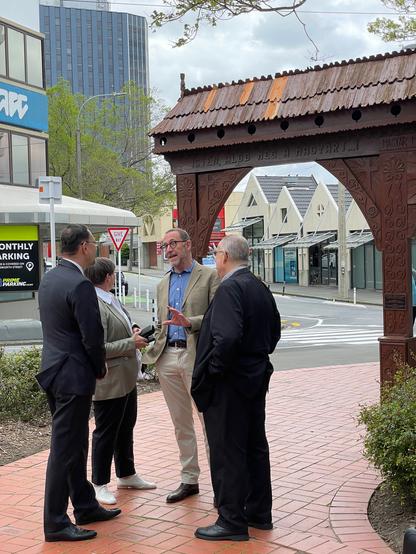
The Hungarian community in Te Whanganui-a-Tara commemorated today the 69th anniversary of the 1956 Hungarian Revolution at the Hungarian Garden. It was a great day with the weather being just perfect. Luckily, we managed to get the capital's very new mayor, Andrew Little, seen here with his wife talking to the Hungarian Ambassador (left) and the Papal Nuncio (right), who is a native Hungarian, to come along and lay a wreath on behalf of the people of the capital. All by the majestic wooden gate, carved in Transylvania, and gifted to us by the Hungarian government back in 2003.

#Hungarian #community #1956Revolution #Hungary #TeWhanganuiATara
Budapest, 23 October 1956. Today marks the 68th anniversary of the Hungarian Revolution. It started when students from a local university, seen here, marched towards the statue of Jozef Bem, a Polish General and hero of the 1848 Revolution. They are demanding independence and the withdrawal of Soviet troops. Later that evening the secret police opened fire on the demonstrators, killing many.

Source: Fortepan [222372] / János Horváth and his family

#fortepan #Hungary #1956Revolution #JozefBem

The local Hungarian community here in Te Whanganui-a-Tara gathered today at the Hungarian Garden to commemorate the 68th anniversary of the 1956 Hungarian Revolution. Attendance varies year to year, especially as many who came to Aotearoa directly after the Revolution have passed on. However, the second and third generations continue to honour the sacrifices made during that time.

And what a glorious day it was in the capital!

#Hungary #1956Revolution #Hungarians #Aotearoa #Wellington #1956

Budapest, 16 June 1989. Exactly 31 years to the day after Imre Nagy was executed in 1958, he and other prominent leaders of the 1956 Revolution are reburied at Plot 301 with full honours following a huge ceremony at the aptly named Heroes Square. Three weeks later Nagy's executioner, János Kádár died having recently been ousted from power. The revolution of 1956 had finally succeeded.

Source: Fortepan [268402] / Glósz András

#fortepan #Budapest #Hungary #1956Revolution #ImreNagy #HeroesSquare

Hungary, 1963. While the Communists remained in power, the 1956 Revolution could never be described or mentioned as such. It had to be referred to, as in this proganda poster from the Police archives, as a counter-revolution led by criminals and hooligans who plundered the 'people's property'.

(See alt-txt for translation of this poster.)

Source: Fortepan [67608] / Magyar Rendőr

#fortepan #Hungary #1956Revolution #propoganda

Budapest, 1988. After the revolution had been crushed, the leaders, including Nagy, were tried and executed by hanging. They were buried faced down, their hands bound in barbed wire in unmarked graves in the furtherest, most isolated corner of the public cemetery on the edge of Budapest, in a area known as plot 301. Nagy and the others were re-buried in 1988 and Plot 301 is now a memorial to these martyrs.

Source: Fortepan [61617] / Hodosán Róza

#fortepan #Hungary #1956Revolution #Plot301

Hungary, November 1956. After the Soviet invasion, some 200,000 Hungarians fled their country to become refugees. Most escaped across the border on foot into Austria to be resettled throughout the world, including 1300 here in New Zealand.

Source: Fortepan [256873] / Peter, Isaac

#fortepan #Hungary #1956Revolution #refugees

Budapest, November 1956. On the morning of the 4th of November, Hungarians awoke to a full-scale Soviet invasion that crushed the revolution within the day. Here we can see Soviet tanks surreptitiously photographed at the Octogon, one of the main intersections in downtown Budapest.

Source: Fortepan [79418] / Berkó Pál

#fortepan #Hungary #Budapest #1956Revolution #Tanks

Edit:clarity

Hungary, October 1956. The staunchly anti-communist Cardinal Mindszenty addresses a small crowd following his release from prison on 30 October where he had been held since 1948 after being convicted of treason. He would remain at liberty for only a few more days before seeking refuge in the American Embassy when the Soviets invaded on 4 November. He remained there until 1971.

Source: Fortepan [197816] / ETH Zürich

#fortepan #Hungary #Budapest #1956Revolution #Mindszenty

Hungary, October 1956. Boxes like this one soliciting cash for the revolutionaires and their families were common in Budapest during the revolution. The sign says "The purity of our revolution allows us to collect for the families of the martyrs". Hungarians still take great pride that the cash collected in these boxes was never stolen. That would have been unthinkable.

Source: Fortepan [39854] / Nagy Gyula

#fortepan #Hungary #Budapest #1956Revolution