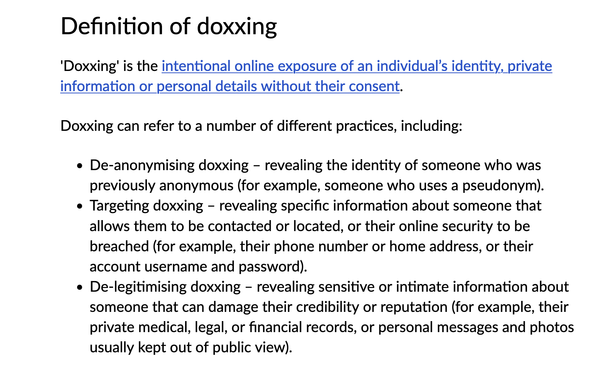
Another rushed public consultation from the Australian Government on Doxxing & Privacy Reforms closing on the 28th of March 2024.
https://consultations.ag.gov.au/integrity/doxxing-and-privacy-reforms/

| Pronouns | They/Them |
Another rushed public consultation from the Australian Government on Doxxing & Privacy Reforms closing on the 28th of March 2024.
https://consultations.ag.gov.au/integrity/doxxing-and-privacy-reforms/
Great FOI and research from Samantha Cole on @404mediaco "Texas Health Department Claims It Has Nothing to Do With Warnings on Porn From Texas Health Department"

An age verification law in Texas demands that porn sites put up a warning from Health and Human Services about the dangers of porn. But the department claims it has nothing to do with it, and no records to show.
Is anyone interested in a support group for drafting responses to the Online Safety (Basic Online Safety Expectations) Amendment Determination 2023?
I hope everyone takes some time out of their day to sign this joint letter telling the Australian Government & eSafety commissioner that they have a duty to protect the privacy and security of all Internet users.

The Australian government is currently considering draft online safety standards that threaten to undermine the use of end-to-end encryption, putting security and privacy of Internet users at greater risk. The eSafety Commissioner has proposed two draft industry standards under the Online Safety Act. Both draft standards include a range of proactive detection obligations on digital […]
The AFP has suspended its use of surveillance tool Auror after an FOI revealed over 100 of its staff had been using it without undergoing a privacy or security assessment.
My favourite (questionable) part of this saga is the text in this email; "mate whats my password"
https://www.crikey.com.au/2023/07/17/afp-auror-surveillance-tech/
Everyone should take the time to read this amazing publication "High Risk Hustling: Payment Processors Sexual Proxies and Discrimination by Design" by the amazing and insightful Danielle Blunt, Gabriella Garcia, Lorelei Lee and Kate D'Adamo and Rachel Kuo which goes into exceptional detail about the financial discrimination that sex workers face and the wider implications of that policing.
Sex workers are increasingly documenting financial discrimination when accessing banks, payment processors and financial providers. As hustle economy workers, barriers to digital financial infrastructure impact sex workers’ abilities to maintain their livelihoods, resulting in structural marginalization and vulnerability to violence. Internationally, peer-led sex worker organizations have documented payment processors that discriminate, collating public policies and user experiences. They report refusals of merchant services, being unable to open accounts, being denied loans, finance or insurance, higher premiums, and having money frozen, withheld or forfeited. In this article, we examine the policies of banks and payment providers who refuse service to sex workers, sex industry businesses and other sexual purposes. Drawing from sex worker media from two different regulatory environments, the United States and Australia, we show how sex workers are identified via multiple means, including through algorithmic detection, malicious flagging, unique business names, service descriptions, external links, use of pseudonyms, linking of personal and professional identities, and sex work activism. We argue that the ‘sexual proxies’ that identify sex workers are founded on problematic assumptions of sex as high risk and operate to capture a wide variety of uses, including access to sex education, abortion services and mutual aid funds. We position financial discrimination against sex workers as a multi-layered problem, stemming from classist, racist, transphobic, and whorephobic laws and policies, accelerated by automated risk assessments and privatization of financial infrastructure. Financial discrimination is enabled by the criminalization of sex work, and, due to the exportation of U.S. policy, continues even in jurisdictions where sex work is decriminalized, buoyed by anti-trafficking policies that conflate sex work with exploitation and identity verification policies driven by anti-terrorism and anti-fraud legislation. As a result, financial discrimination disproportionately impacts sex workers who are undocumented, marginalized or most at risk of violence. The current challenge facing sex workers is how to survive in this system, including by holding payment processors accountable. We outline a series of potential accountability measures, including an overhaul of law and policy frameworks.
Really interesting data linked in that article from:
https://pen.org/report/banned-usa-growing-movement-to-censor-books-in-schools/
From the 1,648 unique titles, 41% explicitly address LGBTQ+ themes or have protagonists or prominent secondary characters who are LGBTQ+ and 40% contain protagonists or prominent secondary characters of color.

