Jelle Zuidema

628 Followers
285 Following
272 Posts
Willem Zuidema. Associate Professor of Natural Language Processing, Cognitive Modelling & Explainable AI, at the Institute for Logic, Language & Computation, University of Amsterdam.

Want to learn how to analyze the inner workings of speech processing models? 🔍

Check out the programme for our tutorial, taking place at this year's Interspeech conference in Rotterdam: https://interpretingdl.github.io/speech-interpretability-tutorial/

The schedule features presentations and interactive sessions with a great team of co-organizers: Charlotte Pouw, Gaofei Shen, Martijn Bentum, Tom Lentz, @hmohebbi, @wzuidema, @gchrupala (and me!). We look forward to seeing you there 😃


#SpeechTech #SpeechScience #Interspeech2025

A.s. donderdag spreekt de Commissie Digitale Zaken met diverse stakeholders over digitale soevereiniteit. Experts @bert_hubert Hubert, Reijer Passchier en Paul Timmers maken zich ernstige zorgen.
https://ibestuur.nl/artikel/actie-nodig-om-de-digitale-soevereiniteit-van-nederland-en-europa-te-versterken/
Actie nodig om de digitale soevereiniteit van Nederland en Europa te versterken - iBestuur

De huidige situatie is onhoudbaar stellen drie experts in hun positionpapers voor de commissie Digitale Zaken.

iBestuur

"As the fediverse continues to grow and evolve, publishers are setting up shop in this new ecosystem. Some outlets have a fediverse strategy that complements their continued activity on traditional social media channels. Others have chosen to abandon traditional channels entirely in order to build a presence that’s more aligned with their values on the open social web."

https://medium.com/fedi-curious/lessons-on-the-road-to-reviving-journalism-via-the-fediverse-01b3748cacc5

Lessons on the Road to Reviving Journalism via the Fediverse

As the fediverse continues to grow and evolve, publishers are setting up shop in this new ecosystem. Some outlets have a fediverse strategy that complements their continued activity on traditional…

Fedi Curious?

Elon Musk is for America what Cecil Rhodes was for the British Empire: an oligarch with far-reaching powers bestowed on him to help the state to grab as much of the world’s waterways, land, resources and labor as it can
My latest for @foreignpolicy

https://foreignpolicy.com/2025/02/07/elon-musk-predatory-capitalism-colonialism-cecil-rhodes/

https://foreignpolicy.com/wp-content/uploads/2025/02/Cecil-Rhodes-Rhodes-collossus-Getty-Images-3289685.jpg?quality=90

The Predatory Capitalist Elon Musk Is America's Colonialist Cecil Rhodes

It’s not the first time that liberal capitalism has retreated—and predatory capitalists have filled the void.

Foreign Policy
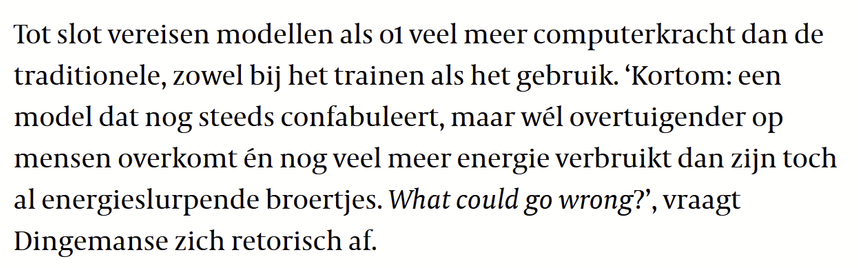
Het nieuwe AI-model van ChatGPT zou denken als een mens: ‘Vooral een staaltje briljante marketing’

OpenAI, de maker van ChatGPT, verlegt zijn koers met een nieuw AI-model. Dat moet minder fouten maken door te denken en redeneren als mensen. Hoe zit dat? ‘De onder­liggende processen zijn fundamenteel anders.’

de Volkskrant

my current thoughts on the Bluesky boom: good for them!

My time here has brought home to me how much people want very different things from micro blogging: some want a feed of fast moving, short, quippy, posts with reach (essentially early Twitter), others want slower, thoughtful (and maybe kinder) discussion, with privacy and control

if that splits into different platforms with different culture (and design), that may ultimately be helpful, and if the two systems have some degree 1/2

✨ Do current neural speech models show human-like linguistic biases in speech perception?

We took inspiration from classic phonetic categorization experiments to explore whether & where sensitivity to phonotactic context emerges in Wav2Vec2 models 🔍
(w/ @wzuidema )

📑
https://arxiv.org/abs/2407.03005

⬇️

Human-like Linguistic Biases in Neural Speech Models: Phonetic Categorization and Phonotactic Constraints in Wav2Vec2.0

What do deep neural speech models know about phonology? Existing work has examined the encoding of individual linguistic units such as phonemes in these models. Here we investigate interactions between units. Inspired by classic experiments on human speech perception, we study how Wav2Vec2 resolves phonotactic constraints. We synthesize sounds on an acoustic continuum between /l/ and /r/ and embed them in controlled contexts where only /l/, only /r/, or neither occur in English. Like humans, Wav2Vec2 models show a bias towards the phonotactically admissable category in processing such ambiguous sounds. Using simple measures to analyze model internals on the level of individual stimuli, we find that this bias emerges in early layers of the model's Transformer module. This effect is amplified by ASR finetuning but also present in fully self-supervised models. Our approach demonstrates how controlled stimulus designs can help localize specific linguistic knowledge in neural speech models.

arXiv.org
Demissionair minister Ernst Hirsch Ballin CDA Congres Rijnhal

Demissionair minister Ernst Hirsch Ballin: "Verantwoordelijkheid nemen, kan ook betekenen: nee zeggen. Ik kan alleen maar zeggen dat Ab Klink gelijk had toen...

YouTube

Not just "she says, he says" but an investigation of who has the better arguments. Not just professional AI-debaters, but people that actually do research on AI or on the impact it has. Not just "Hinton predicts the end of humanity", but some serious detail on how negative consequences may come about. Not just "there are optimists, pessimists and skeptics", but an analysis of who profits from all the hype, and who may be deliberately fueling it and why.

2/2

Imagine being "chief features writer" for the Financial Times, and for your feature on Artificial Intelligence hype you paste together a couple of quotes from the usual suspects you know from Twitter: Marcus, Bender, Chollet, ...

Henry Mance gets away with it, but I think the debate on AI & society deserve a wider set of voices, and journalists that dig a little deeper. 1/2

https://www.ft.com/content/648228e7-11eb-4e1a-b0d5-e65a638e6135

AI keeps going wrong. What if it can’t be fixed?

Pessimists warn it could wipe out humanity. Optimists hail a medical revolution. Henry Mance meets the sceptics who argue that the technology is simply flawed