
Will Soward

@willsoward
2 Followers
4 Following
8 Posts
Learning/User Experience Researcher and Designer, creator of the Neurodiversity Design System, Front-end Website Design and Development, Accessibility Defender, AI retired Illustrator and Photographer.
Websitehttps://www.willsoward.com
Linkedinhttps://www.linkedin.com/in/willsoward/
Codepenhttps://codepen.io/willsoward
ResearchGatehttps://www.researchgate.net/profile/Will-Soward-2
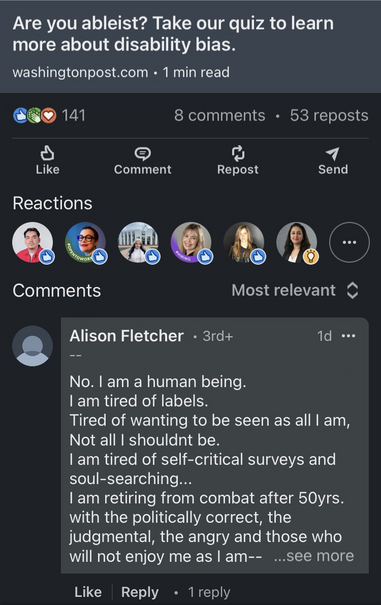
Screenshot lifted from my LinkedIn feed.
I sway back and forth with the conceptual need to define camps of human cognition. There’s no doubt bigotry and prejudice has distinctively negative impacts, however do we always see ignorance as intentional? #neruodivergent #Neruodiversity #humanbehavior
More often than not, I find myself designing a process via interview and data gathering in isolation, spitting out the result, pleased with myself that I was inclusive and used a human centred design methodology… what I really should have been doing is designing WITH humans not just FOR them. #uxdesign #accessibility #uxc
I’m wondering if the beat and rhythm of music can be used to prime a brain ready for learning, supporting some success, at least, to engage with online educational content. There’s definitely something happening physiologically, and harnessing 40bpm might help our neurodivergent learners. https://overcast.fm/+2-B8eIUFc/19:47 #lxdesign #uxdesign #onlinelearning #neuroscience #neurodiversity #accessibility
Focus Toolkit: Tools to Improve Your Focus & Concentration — Huberman Lab

In this episode, I provide a list of behavioral, nutritional, and supplement-based tools you can use to improve your ability to get into a focused state to do mental or physical work. I explain science-supported strategies for transitioning into focus, maintaining focus during the work bout, and exiting the focus session, which is also critical, including decompression/defocusing tools. I explain when and how to use: binaural beats, caffeine, deliberate cold exposure, the pros and cons of working in fasted vs. fed states, and supplements and foods that enhance dopamine, epinephrine (i.e., adrenaline) and acetylcholine to promote optimal focus. Also, I explain how short behavioral practices, such as meditation and visual gaze training, will benefit your ability to focus over the long term. As deep focus is crucial to significantly improve cognitive or physical performance in any realm, this episode should be useful to anyone. By the end, you’ll have an essential toolkit of science-supported, low- to zero-cost…