techno-archaeology aux: I just published a decoder for Installer VISE archives (mac installers from the 90s). it's a rust crate called unvise, and it's MIT licensed: https://github.com/jpt/unvise
it works on all VISE versions for mac up through 3.07, and as far as I'm aware it's the first decoder for the format, which was created by MindVision software. some notes about VISE on Archive Team's wiki: http://fileformats.archiveteam.org/wiki/Installer_VISE
#mac #os8 #os9 #macos8 #macos9 #vise #installervise #decode #classicmac #archive #mindvision

GitHub - jpt/unvise: Extract files from Installer VISE archives, an installer format from the 1990s
Extract files from Installer VISE archives, an installer format from the 1990s - jpt/unvise
We invite you to submit proposals to be part of this exciting program. The deadline for submissions is June 1st, 2026.
Two types of submissions are possible:
– Tutorials: one or more 90-minute slots for interactive, workshop-style classes meant to build relevant skills
– Sessions: a 45-minute slot for a delivered talk, encompassing research seminars, case studies, and more
Please take a look at the key dates below, and share widely with your networks!
May 15: Early Bird Registration opens
June 1: Call for Submissions closes
June 23: Session hosts notified
August 1: Early Bird Registration closes
August 2: Regular Registration opens
October 20-21: UTW 2026 —Tutorials
October 22-23: UTW 2026 —Sessions
https://www.unicode.org/events/utw/2026/sessions/
Call for Session Proposals
Event program for the Unicode Technology Workshop 2026, Oct. 20-23, hosted at Atelier National de Recherche Typographique (ANRT)
why do all of the terms of art in structural engineering sound so painful
in 2D (even in 3D space) this is a different set of problems because you can tessellate based on zoom cheaply (like what Vello does), or do something like Loop-Blinn to fill in curves with a fragment shader. but I haven't yet found a good way to produce text as real geometry - extruded, lit, deformable - in a compute shader, and suspect it's not a very realistic idea
I've changed my mind on this a few times after fixing a broken algorithm implementation, but I'm starting to think a two pass approach to polygonization - fixed-step De Casteljau and then line simplification (using Visvalingam-Whyatt) - is almost always better for curve quality compared to adaptive subdivision. adaptive subdivision (in three-text's case the algorithm from Anti-Grain Geometry) makes locally optimal decisions per curve segment, but the oversample-then-simplify approach distributes points more evenly across the whole contour. and the cost to compute either is trivial. but it's possible I'll change my mind again, maybe when multiple glyphs with very different curvature are involved...
anyone have a recommendation for a paid, EU-based email provider with a good track record on data breaches and customer support? I'd disabled "smart features" in google workplace, but this latest AI feature trying to tell me which words to express myself with as if it's spell-check is a line I won't cross. fastmail, which I've used in the past, is nice, but they're in australia, which is part of the "five eyes" that share data with the US. three options I've come across in my initial search: mailbox.org, proton mail, and tuta. any others? good/bad experiences?
me at 3am eyeing expiring patents
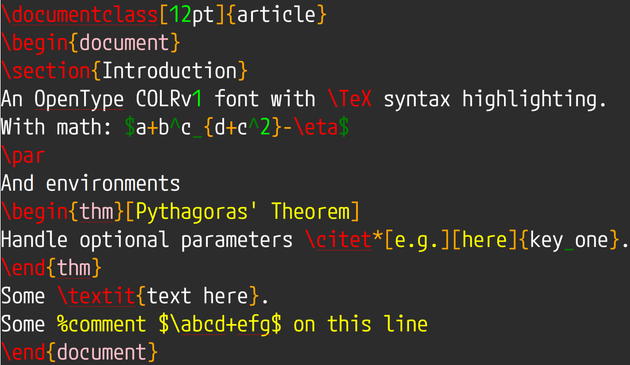
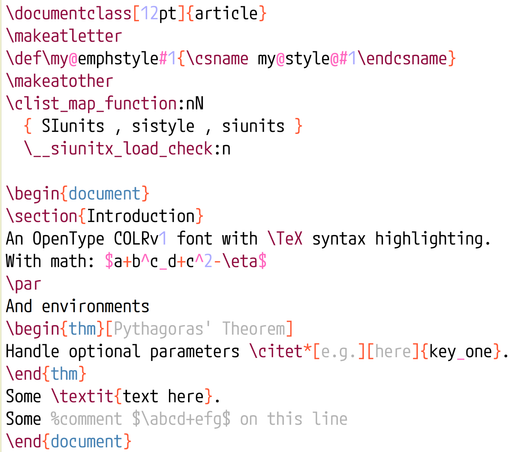
Inspired by the syntax highlighting font by @gdc, I have developed an OpenType colour font with built-in syntax highlighting of TeX documents. This was presented at the TUG2025 conference.
Some details and more links in the blog post: https://rajeeshknambiar.wordpress.com/2025/12/27/a-font-with-built-in-tex-syntax-highlighting/
so either evaluate for failure and re-triangulate, or if checking for that is too expensive or difficult, well, this line of thinking is a bust. currently you can easily get 60+ fps for single lines of text in three-text, it's trying to redraw whole paragraphs where you can feel some of the CPU bound constraints kick in which is what led me down this rabbit hole
I've been experimenting with cage-based coordinate systems to re-triangulate a variable font as little as possible while adjusting along arbitrary axes. without evaluating for failures (which may not be viable, idk), many problems arise when trying to create one topology to rule all masters: you can see one here in the intereior corner of the upper serif, where a triangle cuts straight across the curve boundary

 ANRT
ANRT
 Rajeesh KV