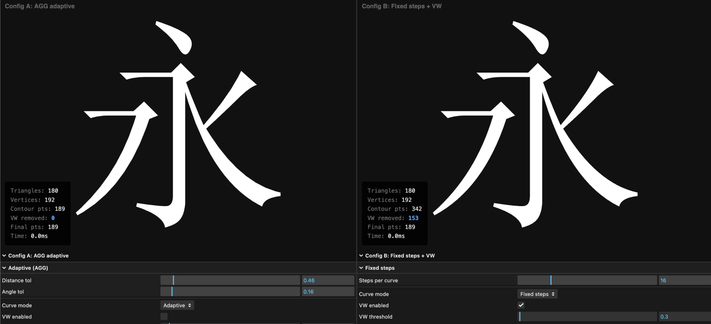
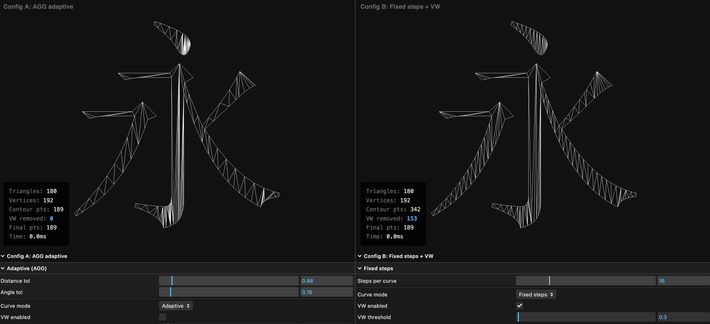
I've changed my mind on this a few times after fixing a broken algorithm implementation, but I'm starting to think a two pass approach to polygonization - fixed-step De Casteljau and then line simplification (using Visvalingam-Whyatt) - is almost always better for curve quality compared to adaptive subdivision. adaptive subdivision (in three-text's case the algorithm from Anti-Grain Geometry) makes locally optimal decisions per curve segment, but the oversample-then-simplify approach distributes points more evenly across the whole contour. and the cost to compute either is trivial. but it's possible I'll change my mind again, maybe when multiple glyphs with very different curvature are involved...
in 2D (even in 3D space) this is a different set of problems because you can tessellate based on zoom cheaply (like what Vello does), or do something like Loop-Blinn to fill in curves with a fragment shader. but I haven't yet found a good way to produce text as real geometry - extruded, lit, deformable - in a compute shader, and suspect it's not a very realistic idea

@tribby I'm not sure where the compute shader comes in to the picture, but extrusion is handled well by SDFs.

Two or three lines of code is needed to turn the 2D SDF for a glyph into a 3D extrusion. You can then raymarch it.

Rendering that geometry to a mesh is a bit less elegant: https://github.com/deadsy/sdfx

Don't pay too much attention to me though, I haven't really played with SDFs.

@theohonohan thank you! I’ve wanted to learn more about SDF in general. there may ultimately be a couple of (tree-shakable, hopefully not too bloated) pipelines in three-text for different kinds of rendering. M/SDF can’t seem to get quite sharp enough for my taste with the libraries I’ve tried so far, but we are just a few weeks away from the loop-blinn patent expiring for those who might want infinitely scalable flat text..