Great piece in the MIT Technology Review on the smart city and what’s next for Toronto’s waterfront after Sidewalk labs.
https://t.co/KiPIbbRhjf
Toronto wants to kill the smart city forever
The city wants to get right what Sidewalk Labs got so wrong.
Mastodon seems so much cleaner than Twitter now. It’s also nice that I don’t have content from the megalomaniac (Elon Musk) forced on my feed. Now, how can we build the network effect on here, and get more people to migrate…
I’m thrilled to be in Cagliari for the EGOS conference
#egos2023Seems like a good day to recommit to using Mastodon
Join us in Cagliari! We welcome submissions to our 2023 EGOS Sub-theme 12 "Institutions, Innovation, Impact: How to Conduct Institutional Research that Really Matters" EGOS (European Group for Organizational Studies). We invite review, meta-methodological, theoretical and empirical papers. By discussing the methodological preferences in the study of institutions, and their affordances, we hope to open a space to rethink methodology and philosophies of science.
It’s great to see people on here reviving the
#followfriday practice. Here are some inspiring accounts I follow:
@andrew @LauraNelson @TedUnderwood
@bernardforgues @cbail @bkeeganAs a first post on here, (and inspired by Ethan Mollick's recent post on Twitter - he's not on mastadon yet) I want to share this HBR piece by Raffaella Sadun. This seems particularly appropriate given current issues at Twitter HQ. “Boring management matters and it is a source of competitive advantage for the companies that take it seriously”. We need to move beyond myth of the charismatic superhero CEO, and appreciate the virtues of serious leaders (and bureaucracy)
https://hbr.org/2022/11/the-myth-of-the-brilliant-charismatic-leader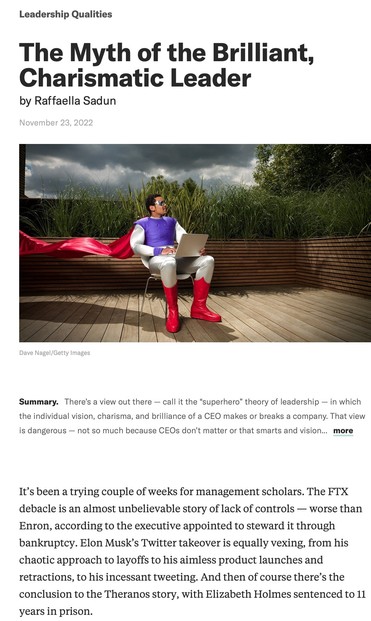

The Myth of the Brilliant, Charismatic Leader
There’s a view out there — call it the “superhero” theory of leadership — in which the individual vision, charisma, and brilliance of a CEO makes or breaks a company. That view is dangerous — not so much because CEOs don’t matter or that smarts and vision don’t help. It’s dangerous because of what it leaves out. Great leadership takes both generic skills and context-specific ones. The most effective leaders have knowledge and social skills that are specific to their company and industry that allow them to motivate other people in the organization to do what’s necessary to succeed.




 Bart Bonikowski
 Brian C. Keegan, Ph.D.