RE: https://www.threads.net/@cnn/post/DDRuspwKMyT
#象友互科
| https://twitter.com/Thomassumthing |
Two years later.
Want to know one of the major reasons Mastodon didn't catch on with journalists and large website owners?
It is *invisible* in referrer statistics.
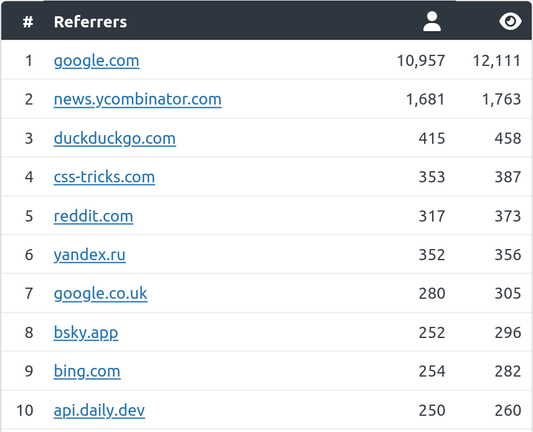
Here's my blog from the last month.
BlueSky now sends me more traffic than Bing.
How much traffic does Mastodon send? It is impossible to know due to the "noreferrer" header in all links.
(I'm not saying your privacy isn't important. But you can't grow a community if no-one knows you exist.)
The actual outcome of this election with •the whole US population• as the denominator:
22% voted for Harris
23% voted for Trump
<1% voted for other
26% eligible but did not vote*
28% not eligible to vote
* (whether by choice or by voter suppression)
Numbers might shift a tiny bit as last votes are counted, but this is close to the final tally.
Just sit with that for one quality minute. Think about what stories people are telling about this election. Then think about what stories are true.
@james well in the last Twitter exodus when people came to Mastodon, they didn't like how they were treated. Telling them to use CWs, telling them there are instances other than m.s, and decided we were toxic.
As well as a few other things that are probably valid. Like I think some instances are probably heavy-handed when it comes to blocking other instances.
I was complaining in my previous toot, but I guess people are just gonna use what they like. Apparently Mastodon isn't most peoples' cup of tea and that's okay.
Yesterday's news leads me to forecast the next big thing in SF/F genre fiction: the Cosy Dystopia—a future or fantasy setting in which the backdrop is ghastly but the sympathetic protagonists are running a tea shop in the borderlands.
Think Warhammer 40,000 space marines, with added knitting. (Narrative focus STRONGLY on the knitting.)
I am not hopeful. I am quite sad.
Elon Musk essentially bought the election when he bought Twitter.
Journalists could have left Twitter, and had it go the way of MySpace. Instead, they continued to legitimize it, thereby giving it life.
For the next four years, decentralized social media will be needed – if only as an alternative to the faux-progressive media that seek to control the public square.
The world is becoming more and more authoritarian, and we need an antidote.