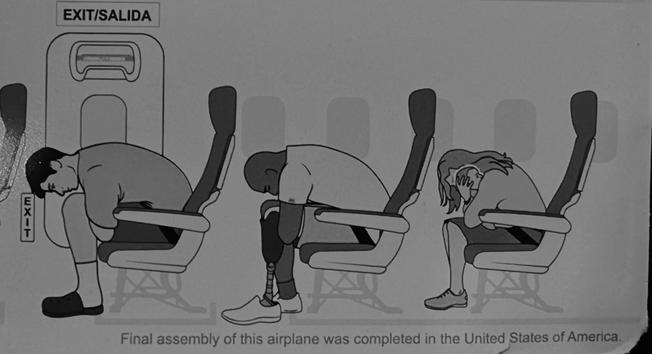
I like how lowkey-inclusive the illustration on the 737 safety sheet is—woman holding a baby, dude with a prosthetic leg, and crocs.

| Location | San Francisco |
| Bluesky | https://bsky.app/profile/yaoyue.org |
| Hub | https://yaoyue.org |
| Work | https://iop.systems |


We should all try to start a block party to bring people together. There's even a fund in San Francisco! https://docs.google.com/forms/d/e/1FAIpQLScYsQHTzVhBeGc2gQdpm3DGshs9GaQTvGSMeeR8NArfEtEpoQ/viewform
Look at this free arrangement I made at the party, with flowers largely funded by the SF Block Party Fund 😀.

My husband has been doing some research on compasses, and he pointed me to a paper [1] that claimed the Chinese character 東 (east) came from a glyph depicting the Indian Circle [2], a simple and precise method to orient oneself by Sun.
This seems much more plausible than the popular explanation, which was the Sun (日) rising from behind a tree (木).
The paper is a fun read if you are into Chinese or geometry, pictures are from the paper.
[1] https://lockwoodonlinejournals.com/index.php/jaos/article/view/796
[2] https://nabataea.net/cinema/navigation-and-the-qibla/navigation-and-the-qibla-5-the-indian-circle/

The Chinese character ⟨東⟩, writing a word meaning ‘east’, is shown here to have arisen in connection with the use of the vertical gnomon in the determination of cardinal direction. The simple geometric procedure involved—by Al-Bīrūnī (973–1048) termed the “Indian Circle”—is attested across a number of other early cultural contexts, and has a Chinese history traceable from classical-era technical treatises such as the “Kǎogōng jì” 考工記 to sixth-century commentary to the mathematical text Shùshù jìyí 數術記遺 . Evidence offered below constitutes the first direct indication for such a practice in second-millennium BCE China .
I have had this 30 year old Chinese song stuck in my head ever since the vigil. It was a song for another family that was destroyed by car accidents https://www.youtube.com/watch?v=3Q6XMIlyTy4
Here's the lyrics and my translation.

<p>The Journal of Transport and Land Use is the leading international journal that publishes original interdisciplinary papers on the interaction of transport and land use. The Editors welcome original submissions across the globe and from a wide range of domains, including engineering, planning, modeling, behavior, economics, geography, regional science, sociology, architecture and design, network science, and complex systems.</p>
Look at this view from across the bus stop—site of the crash. The hills, the station, the trains. Don’t you think it’s a beautiful location for a plaza for all people?
Then look at the transit map—isn’t it too useful a transit hub to be constantly interrupted by cars?

