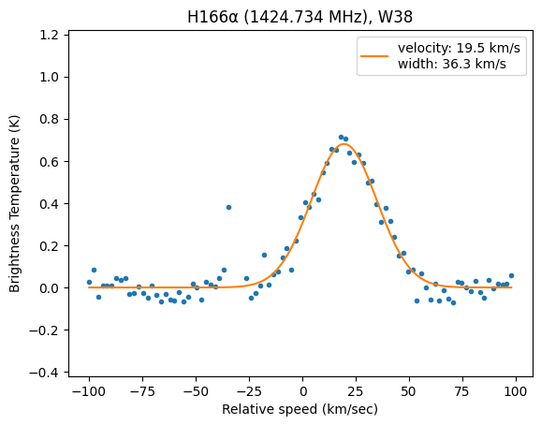
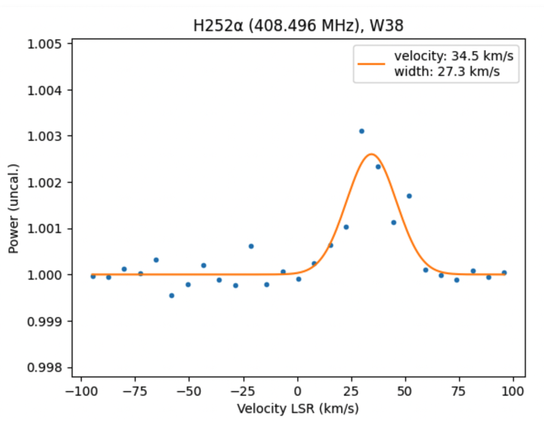
At even higher excitation levels (n=252) we can measure the radio emission in the UHF band (408 MHz).
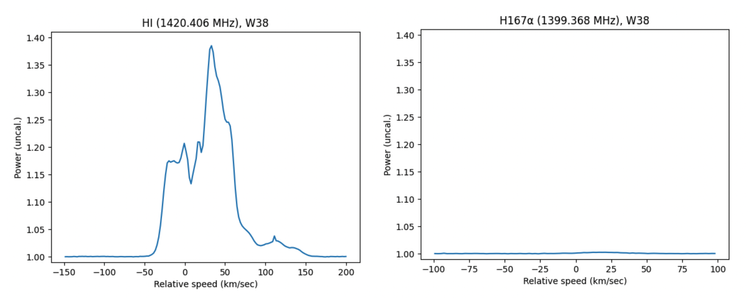
These lines are weak and take a long integration time (30 minutes+) to become visible. For comparison, this is the H167⍺ RRL at the same scale as the neutral Hydrogen (HI) profile at M17.
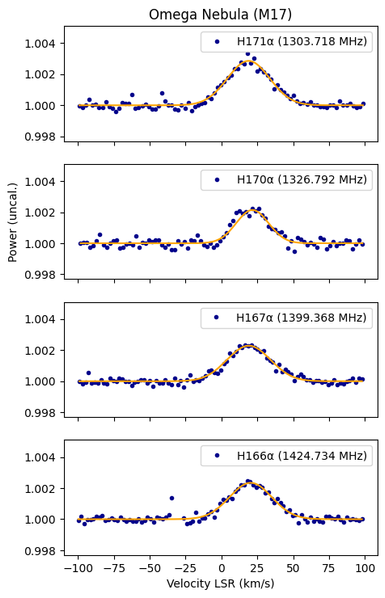
These are spectral lines in the radio spectrum that arise from the transitions of electrons between high energy levels in atoms (n>90), when electrons recombine with ions in ionized gas regions, like HII regions. They are essentially the radio counterparts of the Balmer series of lines (n=2), which are visible light lines. In L-band we can detect 4 of these lines, from different energy levels.
Measuring Radio Recombination Lines (RRL) with the Dwingeloo telescope (
@radiotelescoop ), in the Omega Nebula (M17/W38).