 Sandy Lawrence
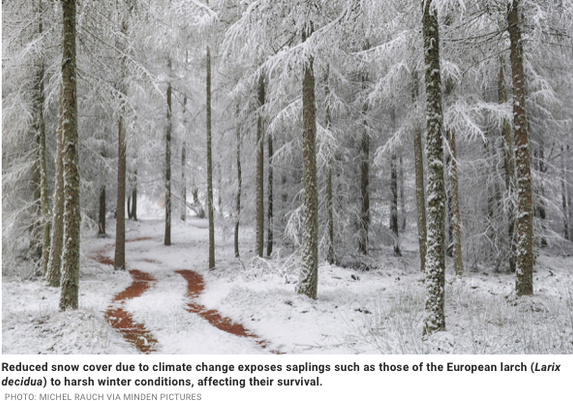
New Phytologist: “Reduced snow cover at the alpine treeline: resistance and recovery of saplings.” The phrase ‘a blanket of snow’ is not just evocative, it actually describes how small, young plants survive high-elevation winters. “Climate change is reducing snow cover duration in mountain regions, exposing young trees and shrubs to harsher winter conditions, including extreme cold, freeze-thaw cycles, and drought.”
To investigate, “A snow removal experiment was carried out at 1700 m above sea level on saplings of five different species (Acer pseudoplatanus, Juniperus communis, Larix decidua,Picea abies and Sorbus aucuparia)” [One of these is new to me: the “Rowan tree (Sorbus aucuparia), or Mountain Ash, is a hardy, small deciduous tree known for its striking compound leaves, creamy-white flowers in spring, and clusters of bright orange-red berries in autumn, rich in Vitamin C and vital for wildlife.” Good to know, + its photos are pretty to boot]. Stem diameter was continuously monitored and compared with the 5 factors of spring hydraulic conductivity (PLCspring), living cell mortality (PLDspring), nonstructural carbohydrates (NSCs), growth and survival rates.”
They “found that snow-free saplings experienced severe damage to their water-transport systems and living cells, leading to reduced growth and increased mortality the following summer.” Although some species could repair damage or regrow from roots, others struggled to recover. “These findings reveal that shorter snow cover threatens mountain forest regeneration because young plants may not survive successive harsh winters without adaptation mechanisms such as resprouting or hydraulic repair.”
Resprouting, now that sounds like something older guys wish their scalp could accomplish. Although for saplings, this is absolutely no laughing matter.
To investigate, “A snow removal experiment was carried out at 1700 m above sea level on saplings of five different species (Acer pseudoplatanus, Juniperus communis, Larix decidua,Picea abies and Sorbus aucuparia)” [One of these is new to me: the “Rowan tree (Sorbus aucuparia), or Mountain Ash, is a hardy, small deciduous tree known for its striking compound leaves, creamy-white flowers in spring, and clusters of bright orange-red berries in autumn, rich in Vitamin C and vital for wildlife.” Good to know, + its photos are pretty to boot]. Stem diameter was continuously monitored and compared with the 5 factors of spring hydraulic conductivity (PLCspring), living cell mortality (PLDspring), nonstructural carbohydrates (NSCs), growth and survival rates.”
They “found that snow-free saplings experienced severe damage to their water-transport systems and living cells, leading to reduced growth and increased mortality the following summer.” Although some species could repair damage or regrow from roots, others struggled to recover. “These findings reveal that shorter snow cover threatens mountain forest regeneration because young plants may not survive successive harsh winters without adaptation mechanisms such as resprouting or hydraulic repair.”
Resprouting, now that sounds like something older guys wish their scalp could accomplish. Although for saplings, this is absolutely no laughing matter.