RE: https://post.lurk.org/@nnirror/116391805100623829
Just gotta amplify this one, so PSA: this might be worth people's time.

Born in a blizzard, grew to 6'2" tall.
Give me your bleeps, your bloops,
Your muddled beats yearning to breathe free,
The wretched debris of your sonic shore.
RE: https://post.lurk.org/@nnirror/116391805100623829
Just gotta amplify this one, so PSA: this might be worth people's time.
It's probably a lost cause and also too short notice, but I'm still thinking about #AlgoApril, which I proposed back in 2022, but it's an incomplete list of prompts and sadly never took off...
https://github.com/algoapril/algoapril-2022
From the readme:
Learning about & applying algorithms and data structures for generative art/design, helping to introduce participants to a wider spectrum of techniques.
Unlike other initiatives like #genuary, #codevember, #nodevember etc., all of which are predominantly using visual/conceptual prompts, the focus of the #AlgoApril initiative is on algorithmic literacy, using technical, algorithmic prompts (of course, with some [visual] references and study materials) without further prescribing how these algorithms should be used. The only aim, goal and hope is for people to creatively engage with these techniques, breaking 'em, hacking 'em and finding interesting uses to create outcomes, which could be considered artistic. Algorithmic layering is encouraged at each turn!
In some sense, this more "bottom-up" approach to creation is maybe alien to some, but the lack of explicit aesthetic or conceptual/artistic goals has the potential to produce a much wider scope of outcomes (hopefully not only visual - audio, text and other outputs are highly encouraged!). There's also hope it could be more educational, helping people to engage with a larger repertoire of fundamental algorithmic tools and then apply & mix them in their own work/practice.
Many of the topics & algorithms selected here will have a more or less known visual representation and we encourage everyone to consciously reject these clichés and make honest attempts to find creative other solutions to visualize/sonify/represent them.
--
In any way, I'll be following the #AlgoApril hashtag and boosting relevant outcomes to help circulation. I'm currently on a few deadlines, so not sure how much I can contribute myself, but might post some of my own prior art related to the prompts...
#Algorithms #DataStructures #AlgorithmicArt #AlgoMusic #GenerativeArt #DataViz #CompSci #Education
It's clear that AI assisted coding is dividing developers (welcome to the culture wars!). I've seen a few blog posts now that talk about how some people just "love the craft", "delight in making something just right, like knitting", etc, as opposed to people who just "want to make it work". As if that explains the divide.
How about this, some people resent the notion of being a babysitter to a stochastic token machine, hastening their own cognitive decline. Some people resent paying rent to a handful of US companies, all coming directly out of the TESCREAL human extinction cult, to be able to write software. Some people resent the "worse is better" steady decline of software quality over the past two decades, now supercharged. Some people resent that the hegemonic computing ecosystem is entirely shaped by the logic of venture capital. Some people hate that the digital commons is walled off and sold back to us. Oh and I guess some people also don't like the thought of making coding several orders of magnitude more energy intensive during a climate emergency.
But sure, no, it's really because we mourn the loss of our hobby.
RE: https://post.lurk.org/@emenel/116144086344527932
Spot on. Appreciate the literacy point.
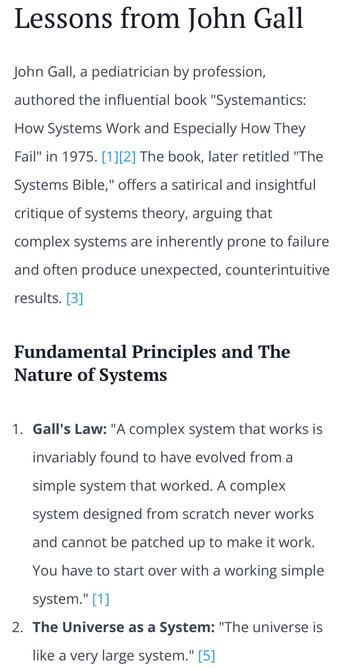
“Systems are seductive. They promise to do a hard job faster, better, and more easily than you could do it by yourself. But if you set up a system, you are likely to find your time and effort now being consumed in the care and feeding of the system itself." — John Gall
A nice summary of:
“Lessons from John Gall”
here:
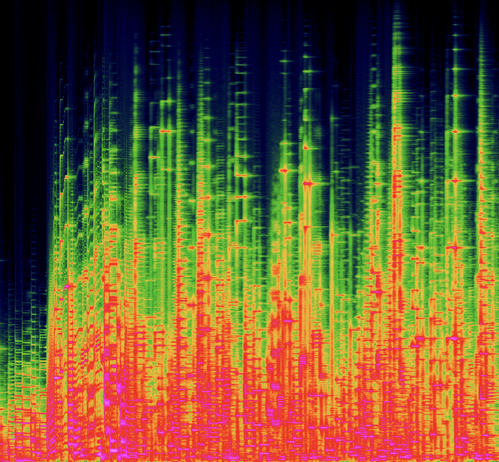
_Rhythm_ is a way of trusting the future.
This sounds poetic, but is also quite literal!
To entrain is to assume: something will happen again; it will happen around about when expected; it is safe to commit energy in advance.
It is a minimal form of trust.
Despair is characterised, in part, by a breakdown of such trust. The future becomes either threatening or blank.
Rhythm gently reinstates futurity.
A pulse says: you can lean forward; time will catch you.
 jonny (good kind)
 Karsten Schmidt
 manic pixie donkey kong
 Arne Brasseur
 Daniel M Karlsson
 fredrik wallberg
 Ruth — of systems & design
 Robert Logan