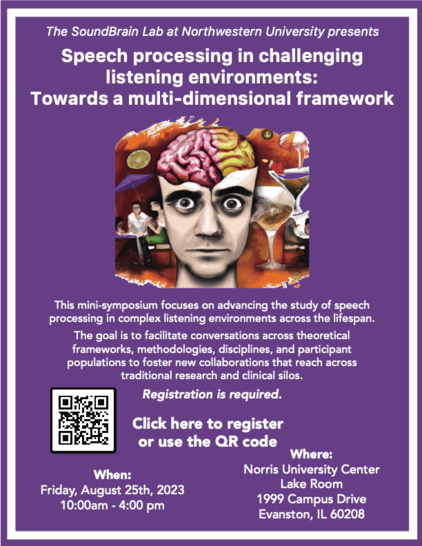
Last talk of the session: Jacie McHaney @soundbrainlab : "Deficits in Sensory Decision-Making Underlie Self-Perceived Hearing Difficulties"
Looked at self-perceived listening difficulties (SSQ). Do people with listening difficulty differ in their sensory decision processes? Had people do a phoneme categorization task (quiet or noise).
Drift diffusion model on RTs for the phoneme task, giving evidence accumulation rate and decision threshold. Decision threshold does not change as a function of SNR.
Generally people have lower accumulation rates at less favorable SNRs. Slope of this (across SNR) relates to self perceived difficulty.
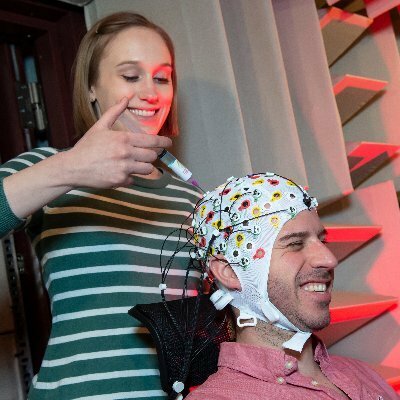
EEG study looking at neural tracking of acoustic and linguistic information in continuous speech (audiobook of Alice in Wonderland). Those with more self perceived difficulties didn't differ on tracking of acoustics (acoustic model).
For language processing, split apart sublexical, word, and sentence information. No differences in tracking for sublexical and word-level...but listeners with more self-perceived difficulty showed increased tracking for sentence level information. Compensation?
I really liked this linking of self-reported difficulties to objective in-lab measures. 💯

 Casey L. Roark
 Andy Dykstra
 Jonathan Peelle