Klee Schöppl

@schoeppl
47 Followers
188 Following
10 Posts
doing a PhD in epistemology in Groningen, the Netherlands
pronounsthey/them
homepagehttps://schoeppl.me
Alt text bannerMe standing in the middle of a group of friends in a cute London street.
Phew. Good job Hungary.
Fühlt sich an wie eine sichere Hand zu halten, während alles schwankt.
Recommended reading for this gripping case study of how systems of oppression (racism in this case) construct their historical narratives: "A Man of Parts and Learning" by Fara Dabhoiwala in the 'London Review of Books'. <https://www.lrb.co.uk/the-paper/v46/n22/fara-dabhoiwala/a-man-of-parts-and-learning>
Fara Dabhoiwala · A Man of Parts and Learning: Francis Williams Gets His Due

The only certainty about the picture is that it shows Francis Williams. No one has ever been able to discover who...

London Review of Books
Just finished the excellent ‘Sexed Up’ by @juliaserano . Like with her previous writings, which this ties into nicely, many core concepts really resonated with me. Thanks for helping me sort through the mess of all things gender.

Recommendation for Brendan Greeley's article "The Nobel for Econsplaining" (https://www.ft.com/content/1e2584d6-65ef-46de-bfb2-28811be65600) on what's essentially economics being proud of its clumsy disciplinary imperialism.

Here's what I'd call the emotional core: "This year the Riksbank awarded its prize to a treatment of early modern institutions so selective it functions as a bedtime story for capitalists. The good institutions produced prosperity. The bad ones produced misery."

The Nobel for Econsplaining

Acemoglu, Johnson and Robinson won a prize for applying economics to the very things economics is inherently bad at figuring out

Financial Times

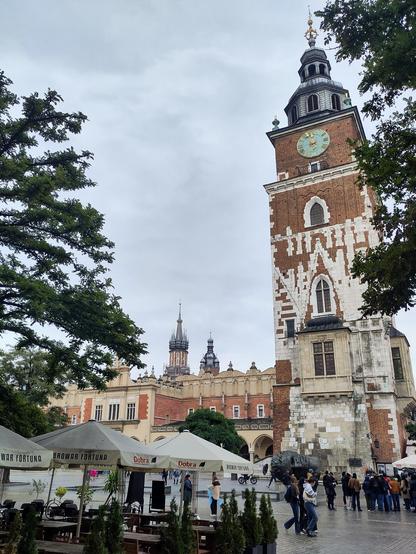
Currently on the train back to Berlin after visiting Kraków to present my work at the Research Seminar of the Interdisciplinary Centre for Ethics.

Lovely old town, kind hosts & possibly the most pleasant and modern train station yet.

Kuiper et al. write "Crucially, the settings by which we were able to reproduce the main analysis were erroneous. Specifically, they relied on a misapplication of the so-called “trim-and-fill” method that corrects for publication bias [...]"

Schuch et al. reply:
"[...] we thank Kuiper et al., for taking the time to re-analyse our 2016 data and confirming that they were able to replicate our original findings."

Colleagues here at the RUG have unearthed some concerning statistical mistakes in a meta-analysis published in the 'Journal of Psychiatric Research' on exercise as a treatment for depression: the authors had "corrected" for publication bias in the wrong direction, exaggerating effect sizes. Findings are being published in a brief letter to the editor (https://doi.org/10.1016/j.jpsychires.2024.08.045), and the response by the original authors (https://doi.org/10.1016/j.jpsychires.2024.08.046) sadly strikes me as quite dishonest. #MetaScience
Letter to the Editor: Comment on Schuch et al., “Exercise as a treatment for depression: A meta-analysis adjusting for publication bias”

It's almost two years old, but I want to recommend the 7-part article "Extropia's Children" by Jon Evans (@rezendi) of 'Gradient Ascendant'. It's a fascinating dive into (the connections of) all things EA, crypto, rationalism and AI x-risk. Refreshingly comprehensive and nuanced; plus just full of excellent takes. <https://aiascendant.substack.com/p/extropias-children>.
Extropia's Children Redux

All surreal contents tabled in one convenient location.

Gradient Ascendant