Ryan Steed (on the job market)

@ryansteed
123 Followers
104 Following
36 Posts
PhD student at Carnegie Mellon | privacy, fairness, & algorithmic systems
Websitehttps://rbsteed.com

Just voted to withold on the REI board candidates. Having someone with more experience with labor negotiations would make sense for the co-op, and I'm disappointed that they blocked that candidate from the board.

Grateful to these journalists who explained the situation in a detailed and balanced way.

https://www.cascadepbs.org/news/2025/03/rei-board-blocks-labor-backed-candidates-ballot

REI board blocks labor-backed candidates from ballot

Unionized employees are asking members to mark "withhold" on their ballots after a Seattle activist and a top Greenpeace leader were excluded.

Cascade PBS

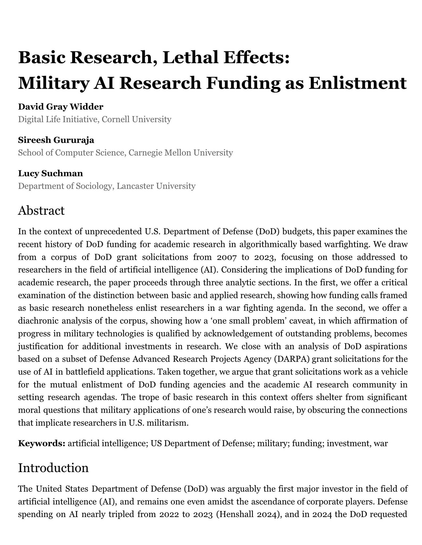
📢 NEW Paper!

@sireesh, Lucy Suchman, and I examine a corpus of 7,000 US Military grant solicitations to ask what the world’s largest military wants with to do with AI, by looking at what it seeks to fund.

#sts #technology

📄: http://arxiv.org/pdf/2411.17840

We find…

We found lots of the tools I expected (fairness & explainability toolkits) but also some other kinds of tools I’d like to see more often (databases documenting AI harms & audit results, interview guides, organizing kits, & more).

While our interviews with practitioners showed that tools alone aren’t enough to achieve accountability, I hope to see more investment in harms discovery, advocacy and other alternative paths to support audit work.

Read or visit http://tools.auditing-ai.com for more!

AI Audit Tool Landscape

AI Audit Tool Landscape

AI Audit Tool Landscape

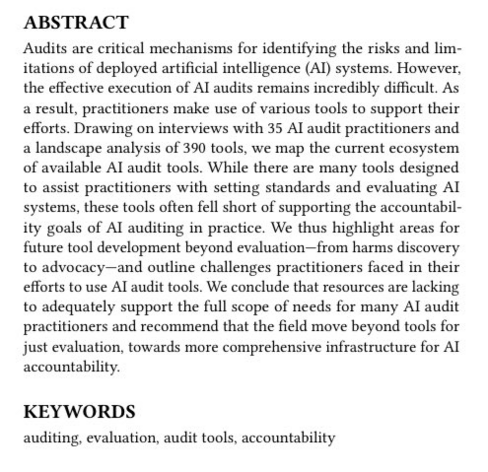
New paper w/ Victor Ojewale, Briana Vecchione, @abebab & Deb Raji!

We interviewed 35 practitioners & analyzed 390 *AI audit tools*, identifying gaps between existing tooling and effective accountability.

https://arxiv.org/abs/2402.17861

Towards AI Accountability Infrastructure: Gaps and Opportunities in AI Audit Tooling

Audits are critical mechanisms for identifying the risks and limitations of deployed artificial intelligence (AI) systems. However, the effective execution of AI audits remains incredibly difficult, and practitioners often need to make use of various tools to support their efforts. Drawing on interviews with 35 AI audit practitioners and a landscape analysis of 435 tools, we compare the current ecosystem of AI audit tooling to practitioner needs. While many tools are designed to help set standards and evaluate AI systems, they often fall short in supporting accountability. We outline challenges practitioners faced in their efforts to use AI audit tools and highlight areas for future tool development beyond evaluation -- from harms discovery to advocacy. We conclude that the available resources do not currently support the full scope of AI audit practitioners' needs and recommend that the field move beyond tools for just evaluation and towards more comprehensive infrastructure for AI accountability.

arXiv.org

Late to the #CHI2024 announcements😅

🏳️‍🌈💻📢Happy to share our Literature Review of LGBTQ+ People in HCI (w/
Ellen Simpson, Anh-Ton Tran, Jed Brubaker, Sarah Fox, and Haiyi Zhu) has been conditionally accepted

🔗 https://arxiv.org/abs/2402.07864

Cruising Queer HCI on the DL: A Literature Review of LGBTQ+ People in HCI

LGBTQ+ people have received increased attention in HCI research, paralleling a greater emphasis on social justice in recent years. However, there has not been a systematic review of how LGBTQ+ people are researched or discussed in HCI. In this work, we review all research mentioning LGBTQ+ people across the HCI venues of CHI, CSCW, DIS, and TOCHI. Since 2014, we find a linear growth in the number of papers substantially about LGBTQ+ people and an exponential increase in the number of mentions. Research about LGBTQ+ people tends to center experiences of being politicized, outside the norm, stigmatized, or highly vulnerable. LGBTQ+ people are typically mentioned as a marginalized group or an area of future research. We identify gaps and opportunities for (1) research about and (2) the discussion of LGBTQ+ in HCI and provide a dataset to facilitate future Queer HCI research.

arXiv.org

‘No Cookies For You!: Evaluating The Promises Of Big Tech’s ‘Privacy-Enhancing’ Techniques.’ Kirsten Martin, Helen Nissenbaum, Vitaly Shmatikov.

‘We identify and examine 3 common principles underlying a slew of “privacy-enhancing” techniques recently deployed or scheduled for deployment by big tech companies… Our article challenges these principles… because the principles themselves are not sufficient to block privacy-violating behavior.’ https://papers.ssrn.com/sol3/papers.cfm?abstract_id=4655228 #privacy #gdpr #surveillance

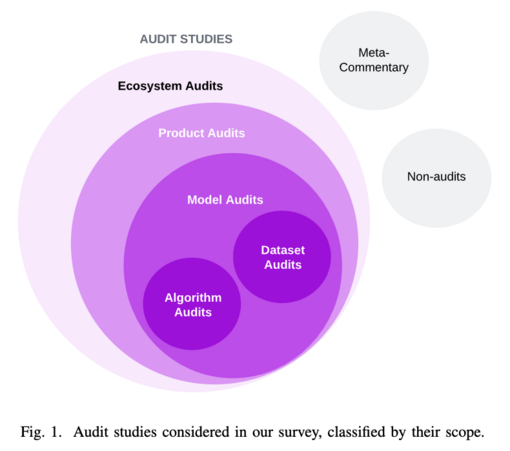
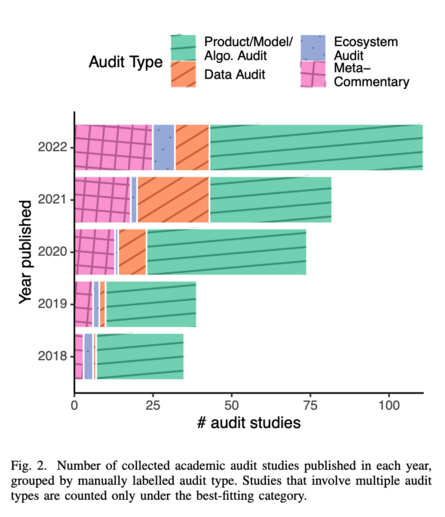
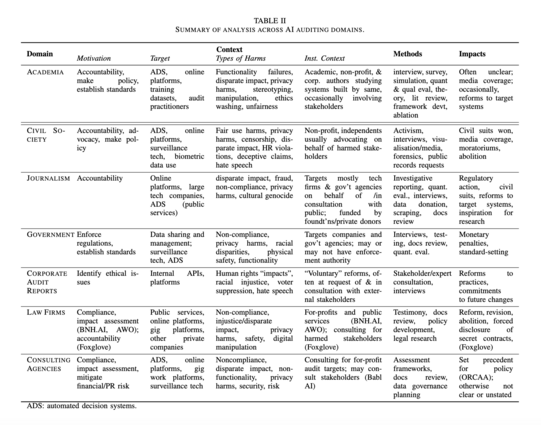
We also find that most published audit work focuses products/models/algorithms — so we echo calls from others to expand audit work to include the entire ecosystem of affected stakeholders.
I learned a lot from this study — some of the most impactful audit work is done academia (e.g. by journalists or regulators) often using very different methods.

Excited to share a new paper with @abebab, Victor Ojewale, Briana Vecchione & Deb Raji

We surveyed 300+ AI audit studies from academia, civil society, govt etc. to understand what work is being done + how it relates to impact & accountability.

https://arxiv.org/abs/2401.14462

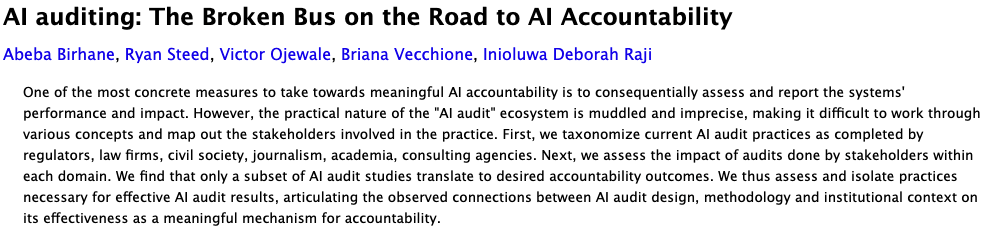
AI auditing: The Broken Bus on the Road to AI Accountability

One of the most concrete measures to take towards meaningful AI accountability is to consequentially assess and report the systems' performance and impact. However, the practical nature of the "AI audit" ecosystem is muddled and imprecise, making it difficult to work through various concepts and map out the stakeholders involved in the practice. First, we taxonomize current AI audit practices as completed by regulators, law firms, civil society, journalism, academia, consulting agencies. Next, we assess the impact of audits done by stakeholders within each domain. We find that only a subset of AI audit studies translate to desired accountability outcomes. We thus assess and isolate practices necessary for effective AI audit results, articulating the observed connections between AI audit design, methodology and institutional context on its effectiveness as a meaningful mechanism for accountability.

arXiv.org