Ryan Cordell

5 Followers
66 Following
34 Posts
he/him—textual technologies enthusiast—suspected mechanical paragraphist—Associate Professor UIUC iSchool & English
Viral Texts Projecthttps://viraltexts.org/
Skeuomorph Presshttps://www.instagram.com/skeuomorphpress/
@luggage yeah, that's kind of what I mean. I get the impulse and love the idea of community-built spaces. But I strongly suspect that 90+% of folks are really not so invested that they're going to do that work—&/or they don't need social media to also demand labor when they're spread so thin—so the question is whether something can be viable without those 90+%
I get the Mastodon idealism—the openness & community orientation are genuinely appealing—but I just had to press the TOOT! button >10 times to post something because of server issues—I suspect for 90+% of potential users that interaction would be their last interaction with this site—even if they share the Mastodon ideals, the tech has to work well enough that using it doesn't become a chore
@quinnanya hm, maybe—but initially I just want to test one in multiple sizes/materials/etc.
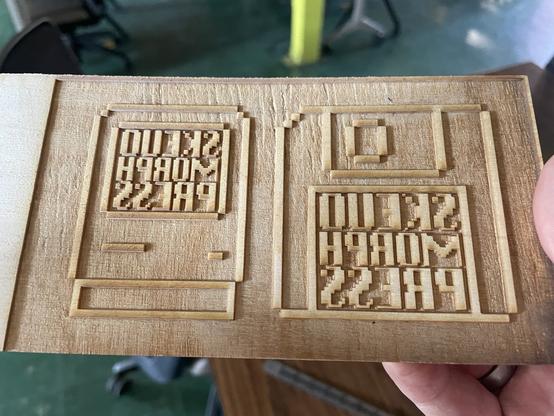
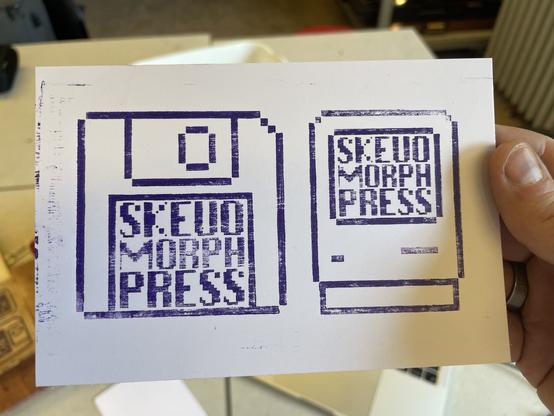
Had two (related) ideas for a Skeuomorph Press’ logo/printer’s mark, so I sketched them in Illustrator & carved them in some scrap wood in the FabLab —I essentially printed from plywood so they’re messy, but I think the idea works. Which is best?
@felwert I get that, though one advantage of twitter is that there are multiple communities I interact with that overlap there—if there were separate Mastodon servers for folks doing book history and DH, for instance, which to join? I don't want to maintain multiple micro-blogging accounts. And I know posts can work across instances, but it's less seamless. I'm not sure either way—just acknowledging that ideals, however lovely, aren't likely to make it work

@samplereality @ryancordell

Will academic institutions or their components set up their own instances?

Will scholarly communities congregate in instances, as some #histodons have been discussing?

Will easy account transfer from instance to instance allow project-or-discipline-oriented instances to wax and wane with less fallout that abandoned blogs and websites?

@ryancordell Scratch the surface, and some fundamental differences show up. The ability of each server to establish its own ethos and moderation policy, for example. The overall culture of content warnings and attention to accessibility strikes a different tone too. The lack of quote posts is a deliberate choice too, designed to discourage people from talking over each other.
@ryancordell I think the federations are actually a huge value-add. From building affinity networks, to protecting privacy, to even the ability to extract and analyze your own social graph, the data ownership and community affordances of a #fediverse are a significant improvement over Twitter. Also, it's ahead of the game on accessibility, e.g. automatic OCR in image descriptions
@ryancordell The greatest non-Twitter thing is Mastodon being part of the fediverse. This means you can follow with your mastodon account others on #pixelfed (like federated Instagram), #peertube (federated YouTube), #lemmy, #Bookwyrm etc. And because it is all based on the open web standard #activitypub you can also build additional software to interact with anybody on the fediverse. Open standards make the ecosystem shine.
@janeadams I hope those ideals are convincing to enough people that the migration continues & sticks. I worry that the slightly-higher difficulty settings will put many people off. I know I tried to post some images earlier today & got confounded when they kept failing to process—what would have taken 5 seconds on twitter took a good 10 minutes to post here—I imagine plenty of folks won't have the patience for those moments