| Substack | http://runarchism.substack.com |
Ginger Grouse (they/them)
- 11 Followers
- 58 Following
- 23 Posts
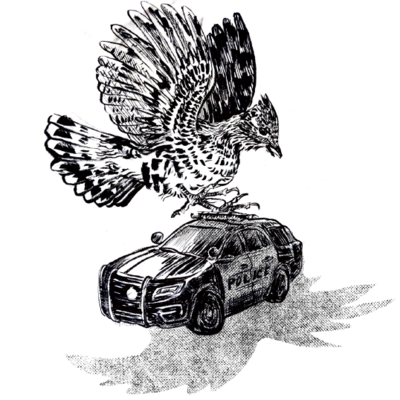
Sometimes writer, land defender, disabled trail runner. Is that profile pic a grouse attacking a cop car? Why yes! It is a to-scale depiction of that time I was fighting a pipeline and witnessed a ruffed grouse attacking the cops. The grouse in Appalachia say ACAB and Land Back, and so do I.

Tried to turn cyptid today. Ran around the mountains, got back to the car, was like, "nah," and kept running. Still had to go back to this civilizational dumpster fire, but it was a good day to play in the snow.

 Ill Will
Adrian Wohlleben on Gen Z uprisings, anti-ICE logistics, and the uncertain leap beyond liberalism.
 anarcho-filesystem
A straightforward write up on how to organize with your neighbors in a way that allows you to take collective, direct action on matters that affect you.
My understanding is that a neighborhood popular assembly is one of the most potent forms of organization since everyone lives somewhere regardless of class, race, disability sexuality, employment. They can also easily federate together.
I find the second section helpful, where they talk about leveraging existing local meetups like at cultural centers and sports leagues as a low pressure way to meet your neighbors.
https://www.blackrosefed.org/how-to-organize-a-neighborhood-popular-assembly/

How To: Organize a Neighborhood Popular Assembly
This is a basic guide on how and why to build structures for decision making and collective action at the neighborhood level, what we call popular assemblies. We emphasize the need for popular assemblies to be rooted in a defined geographic area and aimed at organizing the people who live, work, or stay there to […]
 CrimethInc. Ex-Workers
They tell us that dangerous people are on the loose, threatening our communities.
But if anyone is dangerous, it is those who would do harm to their neighbors in return for a bribe—those who sell their capacity to inflict violence to the highest bidder.
Crush ICE.


 It's Going Down
Read and share this report from @CrimethInc.
Let everyone you know that working people are standing up to fascism in #LosAngeles.
They're standing up for their neighbors and for that, Trump is sending in the military. Stand with them. Solidarity.
"DHS couldn’t control the situation. The feds were overwhelmed and begged the Los Angeles Police Department to come save them. Despite LA mayor Karen Bass saying she was “appalled” about the presence of ICE in Los Angeles, the LAPD still showed up in large numbers. A low-flying helicopter was telling people that they would be arrested and issuing dispersal orders as LAPD pushed people away from the building over the next four to five hours. Everyone left covered in pepper ball dust and tear gas."

Rooted Networks: the Facts that Back an Ecological Revolution Part II, by Peter Gelderloos

I’ve been noticing how many people and organizations remain frozen in irrelevant modes of action, reacting to one crisis after another using tools designed for a political system that no longer exists. This piece is a kind of parable that tries to illustrate the problem, followed by a reflection on the shift in political culture that I believe we need to make.

