After a few years here I've not been able to fully get used to Mastodon. This account will remain open, but I will use more consistently my Bluesky account.
If you use it, follow me there! :)

Follow me for content about engineering processes, development productivity and anything related to software industry, with a particular interest in Android.
Staff Mobile Platform @ Glovo. *My opinions are my own*.
| BlueSky | https://bsky.app/profile/rolgalan.bsky.social |
| Previous Mastodon | https://rls.social/@rolgalan |
| Medium | https://medium.com/@rolgalan |
| twitter.com/rolgalan_ |
After a few years here I've not been able to fully get used to Mastodon. This account will remain open, but I will use more consistently my Bluesky account.
If you use it, follow me there! :)
This works great, but I finally decided to create my own official Bluesky account, so I am disabling this bridged account.
You can follow me on:
https://bsky.app/profile/rolgalan.bsky.social
I would say these numbers are the most relevant conclusion (you can read the article for the math to get here).
This is the amount of users you would need to track for reliable monitoring. Remember this is per dimension.
If you want to catch crashes impacting 0.1% users in each country you operate, you will need 4.7k users tracked in each country.
Time is also a dimension. If you want to catch this in minutes you will need that amount in that time window.
Since the moment I started sampling #observability I had the doubt: is this enough? How many events are statistically significant to detect issues in the users?
I never found a clear answer, so decided to do some math to get some clear estimations and wrote this article.
I wonder how others are calculating this and how you ensure you have enough metrics to detect issues by their level of impact to configure your monitors.
Repeat after me: YOU ARE NOT GOOGLE!
«If you’re using a technology that originated at a large company, but your use case is very different, it’s unlikely that you arrived there deliberately; no, it’s more likely you got there through a ritualistic belief that imitating the giants would bring the same riches.»
«Maybe you expect to scale. But have you done the math? How much would your business need to grow before all your data would no longer fit on one machine?»
https://blog.bradfieldcs.com/you-are-not-google-84912cf44afb
I never heard about the One Billion Row challenge, about performance tricks to make Java read a 13gb data set in the fastest time possible.
The talk is pretty nice and is so nice to see how much people like challenges and how they get involve to solve such things in a community.
Also quite impressive the kind of "magic" people come up to do the craziest optimizations.
There is a table extending these 3 limits, adding up to 7 categories in the middle, elaborating a bit more in how the user would feel to different delays.
It's interesting to take a look, but is easier to remember 0.1, 1 and 10.
https://learn.microsoft.com/en-us/windows/apps/performance/responsive
Summary to remember:
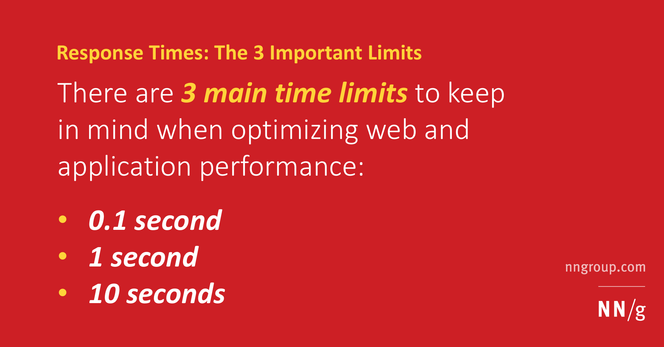
- Up to 0.1 second anything feels instantly.
- Between 0.1 to 1 second the user will notice the outcome of their actions is not immediate, but good enough.
- 1 to 10s you should make clear that something is working (loading indicator).
- No one will keep paying attention more than 10 seconds. Above this, they will do something else, so you better add some progress indicator and help them to reorient themselves again when coming back.
The 3 main time limits to keep in mind when optimizing application performance. These have been the same for over 50 years and most likely won't change much in the future, as are determined by human perceptual abilities.
https://www.nngroup.com/articles/response-times-3-important-limits/
I read that the official Mastodon instance of the Swiss government will be closing down.
They say there are few active users, low engagement, and minimal interaction, which seems quite plausible. Additionally, they claim that "on platforms like X or Instagram, the Federal Council and the Federal Administration have many more followers." I believe that too, of course.
However, I do not agree with their decision. I think a government shouldn’t be overly concerned about follower counts and interactions, but rather about providing free, autonomous communication that is independent of third-party companies. In my view, a government shouldn’t operate like a business focused on "numbers."
Still, I appreciate their experiment - many governments, like the Italian one, haven’t even tried.
Regarding costs and management effort: an instance with 5 users and 3,500 followers (numbers provided by them) can run on a VPS for €3 a month and doesn't require heavy moderation. The cost for them is nearly zero. Yet, the freedom of information and discussion, especially for a Neutral Country, should always be a priority.
I believe that maintaining control over one’s information channels is crucial, especially in today's world. But, I fear that decision-makers only consider the numbers, which often favor the flashiest - but worse - solutions.
Encouraging citizens to use closed platforms is, in my opinion, a wrong choice.
Thanks to the Swiss government for at least giving it a shot.
https://www.admin.ch/gov/it/pagina-iniziale/documentazione/comunicati-stampa.msg-id-102585.html
#Mastodon #FreedomOfSpeech #Switzerland #Fediverse #SocialNetworks


 Stefano Marinelli