Richard Fletcher

344 Followers
236 Following
27 Posts
Director of Research at the Reuters Institute for the Study of Journalism, University of Oxford. Lead researcher + co-author of the Digital News Report.
Websitehttp://www.richardfletcher.me
Google Scholarhttps://scholar.google.com/citations?user=g-1qDAUAAAAJ&hl=en
Twitterhttps://twitter.com/richrdfletcher
Digital News Reporthttps://reutersinstitute.politics.ox.ac.uk/digital-news-report/2022

Only a few weeks left to apply to join the @reutersinstitute research team.

Great opportunity for someone who has just finished (or about to finish) their PhD.

Join us!
https://reutersinstitute.politics.ox.ac.uk/job-vacancies

Job vacancies

As a member of staff at the Reuters Institute for the Study of Journalism you will be part of an internationally-renowned institute exploring the future of journalism worldwide through debate, engagement, and research. We are part of the Department of Politics and International Relations at the University of Oxford. As a global research centre we want our team to reflect this. We are committed to equality and value diversity among our colleagues. Read more information about the benefits of working at the university. Any job vacancies and freelance opportunities at the Reuters Institute will appear below. All applications for staff roles are administered by the university's HR department.
Reuters Institute for the Study of Journalism

New paper!

Some are concerned that news media unintentionally make misinformation worse by repeating false claims while reporting on them, or as part of debunking, fact-checking, etc.

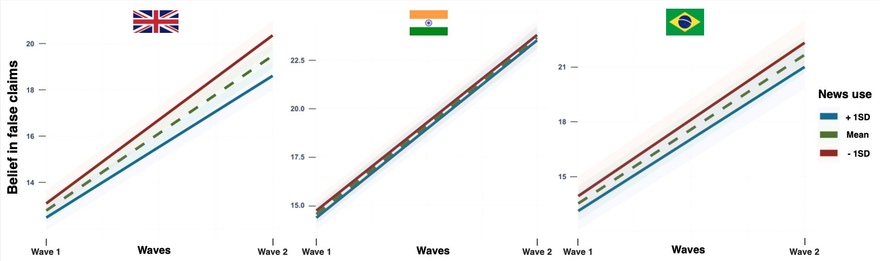
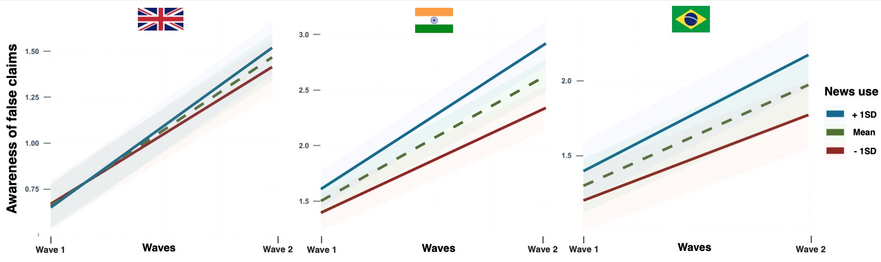
However, across 🇧🇷 🇮🇳 🇬🇧 our panel survey found that news use increased people's awareness of false claims without increasing their belief in them.

In some cases news media use even weakened false belief acquisition.

Open access paper here: https://journals.sagepub.com/doi/10.1177/19401612221148981

New research note with Julia Kling, @toepfl & @neilthurman where we map the website/app audiences of RT + Sputnik in 21 countries.

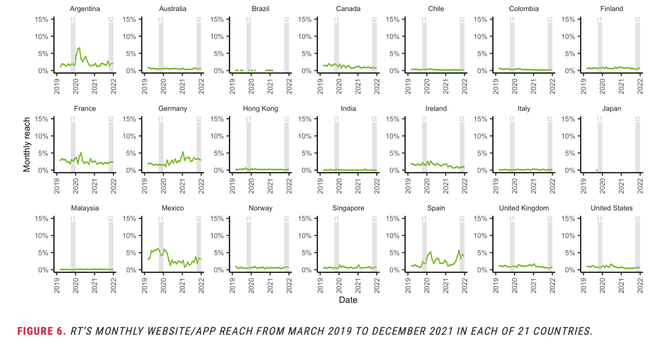
Using Comscore tracking data we find that their web/app reach before the invasion of Ukraine was <5% in each country, staying very roughly similar since 2019 (with country variation and occasional big spikes), though perhaps evidence of a decline in Sputnik reach.

We also find both are slightly more widely used by men and older age groups.

https://misinforeview.hks.harvard.edu/article/mapping-the-website-and-mobile-app-audiences-of-russias-foreign-communication-outlets-rt-and-sputnik-across-21-countries/

Mapping the website and mobile app audiences of Russia’s foreign communication outlets, RT and Sputnik, across 21 countries | HKS Misinformation Review

Following Russia’s invasion of Ukraine, policymakers worldwide have taken measures to curb the reach of Russia’s foreign communication outlets, RT and Sputnik. Mapping the audiences of these outlets in 21 countries, we show that in the quarter before the invasion, at least via their official websites and mobile apps, neither outlet reached more than 5% of the

Misinformation Review