 taz
tazDie AfD Sachsen-Anhalt fragt gezielt nach Listen postkolonialer Seminare und Lehrstühle. Wie die Universitäten beginnen, sich gegen die Angriffe zu wappnen.
https://taz.de/!6116589
https://taz.de/!6116589

📢 Wichtige Mitteilung: Der DNGPS-Vorstand sucht Verstärkung! 📢
Im Rahmen unserer Mitgliederversammlung im Oktober 2024 werden einige Vorstandsposten neu besetzt. Um unsere Vereinstätigkeit wie bisher weiterführen zu können, benötigen wir eure Unterstützung!
Du kannst dir vorstellen, einen Vorstandsposten zu übernehmen? Dann melde dich gerne bei uns! 😊


Freude? Keine Zeit!
Erholung muss auch warten.
Lebensentscheidungen ebenfalls.
Wissenschaft hat Priorität!
Wer dauernd wichtige Dinge aufschiebt, stellt später leider oft fest: Sie lassen sich nicht mehr nachholen.
Mein Plädoyer gegen das Aufschieben von Erfreulichem: Heute in meinem Newsletter! #ArbeitInDerWiss

Während wir darauf warten, dass wir die Etappenziele unserer akademischen ‚Karriere‘ erreichen, um dann endlich das zu tun, das wir schon lange machen wollten, zieht unser Leben an uns vorbei. Damit muss Schluss sein!


Polit-X ermöglicht es politische Dokumente im Volltext auf Landes-, Bundes- und Europäischer Ebene nach dem Suchinteresse zu durchsuchen. Darüber hinaus bieten diverse weitere Features die Möglichkeit Analysen durchzuführen, Prozesse zu verfolgen und seit neuestem auch eine KI-basierte Zusammenfassung von Dokumenten, die eine Arbeitserleichterung im politischen Monitoring bedeutet. Zum heutigen Webinar werden Sie in die Möglichkeiten von Polit-X eingeführt, inbesondere in unsere KI-basierten Funktionen. Es wird Ihnen anschaulich präsentiert, wie das Tool im wissenschaftlichen Kontext verwendet werden kann.

Here is our new #preprint on #openaccess in #ukraine 🇺🇦 co-authored with @hauschke
We examined a 10-years period (2012-2021) based on data from Dimensions, WoS, and Scopus and determined that 71.5% of all considered articles were #OA at the time of analysis.
Gold #OA was the most common subtype, accounting for 48,1%.
The highest percentage of OA was found in the Humanities and Social Sciences, with a rate of 89.7% and 88.5% respectively.
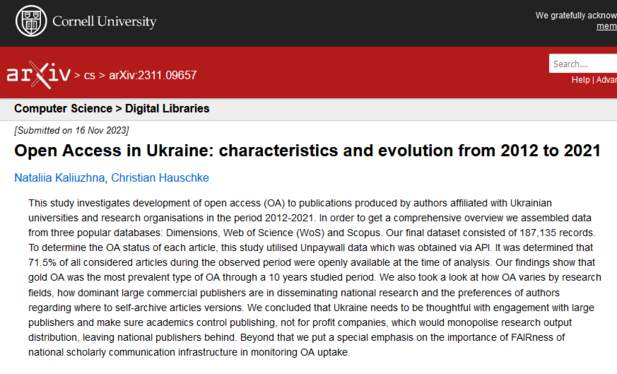

This study investigates development of open access (OA) to publications produced by authors affiliated with Ukrainian universities and research organisations in the period 2012-2021. In order to get a comprehensive overview we assembled data from three popular databases: Dimensions, Web of Science (WoS) and Scopus. Our final dataset consisted of 187,135 records. To determine the OA status of each article, this study utilised Unpaywall data which was obtained via API. It was determined that 71.5% of all considered articles during the observed period were openly available at the time of analysis. Our findings show that gold OA was the most prevalent type of OA through a 10 years studied period. We also took a look at how OA varies by research fields, how dominant large commercial publishers are in disseminating national research and the preferences of authors regarding where to self-archive articles versions. We concluded that Ukraine needs to be thoughtful with engagement with large publishers and make sure academics control publishing, not for profit companies, which would monopolise research output distribution, leaving national publishers behind. Beyond that we put a special emphasis on the importance of FAIRness of national scholarly communication infrastructure in monitoring OA uptake.

 DNGPS e.V.
 Amrei Bahr
 Pollux
 Guido Kühn
 Nataliia Kaliuzhna
 Heinz Pampel
 Open-Access-Tage